
Forget dumping full datasets or laying out every transaction detail Dusk only shares what’s absolutely required for validation and compliance.It’s a privacy first approach,and it fits right in with today’s data protection standards.People are demanding more control over their own data,and Dusk answers that call.
Here’s how it works:Dusk uses selective disclosure.If you need to prove something eligibility,that you meet a balance requirement,or that you’re compliant you can.But you don’t have to hand over anything else.No extra personal details,no unnecessary financial history.This happens through cryptographic commitments and zero knowledge proofs,which let users prove just what’s needed,nothing more. Counterparties and validators see enough to confirm the facts,while everything else stays private.
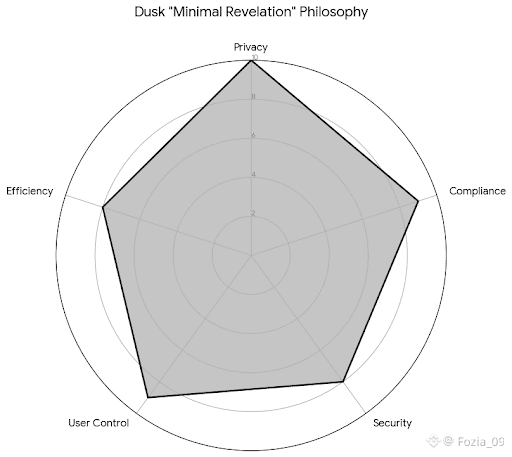
Why does this matter?Because the less information you put out there,the lower the risk.Massive data leaks,surveillance,misuse those problems shrink when you share less. Dusk’s model cuts down the potential fallout, even if something goes wrong.At the same time,users keep hold of their digital identities and transaction records,which builds trust in the system.
Minimal revelation also makes it easier for Dusk to work with regulated industries. Banks and other institutions can plug into the network,meet compliance checks,and still keep client data confidential.Regulatory requirements get met,but nobody’s forced to give up full transparency.That opens the door to blockchain based settlement and asset management without the usual privacy headaches.
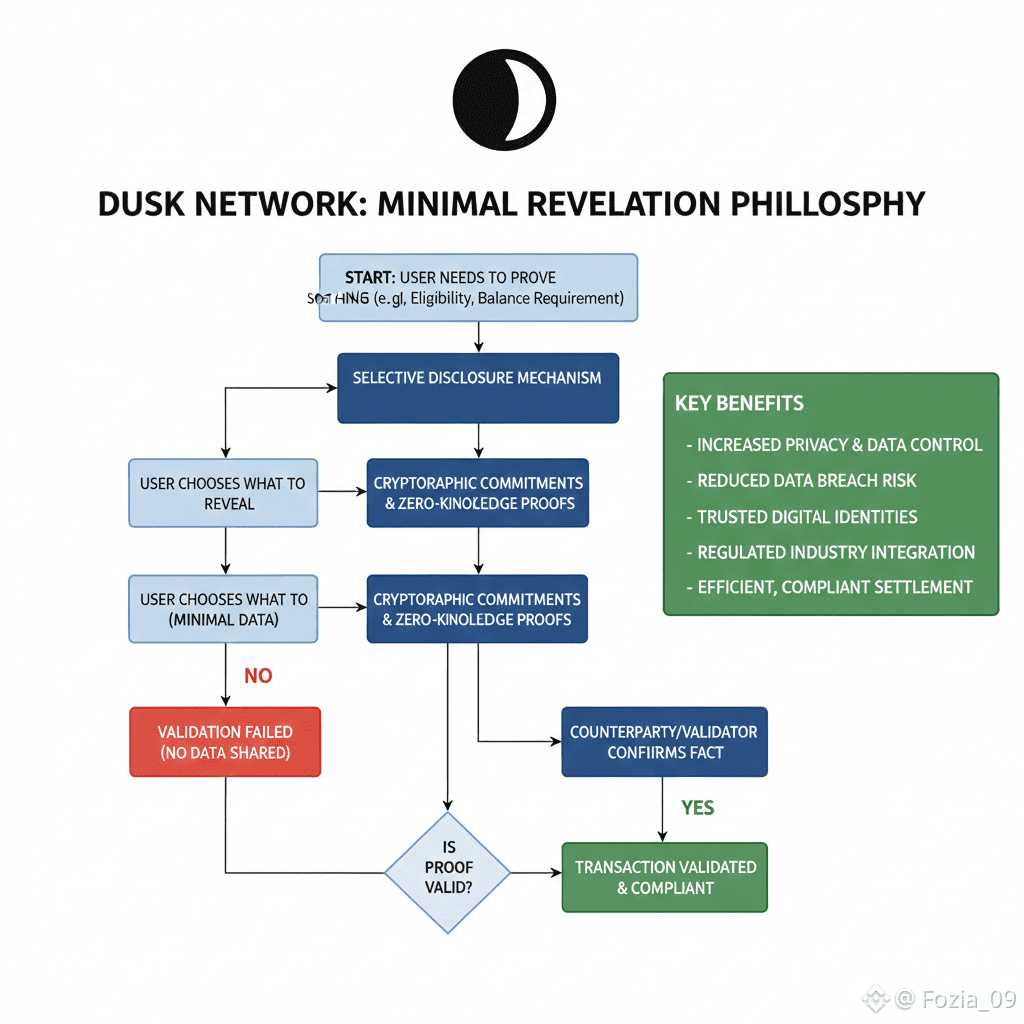
In practice,Dusk changes the way trust works.Full disclosure isn’t the foundation anymore; cryptographic proofs and protocol rules take that role.Dusk shows you can have strong privacy,efficient validation,and regulatory compliance all at once.It’s a new model for digital trust,built right into the infrastructure. @Dusk $DUSK #dusk
