
Artificial intelligence isn’t just another layer of software anymore.It’s quickly becoming the backbone of financial systems,content networks,automation pipelines,you name it. The more we embed AI into these essential areas, the more we need to trust its core architecture.Here’s where things start to get shaky:modern AI systems lean heavily on external plugins and third party integrations. Sure,plugins feel handy when you’re building fast.But as soon as you scale,they turn into anchors dragging down reliability,security, and autonomy,all the things a real AI infrastructure needs.
Let’s start with latency.Plugins don’t run right alongside the AI model.Every time the system fetches data,pings an API,or waits for outside processing,you get delays.In a single interaction,maybe that doesn’t matter.But in real time environments think trading systems,predictive analytics,live chatbots those lags pile up.Suddenly,your AI can’t keep up.What looked like a shortcut becomes a choke point.The system slows, users notice,and the whole point of intelligent automation starts to unravel.
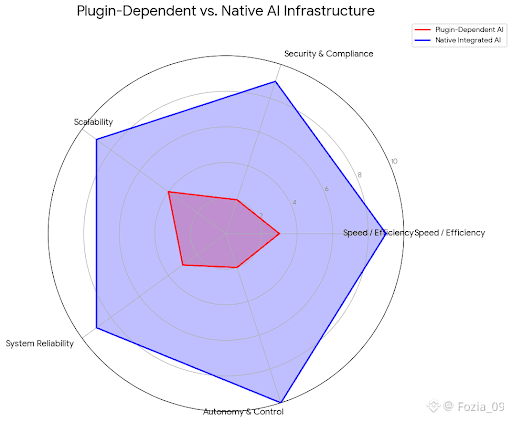
Now, security.Every plugin is a new doorway, and every door can be forced open.The more external services you connect,the more chances you give attackers to slip in.Data leaks,API abuse,malicious updates, unauthorized access these aren’t just hypothetical risks.When AI handles sensitive information like financial records or private IDs,sending data through third parties means losing oversight.For serious,enterprise grade AI,that’s a dealbreaker.You can’t enforce compliance or prove security if you don’t control the whole path your data takes.
Scalability hits another wall.External services have limits rate caps,usage quotas, unpredictable pricing.As your AI grows, those limits turn into hard stops.Instead of scaling up on your own terms,you’re stuck negotiating with outside providers.Costs jump,performance gets inconsistent,and you lose the ability to guarantee the platform will hold up under pressure.For AI systems that serve millions of users or automate critical workflows,that’s unacceptable.
Then there’s the mess of architectural fragmentation.Plugins come from different vendors,follow different standards,and update on their own schedules.Over time, your AI system becomes a patchwork:one part changes,another breaks.Maintenance gets harder,debugging turns into a headache,and upgrades start to feel risky. The technical debt piles up,and soon, optimizing or securing the system is more work than it’s worth.
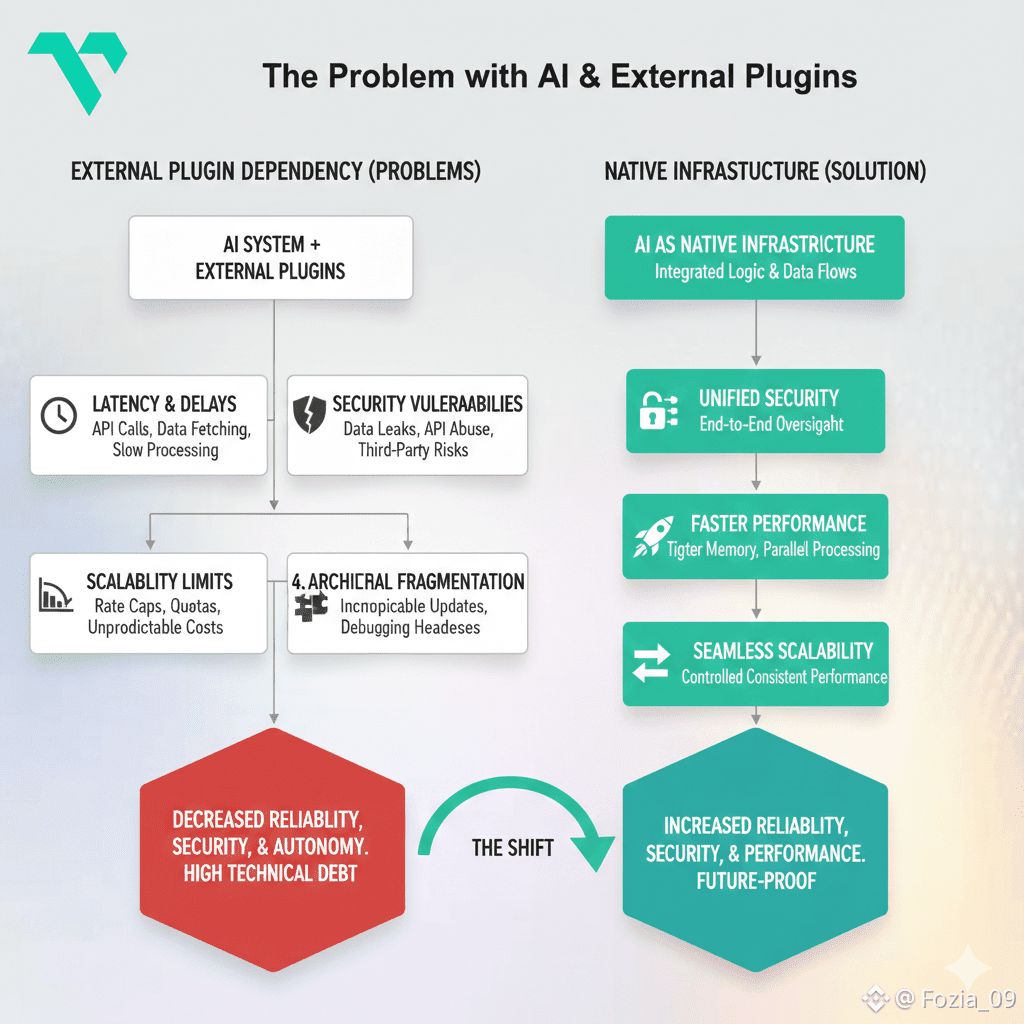
So what’s the alternative?Build AI as a native part of the infrastructure.When you bake your logic,data flows,and processing directly into the core system,things get simpler and stronger.Security is unified.Memory management is tighter.Parallel processing is faster and more reliable.This matters even more in distributed environments,where everything must stay in sync and recover from failure without a hitch.
At the end of the day,AI can’t afford to lean on external plugins if it’s going to serve as real infrastructure.The future calls for tight integration:systems that are faster,safer, easier to scale,and more self reliant.By cutting plugin dependencies and focusing on native execution,the next generation of AI will finally deliver the reliability and performance we expect across finance,data services,automation,and beyond.
