
I once watched a developer migrate a small app from Ethereum to an “EVM-compatible chain.” On paper, it was supposed to be painless. Same codebase. Same tools. Same assumptions. And at first, it was.
Then the cracks appeared.
Fees jumped without warning. Wallet flows that worked in testing failed at the worst moments. Finality was advertised as fast, but didn’t feel reassuring when real value was on the line. That experience changed how I hear the phrase “EVM compatible.” It’s not a badge of quality. It’s more like a handle on a door. Helpful—but it tells you nothing about what’s behind it.
Plasma (XPL) stands out to me because it seems to be trying to open a very different door. Not another Ethereum fork chasing vibes and incentives, but a stablecoin-focused Layer 1 that happens to speak Ethereum fluently. That framing matters. Plasma positions itself less as a DeFi playground and more as a payments rail—zero-fee USD₮ transfers in certain flows, and a gas model designed to feel closer to everyday payments than to on-chain maintenance work.
If we’re talking about EVM Compatibility 2.0, that’s the shift. The objective isn’t just to run Solidity contracts. It’s to make the entire system behave like financial infrastructure: predictable, boring, and calm under pressure. Plasma’s messaging doesn’t scream “farm here” or “gamble faster.” It sounds more like, “this should not break when real people use it.”
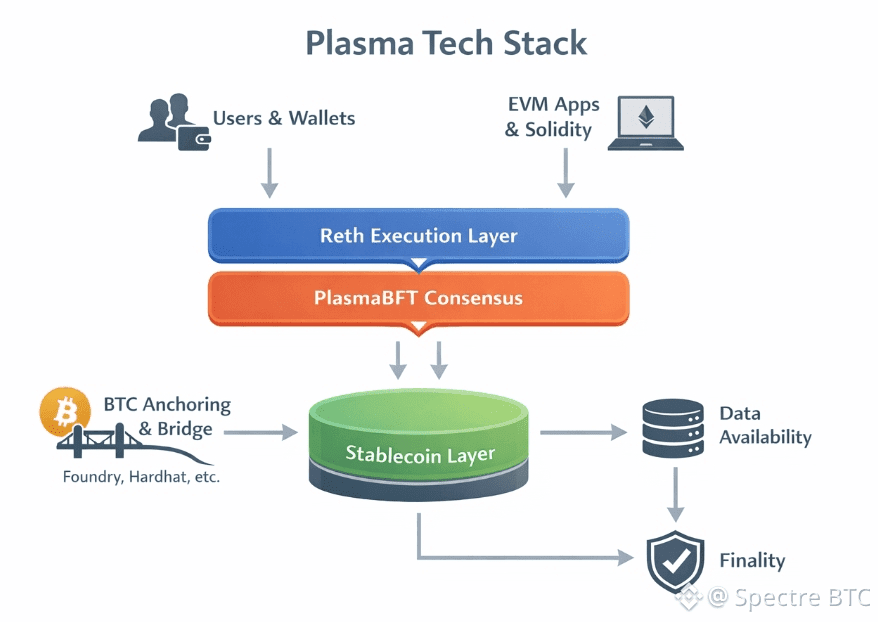 Under the hood, Plasma separates responsibilities into two main layers. One handles execution. The other handles ordering and finality.
For execution, Plasma uses Reth, an Ethereum client written in Rust. You can think of Reth as the engine that processes blocks and state transitions. Rust’s reputation for strictness and safety doesn’t make it magical, but it does reduce entire categories of bugs. In an ecosystem where “EVM-compatible” often means “copied quickly,” choosing a modern, performance-oriented Ethereum client is a way of signaling that compatibility is meant to hold up under load, not just in demos.
This distinction matters because many EVM chains feel fine—until they don’t. Until the mempool clogs. Until nodes fall behind. Until the system starts feeling brittle. Plasma’s execution design aims to make EVM behavior feel authentic and resilient, not superficial.
Then there’s consensus. Plasma uses PlasmaBFT to manage sequencing and finality—the part of the system that decides transaction order and when blocks are truly settled. If execution is the engine, consensus is traffic control. When traffic control works well, everything feels smoother: faster settlement, less uncertainty, less waiting around to see if something might be reorged.
On the developer side, Plasma intentionally keeps things familiar. Standard Ethereum tools—Foundry, Hardhat, MetaMask—are part of the expected workflow. That’s the upside of EVM compatibility when it’s done right: developers don’t have to relearn the world just to ship something useful.
So where does “Compatibility 2.0” actually show itself?
It shows up in priorities. Stablecoins aren’t treated as an add-on; they’re the main event. Plasma talks openly about zero-fee USD₮ transfers in supported cases and a fee experience designed around stablecoin usage rather than constant gas token management. That’s not just a UI tweak—it’s a structural choice that affects who can realistically use the network.
Because the reality is simple: most people don’t want to think about gas. They want to send value, know it settled, and move on. If Plasma can make that experience feel closer to conventional money apps—without abandoning the EVM ecosystem—that’s not “just another chain.” It’s a different category wearing Ethereum’s tooling.
There’s also a recurring security theme in Plasma’s design: Bitcoin anchoring and a more trust-minimized approach to bridging BTC into an EVM environment. The goal seems to be borrowing Bitcoin’s settlement gravity while retaining Ethereum’s programmability. For a network positioning itself as stablecoin infrastructure, that’s a deliberate and heavy ambition—not flashy, but serious.
At this point, I don’t care whether a chain is exciting. I care whether it’s dependable when no one is watching. EVM Compatibility 1.0 was about deploying contracts. Compatibility 2.0 is about the full experience: fees, finality, tooling, and whether the system actually behaves like money.
Plasma’s pitch, at its core, is simple: keep the EVM language, replace the nervous system. If they execute on that vision, the win isn’t that Plasma feels like Ethereum. It’s that it feels like payments—without asking developers to abandon the tools they already trust.


