🚨 COPPER IS ENTERING A STRUCTURAL SUPERCYCLE
Copper Is Quietly Setting Up One Of The Most Important Long-Term Supply Shocks Of This Generation.
This Is Not A Short-Term Trade Narrative — It Is A Multi-Decade Macro Shift Driven By Math, Physics, And Infrastructure Reality.
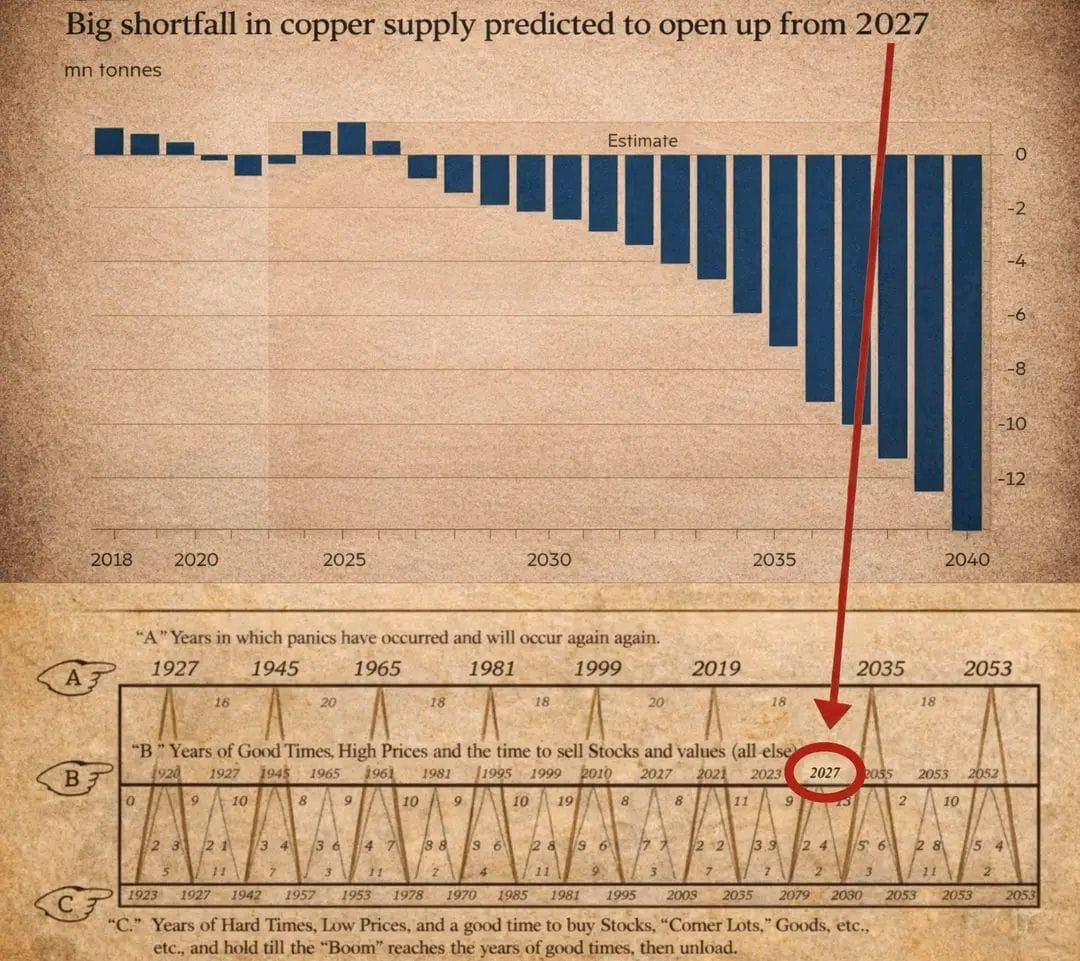
Multiple Institutional Forecasts, Including Bernstein, Indicate That A Structural Copper Shortage Could Begin Around 2027 And Intensify Through 2050.
Here’s Why This Matters.
→ DEMAND IS ACCELERATING
→ SUPPLY IS STRUCTURALLY CONSTRAINED
→ THE GAP IS MATHEMATICALLY UNSUSTAINABLE
Below Is The Framework Explaining Why Copper Is Entering A New Supercycle.
1) THE SUPPLY CLIFF — THE CORE PROBLEM
Copper Supply Is Facing A Severe Structural Bottleneck.
• There Are Virtually No Major New Copper Mines Coming Online
• Permitting And Development Takes 17–20 Years On Average
• Even If A Large Deposit Were Discovered Today, Meaningful Production Would Likely Not Begin Until The 2040s
At The Same Time:
• Ore Grades Are Declining
• The Highest-Quality Deposits Have Already Been Extracted
• Mining Is Becoming Deeper, More Expensive, And Less Efficient
According To S&P Global, The World Could Face An Annual Copper Deficit Of Approximately 10 Million Tonnes By 2040 — Roughly 25% Of Projected Demand At Current Price Levels.
This Is Not A Cyclical Issue.
It Is A Structural Supply Constraint.
2) THE AI AND ENERGY INFRASTRUCTURE SHOCK
Copper Demand Is No Longer Driven Only By Traditional Industrial Use.
Artificial Intelligence Is A Major New Demand Driver.
• Data Center Capacity Is Projected To Increase Dramatically By 2040
• AI Systems Require Enormous Electrical Power And Advanced Cooling
• Liquid Cooling Infrastructure Relies Heavily On Copper Plates, Tubing, And Piping
The Existing Power Grid Cannot Support This Load Without Massive Upgrades.
• Millions Of Miles Of New Transmission Lines Are Required
• Substations, Transformers, And Distribution Networks Are Copper-Intensive
• Grid Expansion Is Capital-Heavy And Time-Consuming
This Demand Is Structural, Not Optional.
3) ELECTRIFICATION AND THE ENERGY TRANSITION
Even Without AI, Copper Demand Was Already Rising Rapidly.
• Electric Vehicles Use Approximately Three Times More Copper Than Internal Combustion Vehicles
• Wind And Solar Installations Are Highly Copper-Intensive
• Battery Storage, Charging Infrastructure, And Grid Stabilization All Increase Copper Consumption
The World Is Attempting To Rebuild Global Energy Infrastructure Over The Next 25 Years Using A Metal That Is Already In Short Supply.
This Is A Physical Constraint, Not A Policy Debate.
4) COPPER AS A STRATEGIC ASSET
When Supply Tightness Becomes Acute, Copper Will No Longer Trade Like A Typical Industrial Commodity.
• Manufacturers Will Compete Aggressively For Inventory
• Securing Supply Will Matter More Than Spot Pricing
• Strategic Stockpiling Will Increase
In Such Environments, Pricing Becomes Non-Linear.
Copper Transitions From An Industrial Input To A Strategic Resource.
5) THE BIG PICTURE
This Setup Does Not Depend On Speculation Or Sentiment.
It Is Driven By:
• Long Lead Times
• Declining Supply Quality
• Infrastructure Reality
• Energy Demand Growth
Markets Tend To Underprice These Dynamics Until Shortages Become Visible — At Which Point Repricing Happens Quickly.
FINAL THOUGHT
Copper Does Not Need Hype.
It Needs Time.
The Structural Forces Are Already In Motion.
Those Who Study Long-Term Supply-Demand Dynamics Understand Why This Market Deserves Attention.
Macro Cycles Reward Preparation — Not Reaction.
Sometimes The Market Moves Quietly For Years Before The Adjustment Becomes Impossible To Ignore ⚠️