
Si vous avez suivi récemment l'espace DePIN (Réseaux d'Infrastructure Physique Décentralisée), vous avez probablement remarqué un changement majeur. Nous ne regardons plus seulement des altcoins individuels ; nous assistons à la désagrégation totale du cloud traditionnel (AWS, Google Cloud) en une pile décentralisée et open-source.
En regardant DIMO, Dynex, GPUnet et Fluence, une image très claire de ce nouveau Cloud Décentralisé commence à émerger.
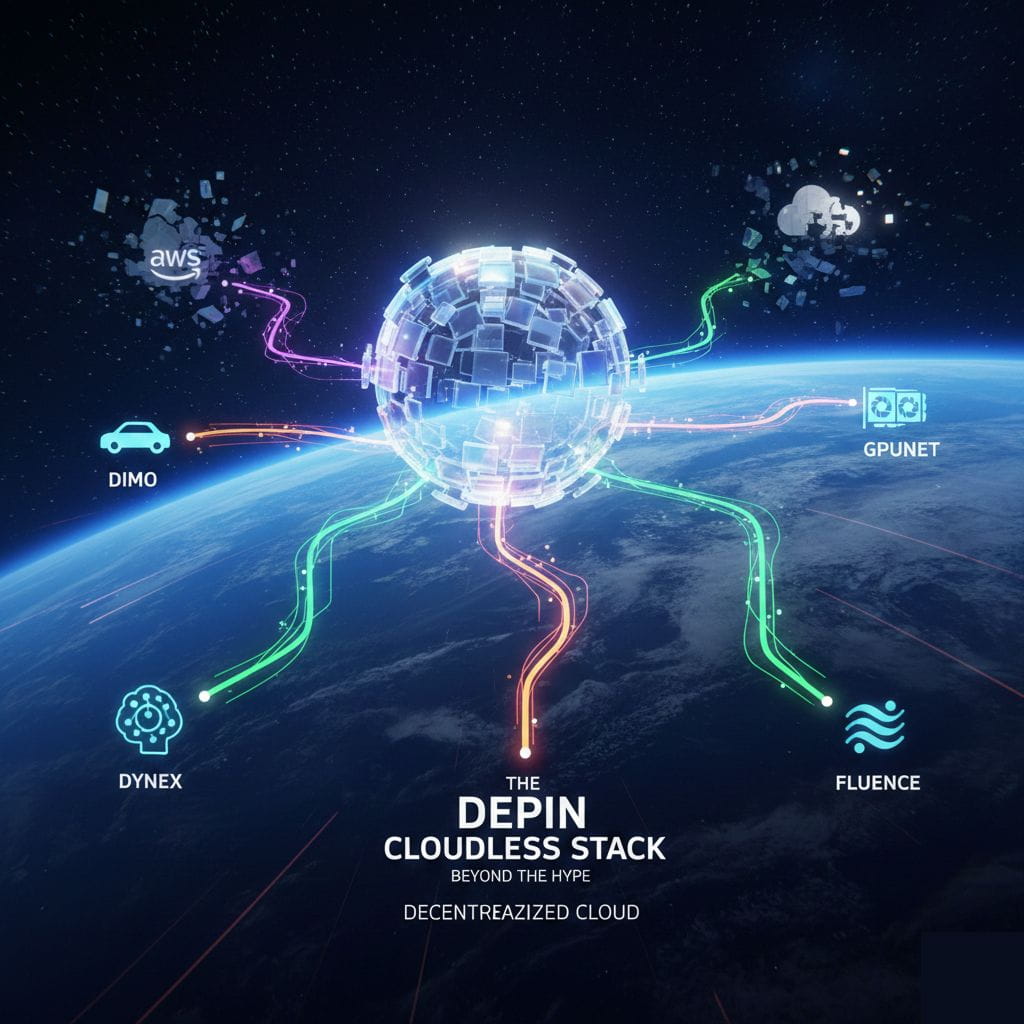
🧠 La Tendance Partagée : DePIN pour l'IA et les Données
Ce qui ressort, c'est que ces projets construisent un cloud verticalisé. Dans le monde Web2, l'infrastructure était spécialisée en CDNs, entrepôts de données et plateformes sans serveur. Nous voyons cette même spécialisation se produire dans Web3 :
Le matériel spécialisé est roi : Que ce soit des voitures sur la route ($DIMO) ou des GPU dans des centres de données ($GPUnet/$DNX), l'approvisionnement est regroupé sur la chaîne pour briser les monopoles centralisés.
L'IA comme moteur : Vous avez besoin de données de véhicules pour entraîner des modèles, de GPU pour les exécuter, et d'un environnement d'exécution pour héberger les agents IA. Ces projets sont le carburant et le moteur de la révolution IA.
💡 POURQUOI FLUENCE SE DISTINGUE : La couche "Logique"
Alors que la plupart des projets DePIN se concentrent sur le "physique" (points d'accès, capteurs, GPU), Fluence construit la Couche Logique.
La mission de Fluence est de fournir un backend "Sans Cloud". Il ne veut pas simplement vous vendre un serveur ; il veut vous donner une version décentralisée d'AWS Lambda.
Au lieu de louer une machine spécifique et de la gérer vous-même, Fluence permet aux développeurs de déployer des fonctions et des services dans un marché global. Cela agit comme la colle qui connecte les ressources brutes :
Un pipeline d'IA pourrait tirer des données de DIMO...
Les traiter en utilisant un travail sur GPUnet...
Et exposer l'API finale à travers un service fonctionnant sur Fluence.
🌍 Résumé : Un avenir sans permission
Le schéma ici est clair : Web3 s'éloigne des mèmes "purement financiers" et se dirige vers l'utilité coordonnée par des tokens. Fluence se positionne comme le plan de coordination neutre où ces ressources physiques deviennent utilisables par les développeurs. En éliminant le verrouillage des fournisseurs, ils transforment le calcul en une ressource publique partagée plutôt qu'un produit d'entreprise.