
Blockchain technology has proven its ability to secure value without centralized intermediaries. Yet as adoption grows, the limitations of early designs have become increasingly clear. Congestion, unpredictable fees, and slow settlement make many networks ill-suited for everyday financial activity. XPL (Plasma) addresses these challenges by focusing on system-level efficiency, economic clarity, and infrastructure built for real usage rather than speculation.
@Plasma is not trying to replace existing blockchains. Instead, it refines how they are used bringing execution closer to the needs of stablecoins, payments, and high-volume financial flows.
A Design Philosophy Rooted in Practicality
At its core, Plasma is guided by one principle: financial infrastructure should be predictable. Users should know what a transaction costs, when it will finalize, and how it behaves under load. Plasma achieves this through a focused design that removes unnecessary complexity while preserving decentralization and security.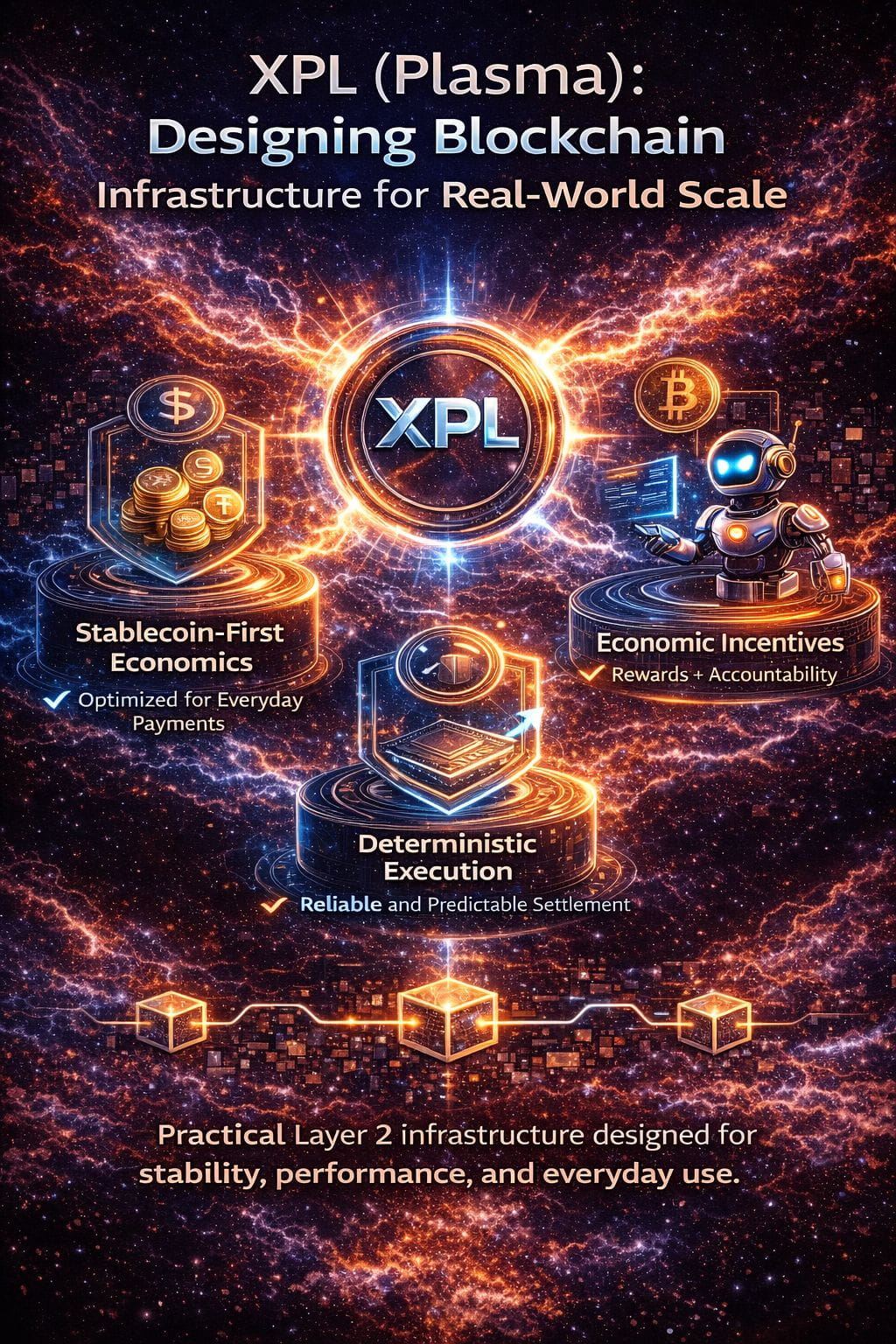
Rather than optimizing for novelty, Plasma optimizes for reliability. Deterministic execution ensures that transactions behave consistently across the network. Stablecoin-first economics eliminate dependence on volatile gas tokens. Fast finality reduces waiting times and uncertainty, making the network suitable for real-time financial interactions.
Execution Layer Built for Stability
Plasma operates as an EVM-compatible execution layer, allowing developers to deploy existing Ethereum applications with minimal changes. Under the hood, Plasma leverages modern Ethereum client architecture, including Reth, to deliver high performance and modular execution.
This approach offers the best of both worlds:
Developers retain familiar tooling and smart contract logic
Users experience faster settlement and simpler interactions
By separating execution from settlement guarantees, Plasma avoids the bottlenecks that limit monolithic chains.
PlasmaBFT and Finality at Speed
A key component of Plasma’s performance is PlasmaBFT, a consensus mechanism designed for rapid transaction confirmation. Plasma achieves sub-second execution finality, enabling applications that require immediate responsiveness, such as payments, trading interfaces, and on-chain services.
To maintain long-term security and neutrality, Plasma anchors periodic checkpoints to Bitcoin, roughly every ten minutes. This layered approach combines fast execution with robust external settlement, reducing reliance on trust while maintaining efficiency.
Stablecoins as Core Infrastructure
Unlike many networks where stablecoins are secondary assets, Plasma treats them as first-class citizens. The network is optimized for:
Gasless stablecoin transfers
Fee payments directly in stablecoins
High-throughput, low-cost settlement
These design choices matter at scale. When users no longer need to hold a separate volatile asset to interact with the network, barriers to entry drop dramatically. Plasma’s UX mirrors traditional payment systems while retaining blockchain transparency and programmability.
Validator and Operator Economics
Economic incentives play a central role in Plasma’s security model. Validators and operators stake XPL to participate in consensus and block production. Rewards are distributed for uptime, correct execution, and network contribution.
Risk is an essential counterpart to reward. Slashing and penalties enforce accountability, ensuring that malicious behavior or negligence carries financial consequences. This alignment of incentives ensures that network health and operator profitability move in the same direction.
Over time, this model creates a self-reinforcing system where trust emerges from economics rather than assumptions.
System-Level Efficiency Under Load
#plasma architecture is designed to perform consistently even during periods of heavy activity. Deterministic execution reduces variability, while fast finality prevents transaction backlogs from cascading through the system.
By avoiding fee auctions and unpredictable congestion, Plasma maintains stable performance as usage grows. This makes it particularly well-suited for real-world financial applications where reliability is non-negotiable.
Plasma’s Place in the Scaling Landscape
While rollups dominate much of today’s scaling conversation, Plasma represents a complementary approach focused on execution efficiency and user guarantees. Its emphasis on exit rights, layered security, and economic alignment has influenced many modern designs.
Plasma’s contribution is not just technical it is conceptual. It reframes how blockchains should scale: by separating concerns, minimizing friction, and anchoring trust at the base layer.
Looking Forward
XPL (Plasma) is building infrastructure for a future where blockchain is no longer experimental. Payments, settlements, and financial coordination require systems that are fast, predictable, and resilient.
By focusing on stablecoins, deterministic execution, and incentive-driven security, Plasma moves blockchain closer to everyday utility. It is not designed for hype cycles, but for long-term adoption where users care less about the chain they are using and more about whether it simply works.$XPL

