

In crypto, “compliance” and “privacy” are usually treated like rivals. One is framed as the world of rules, identity checks, reporting, and licenses. The other is framed as the world of secrecy, censorship resistance, and hiding information from everyone. Put them in the same sentence and people assume you’re describing a compromise, less privacy to satisfy regulators, or less compliance to satisfy privacy.
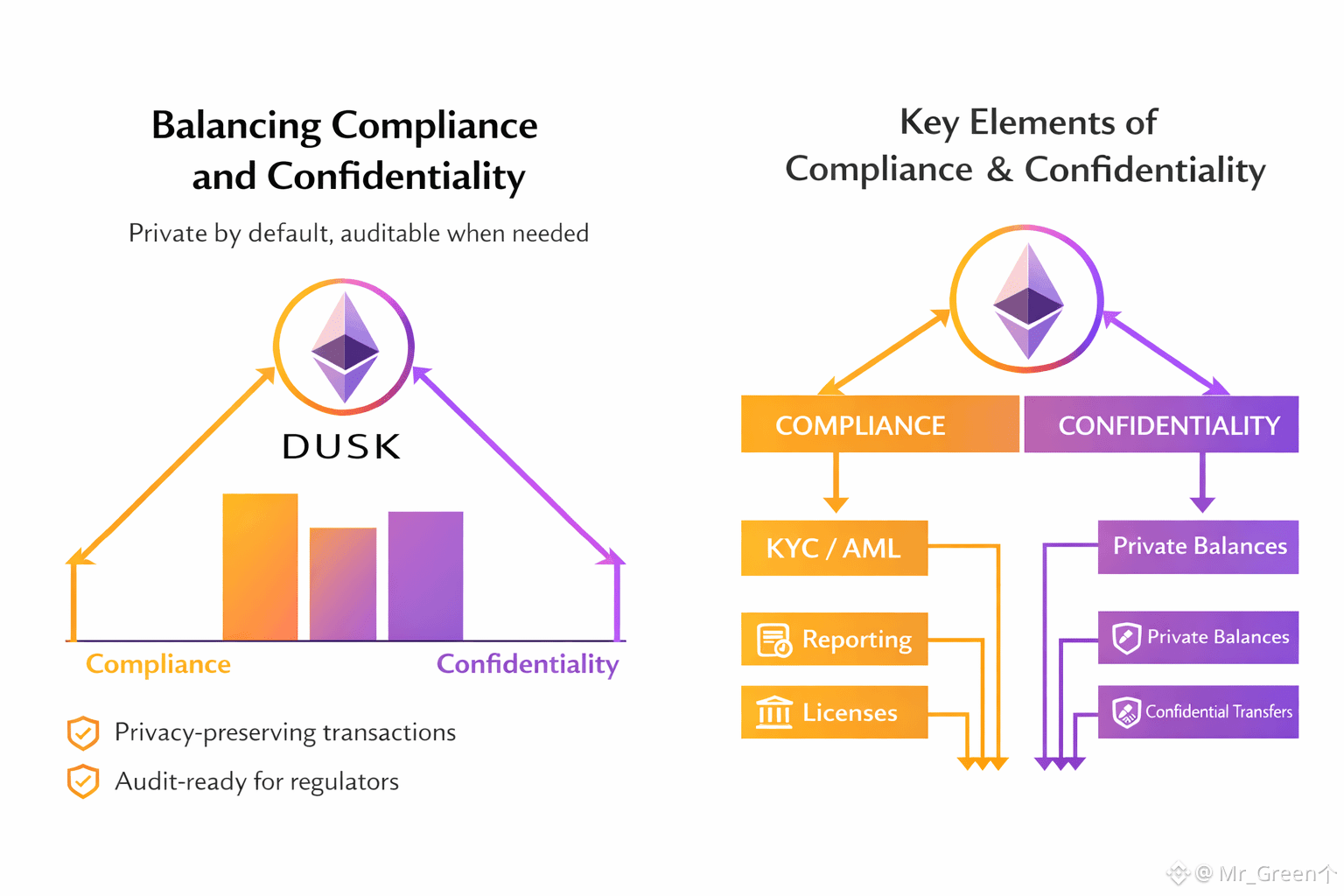
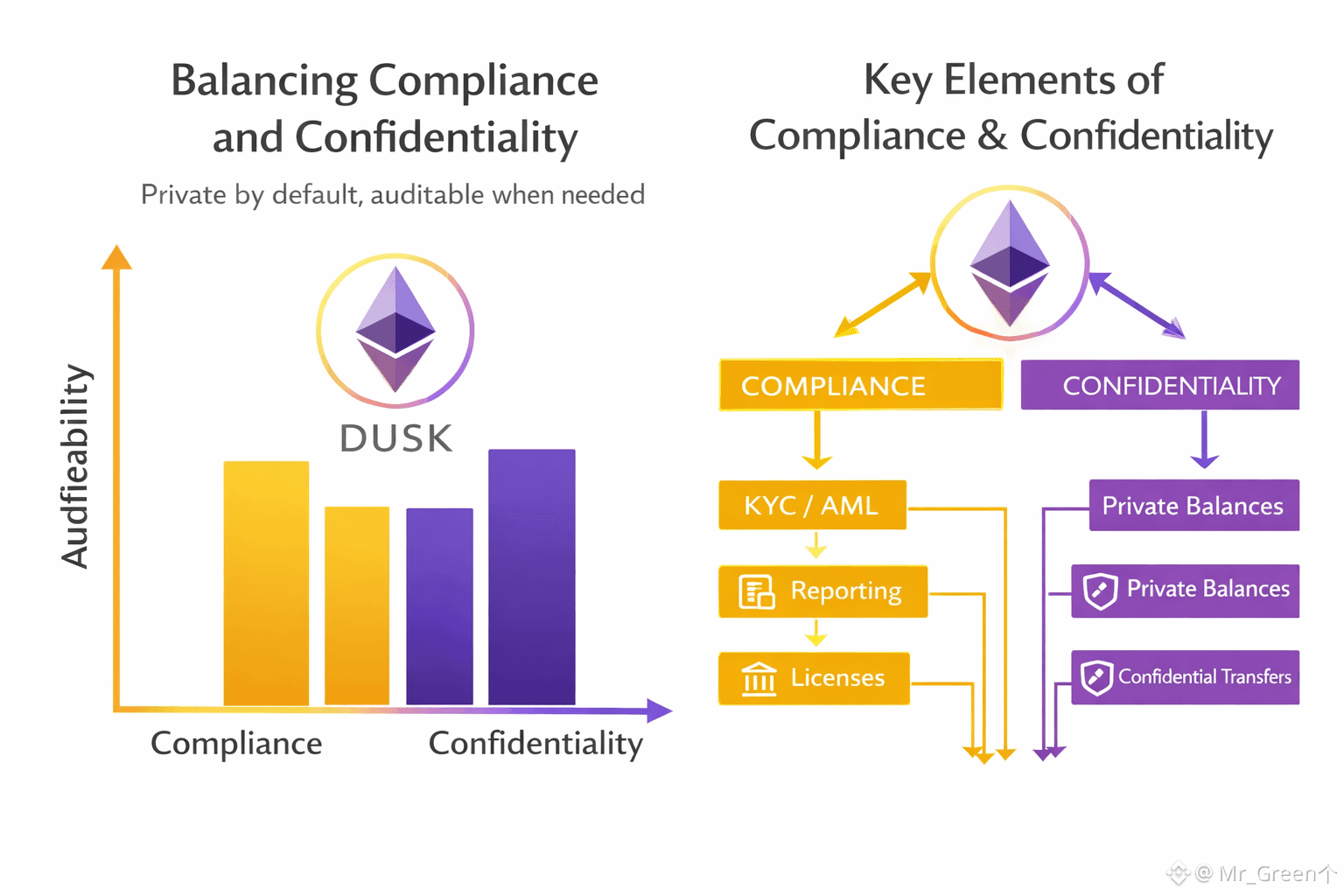
Dusk’s story is interesting because it rejects that framing. It treats compliance and confidentiality as two rails that must run side by side if blockchains want to support real finance. In modern markets, confidentiality isn’t a loophole; it’s normal. Traders don’t publish their strategies. Funds don’t disclose positions to the public in real time. Companies don’t broadcast every financial detail to competitors. Yet those same markets remain regulated and auditable. Regulators can demand records, investigate misconduct, and enforce rules. The everyday operating mode is private; accountability comes through selective disclosure and oversight. Dusk’s thesis is that on-chain finance needs to mirror that reality, not fight it.
That thesis becomes clearer when you look at what Dusk is actually building: not just a chain, but a modular financial stack aimed at regulated use cases. Dusk describes its architecture as a three-layer system, DuskDS for consensus, data availability, and settlement; DuskEVM as an EVM execution layer; and a forthcoming privacy-focused layer called DuskVM. This modularity matters because it lets Dusk separate concerns that are often tangled together on other chains. Settlement security can be one thing. Developer experience can be another. Privacy can be its own specialized engine rather than an afterthought.
The adoption problem in crypto is rarely about ideas. It’s abou
t integration cost. Institutions don’t want to rebuild their tooling, rewrite smart contracts into exotic languages, or gamble on ecosystems that require bespoke infrastructure at every step. That’s why DuskEVM is such a pivotal move: it’s an EVM-compatible execution layer designed so developers can deploy standard Solidity smart contracts, using familiar Ethereum tools and infrastructure, while settling back to Dusk’s Layer 1. If you’re trying to convince regulated finance to step onto blockchain rails, lowering integration friction isn’t a nice-to-have; it’s the price of entry.
But “EVM compatibility” alone doesn’t solve the deeper issue. The EVM world is public by default. Transparency is great when you’re verifying that a protocol is solvent or checking that rules are enforced. It becomes a structural weakness when the goal is real market activity. In public DeFi, the biggest traders often have the worst experience: large orders get detected, strategies get copied, intent becomes legible to adversaries, and the market behaves like a surveillance machine. That’s not how serious markets function. It’s also why tokenized securities won’t reach meaningful scale if every participant is forced to broadcast sensitive activity to the entire world.
This is where Dusk’s confidentiality story becomes central, not cosmetic. Dusk’s “Hedger” is presented as a privacy engine purpose-built for the EVM execution layer, combining homomorphic encryption with zero-knowledge proofs to enable confidential transactions that remain compliance-ready. The nuance here is crucial: Dusk is not selling privacy as “nobody can ever know anything.” It’s selling confidentiality as the default mode, with verifiability and auditability preserved. In other words, you can keep sensitive details encrypted while still proving that the transaction is valid and policy-compliant. That’s exactly the mental model regulated markets already use, confidential operations under lawful oversight.
If you want to understand why this matters, think about what makes a real exchange work. Price discovery requires liquidity. Liquidity requires professional participants. Professional participants require protection from information leakage. A market where every move is publicly observable in real time is a market where informed adversaries can extract value from your intent. Dusk explicitly frames Hedger as enabling not just private transfers but more complex confidentiality features, including building blocks for obfuscated order books an institutional requirement that rarely fits cleanly into purely transparent DeFi. Dusk has also publicly promoted Hedger as part of its DuskEVM direction, signaling that the privacy layer isn’t a distant research footnote but a near-term product surface.
Compliance enters the story not as a checkbox, but as a design constraint that shapes which applications can exist. The flagship example is Dusk’s long-running partnership narrative with NPEX, a Netherlands-based exchange. Dusk describes this partnership as the launch of a blockchain-powered security exchange designed to issue, trade, and tokenize regulated financial instruments. NPEX itself states that it holds an MTF and ECSPR license from the Netherlands Authority for the Financial Markets (AFM) and is under continuous supervision (also mentioning De Nederlandsche Bank). That is not a trivial detail. It’s the difference between “tokenization” as a crypto experiment and tokenization as something that can live inside European financial regulation.
DuskTrade, expected in 2026, is the natural consequence of putting compliance and confidentiality on equal footing. It’s positioned as a compliant trading and investment platform meant to bring a substantial volume of tokenized securities on-chain—framed in Dusk’s messaging as a major step toward regulated RWAs. From a market-structure perspective, the goal isn’t simply “put securities on-chain.” The goal is to create an end-to-end environment where securities can be issued, traded, and settled with the kinds of constraints real assets require: eligibility rules, investor protections, reporting obligations, and controlled disclosures. That’s where Dusk’s confidentiality technology becomes more than a feature. It becomes the thing that can make regulated on-chain markets usable for sophisticated participants.
It’s worth pausing on a subtle but powerful point: compliance and confidentiality aren’t opposites, they often depend on each other. Compliance needs accurate records, but it doesn’t require broadcasting everything publicly. Confidentiality protects participants from exploitation, but it doesn’t have to block oversight. The real conflict is between “privacy as total opacity” and “regulation as total surveillance.” Dusk’s positioning is basically a third path: cryptographic confidentiality with selective, provable auditability. When you frame it that way, Dusk starts to look less like a typical L1 competing for mindshare, and more like infrastructure trying to satisfy the constraints of real financial plumbing.
This also explains why Dusk is leaning into modular architecture. A monolithic chain usually forces one set of trade-offs onto every application. A modular stack can offer different execution environments for different needs. DuskDS anchors finality and settlement. DuskEVM gives the industry a familiar surface area for building. DuskVM aims to deepen privacy functionality at the execution level. This separation matters because regulated finance is not one thing. It’s a collection of workflows, issuance, custody, trading, settlement, disclosure, reporting, each with its own technical and legal requirements. A chain that wants to host those workflows needs to be more like a platform of specialized components than a single “one size fits all” environment.
None of this guarantees success, and any serious article should admit the hard parts. Privacy tech is heavy. Zero-knowledge systems and encryption-based computation can impose performance and UX costs. Regulated adoption is slow because institutions move through committees, vendors, audits, and legal reviews. Liquidity is earned, not declared. But what makes Dusk worth analyzing is that its roadmap aligns with the actual bottlenecks that have kept “institutional DeFi” mostly theoretical: integration friction, confidentiality, and credible regulatory alignment.
If Dusk delivers on this “side by side” thesis, the payoff is larger than one chain’s success. It would demonstrate a model for what on-chain regulated markets might look like: not a world where everything is public and exploitable, and not a world where everything is hidden and unverifiable, but a world where compliance and confidentiality reinforce each other through cryptography and structured market design. That’s the kind of infrastructure that could make tokenized securities feel less like a narrative and more like a functioning financial system, settling on-chain, behaving like real markets, and finally giving regulated finance a reason to treat blockchain as more than a curiosity.
