
@Dusk There’s a quiet tension running through modern finance: the parts of the system that need sunlight for trust are often the same parts that need shade for safety. That tension used to feel philosophical. Now it feels operational. In Europe, MiCA has moved past the press-release phase. Firms are now making real calls about licensing, governance, and what “good” client and reserve handling looks like on an ordinary Tuesday. And regulators are still working through the messy part: who should be in charge of oversight, and whether more of it should sit at the EU level instead of being spread across national authorities.
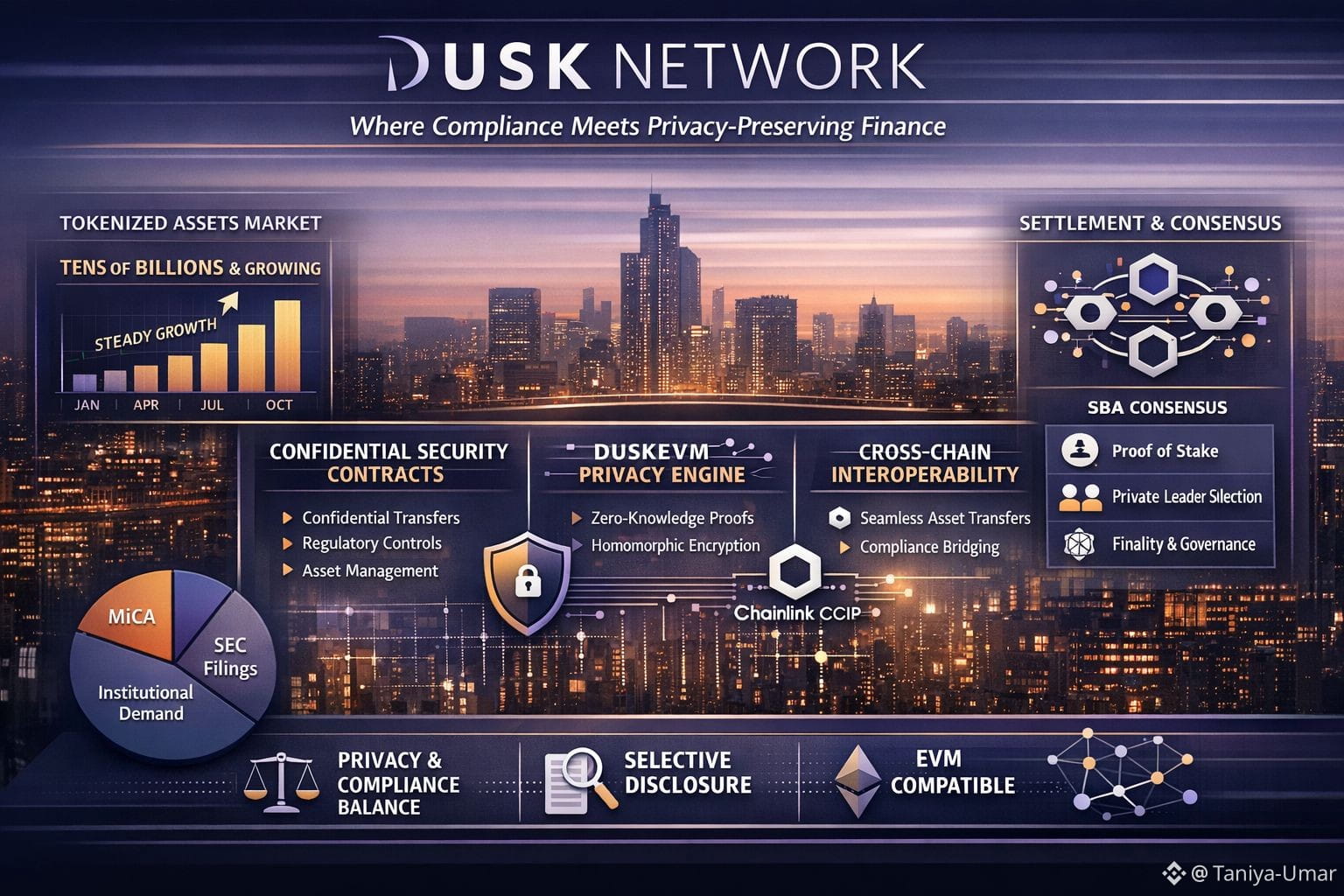
Meanwhile, tokenization isn’t living in a lab anymore. It’s starting to get treated like a serious track, not a weekend pilot. In late January 2026, F/m Investments filed with the SEC seeking approval to tokenize shares of its Treasury bill ETF (TBIL) on a permissioned blockchain—while keeping the product inside the existing U.S. regulatory wrapper. That detail matters. It suggests the direction of travel is not “replace the system,” but “upgrade parts of it without breaking investor protections.” And if you look at the market data people are watching, it’s clear why the topic keeps resurfacing: widely used on-chain analytics platforms tracking tokenized real-world assets put the market in the tens of billions, with steady month-over-month movement that looks more like infrastructure adoption than a speculative spike.
This is where Dusk Network’s positioning starts to feel unusually specific. Dusk isn’t trying to be a general-purpose “everything chain” with privacy as a nice-to-have. Its own framing is built around confidentiality and on-chain compliance for regulated assets, including the reality that financial rules don’t disappear just because a ledger is digital. The point isn’t to hide the existence of activity. It’s to avoid turning every detail of that activity into public theater.
When people talk about “privacy” in crypto, it can sound like a moral argument. Dusk’s framing is more practical: regulated markets need privacy because institutions and clients do. If positions, transfer sizes, and counterparties are fully transparent by default, you can create a system that is auditable and still unusable at scale. Strategy leaks. Clients become targets. Even innocent activity becomes a permanent, searchable record. The better question is not “privacy or compliance?” but “what needs to be proven, and to whom?”
Dusk’s answer shows up in its core components. The network describes Zedger as an asset protocol that supports the Confidential Security Contract (XSC) functionality needed for securities-style use cases, including lifecycle management and regulatory alignment in how the system is meant to behave. If you strip away the labels, the idea is straightforward: encode who can hold an asset, who can trade it, and how it behaves over time—while keeping sensitive fields shielded unless the right party has a legitimate reason to see them.
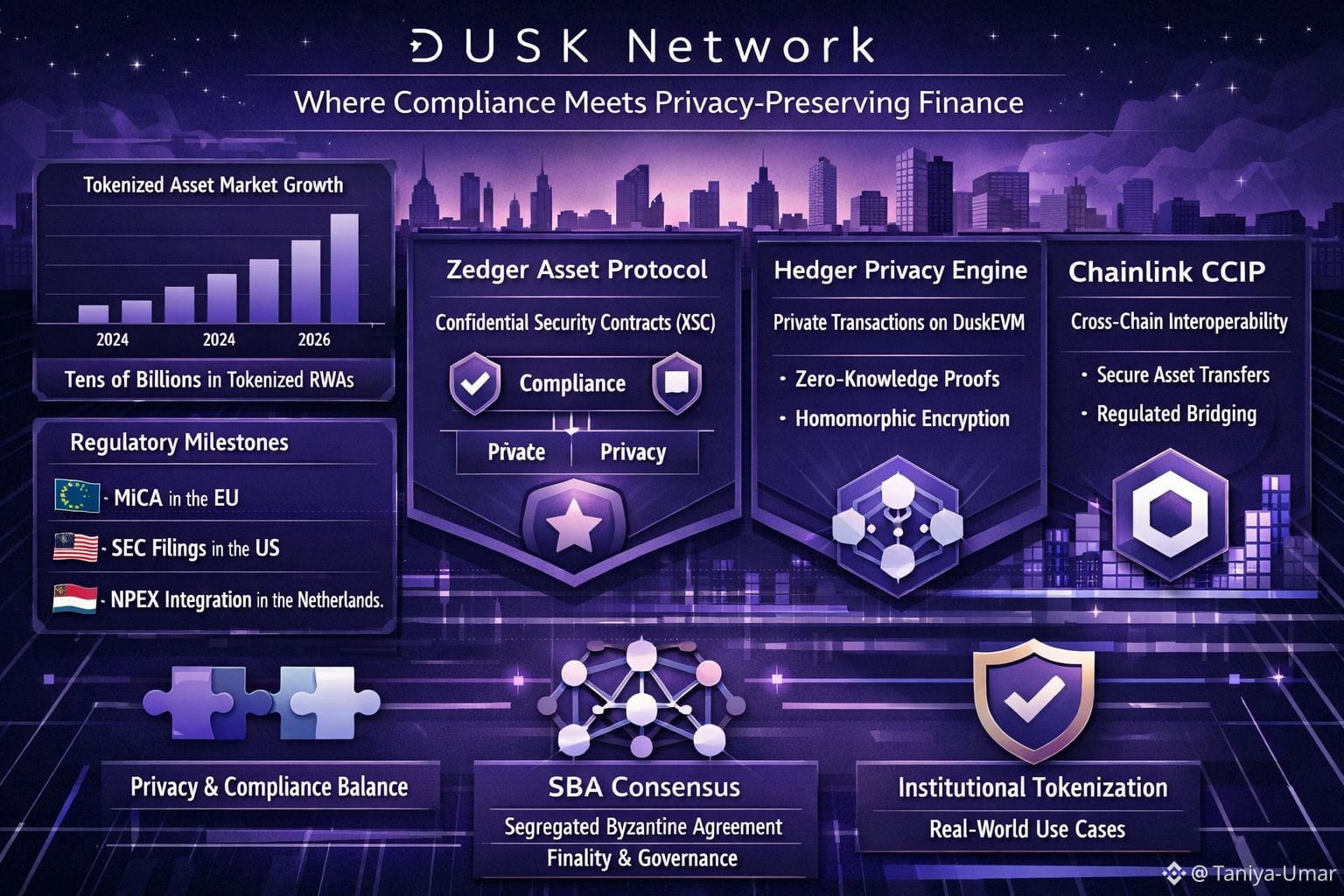
What makes this more than a whitepaper story is that Dusk has been building around an EVM execution layer too. It introduced Hedger as a privacy engine for DuskEVM, designed to enable confidential transactions using a combination of homomorphic encryption and zero-knowledge proofs, with “compliance-ready” intent rather than blanket opacity. I find that distinction important, because it signals a design goal that’s closer to banking reality: selective disclosure, not invisibility.
And then there’s the cross-chain problem, which institutions tend to care about more than crypto culture does. If a regulated asset is issued on one chain but liquidity, tooling, or collateral workflows live elsewhere, the asset either gets stranded or gets bridged in ways that weaken controls. Dusk and the Dutch exchange NPEX have leaned into this by integrating Chainlink CCIP as an interoperability layer, framing it as a way for tokenized assets issued on DuskEVM to move across ecosystems while staying aligned with compliance constraints.
Underneath all of it is the unglamorous question risk teams always ask: can the chain actually settle with confidence? Dusk’s whitepaper describes its proof-of-stake consensus, Segregated Byzantine Agreement (SBA), including privacy-preserving elements around leader selection. You don’t have to be a cryptographer to appreciate what that signals: they’re thinking about finality and governance as part of the product, not as an afterthought.
None of this “solves” the privacy-versus-regulation puzzle in one stroke, and it shouldn’t pretend to. But it does explain why Dusk is being talked about in the same breath as compliance and institutional tokenization right now. The world is moving from theory to implementation—MiCA deadlines, SEC filings, real issuance experiments—and the infrastructure that survives will be the kind that lets markets be discreet and accountable at the same time.