

A storage network is not a hard drive. It is a promise made by many machines, in many places, to keep showing up tomorrow. And promises at scale need a language that is precise. Not poetry. Not slogans. A unit. A meter. A way to pay for time, and a way to reward the people who keep the system honest.
In Walrus, that language is WAL.
Walrus is a decentralized storage protocol designed for large, unstructured files called blobs. A blob is simply a file or data object that is not stored as rows in a database table. Walrus stores blob contents off-chain on storage nodes, while using the Sui blockchain for coordination, payments, and availability attestations. Only metadata is exposed to Sui or its validators. The goal is practical: keep data retrievable even if some storage nodes fail or behave maliciously.
WAL sits at the center of that practicality, because Walrus is not only about storing bytes. It is about storing bytes for a period of time, under clear rules, with measurable responsibility.
On Walrus, storage space is represented on Sui as a resource that can be owned, split, merged, and transferred. This is important because it turns storage into something you can manage like an asset. You can acquire it directly, or receive it, or move it between owners. Then you tie that storage resource to a blob ID for a certain duration. When the system accepts an availability certificate and emits the availability event on Sui, that moment becomes the Point of Availability. From that point onward, Walrus takes responsibility for keeping the blob available for the stated availability period.
Now comes the economic reality. Keeping data available costs money, not once, but continuously. Operators run hardware. They serve reads. They survive partial failures. They handle epoch transitions. They keep slivers retrievable even when the network is not behaving politely.
WAL is used for payments for storage. It is also the token used to delegate stake to storage nodes. These two roles are connected. Payments keep the service alive, and stake shapes who is trusted to provide the service.
Walrus is operated by a committee of storage nodes that evolves between epochs. In each epoch, a set of storage nodes is active in operating the system, and over time, membership changes. WAL is used in a delegated proof-of-stake model where people can delegate stake to storage nodes, and nodes with higher stake become part of the epoch committee. In plain terms, WAL is not just a payment coin. It is also a coordination tool. It helps the network decide who holds responsibility in the next period.
This matters because storage is not neutral. Someone must be accountable for shards during an epoch. Someone must serve slivers. Someone must respond when a reader asks for data. A committee model makes that responsibility clearer, and delegated stake gives the community a way to influence who is chosen.
The economic flow is designed to match time. When users purchase storage space from the system object on Sui, they pay into a storage fund that holds funds intended to cover storage across one or multiple storage epochs. Those payments are separated over the epochs they span, and each epoch funds are paid out to storage nodes according to performance. This detail is easy to skip past, but it is the heart of the incentive design. Walrus is not trying to pay for a moment. It is trying to pay for continuity.
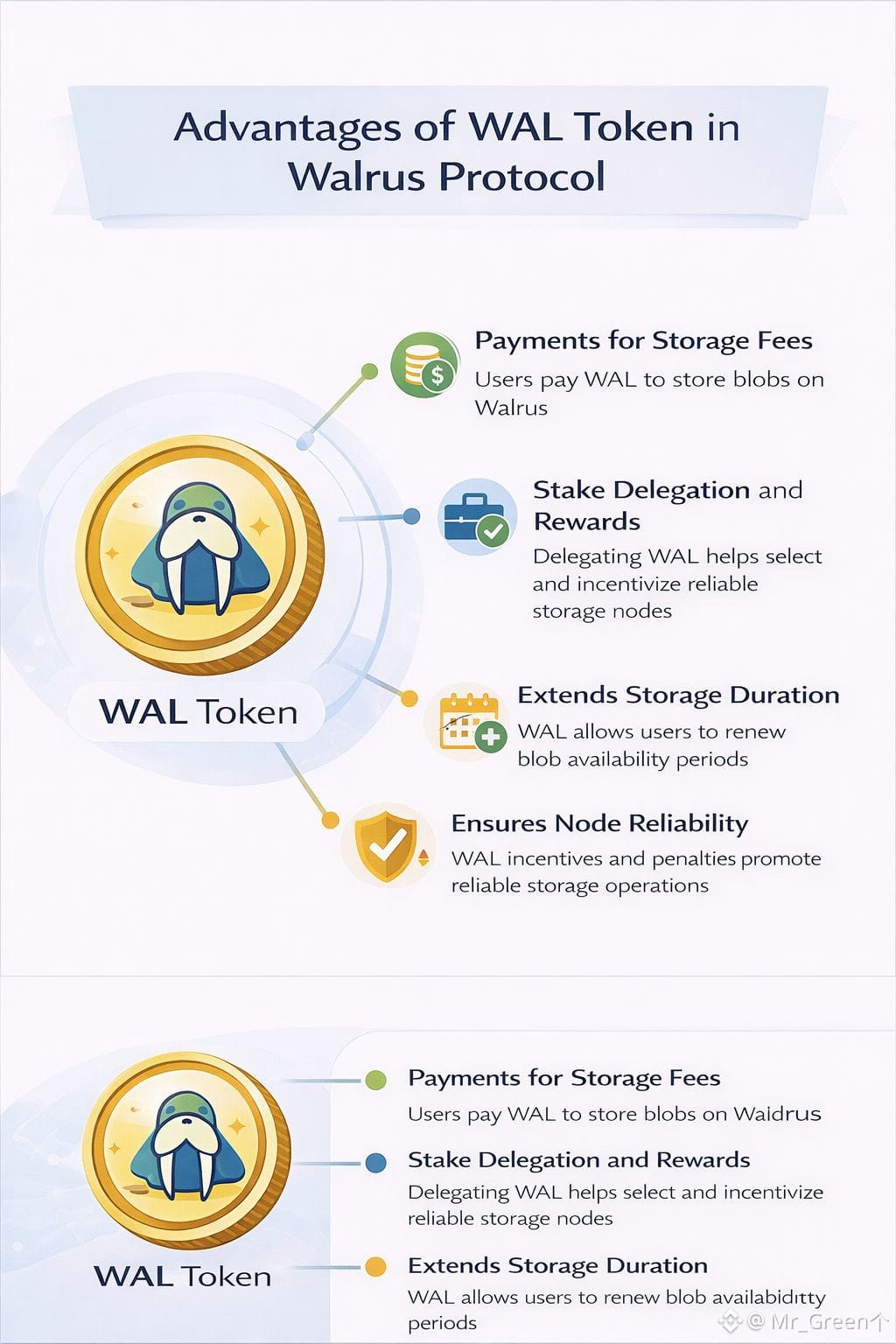
Continuity is also why Walrus supports extending storage without re-uploading content. If a certified blob needs to remain available longer, a user can extend its lifetime by attaching additional storage resources with a longer expiry period. Because no blob content is needed to extend time, this refresh can be done on-chain within the protocol, and storage nodes respond to the event by extending how long they keep the slivers. That makes WAL feel less like a one-time fee and more like a way to renew responsibility.
WAL also has a practical subdivision called FROST, where 1 WAL equals 1 billion FROST. That kind of granularity matters in a system where payments might need to be fine-tuned across different blob sizes and storage durations.
Mainnet made these ideas more than a theory. When Walrus Mainnet went live, the network became usable to publish and retrieve blobs, to upload and browse Walrus Sites, and to stake and unstake using the live Mainnet WAL token. Mainnet also introduced features that tighten the connection between protocol design and real-world operation. For example, the system includes a subsidies contract operated by the Walrus foundation to help early adopters acquire subsidized storage, and the CLI client uses it automatically when storing blobs. That is an economic bridge. It helps people learn the system without immediately turning every experiment into a high-friction cost decision.
There is another side of incentives that matters just as much as rewards: discouraging behavior that harms the network. Walrus assumes Byzantine conditions are possible. It designs for them technically with erasure coding and verification, but incentives still matter. If a node wants to get paid without actually storing data, the system needs ways to make that strategy unreliable. Walrus describes a challenge mechanism for storage attestation where storage nodes challenge shards to provide symbols for blob slivers past the Point of Availability, using a seeded sequence that creates a sequential dependency and must be answered in a timely manner. Challenge results are reported on-chain. This does not replace cryptography. It complements it with evidence of service. It reinforces the idea that WAL-funded rewards should follow demonstrated reliability, not mere presence.
For developers, this is the practical picture. WAL is how your application pays for off-chain availability with on-chain accountability. Your blob content does not go to Sui, but your blob’s lifecycle does. Your costs are shaped by size and time, and your design choices matter. Large blobs fit the system’s economics better than many tiny blobs, because protocol overhead and coordination costs do not shrink to zero for small payloads. If you treat WAL as “storage rent measured in time,” you start designing blobs and updates more carefully.
For operators and delegators, WAL is the tool that shapes the network’s character. Delegation influences which nodes become part of the committee. Rewards and performance push nodes toward good behavior. Over epochs, WAL is meant to align long-term reliability with long-term participation.
If you step back, WAL is not interesting because it is a token. It is interesting because it makes storage legible. It turns availability into something that can be paid for, renewed, and measured. It turns “trust us, we host it” into “here is the resource, here is the period, here is the event that marks responsibility, and here is the incentive system that keeps operators showing up.”
In a world where data keeps growing and disputes keep getting sharper, that kind of legibility is not decorative. It is calming. WAL is one of Walrus’s ways of turning storage from a vague promise into a continuing responsibility that can be funded and enforced over time.