
@Vanarchain In the last year, “AI on-chain” has stopped sounding like a quirky tagline and started feeling like a practical design problem people are trying to solve. Not in the abstract, but in the messy places where data is scattered, rules change, and somebody still has to press the button. Vanar’s stack frames that problem in a simple sequence: remember, reason, automate. Axon is the piece that makes the third verb matter, and that’s why it keeps showing up in discussions around VANRY.
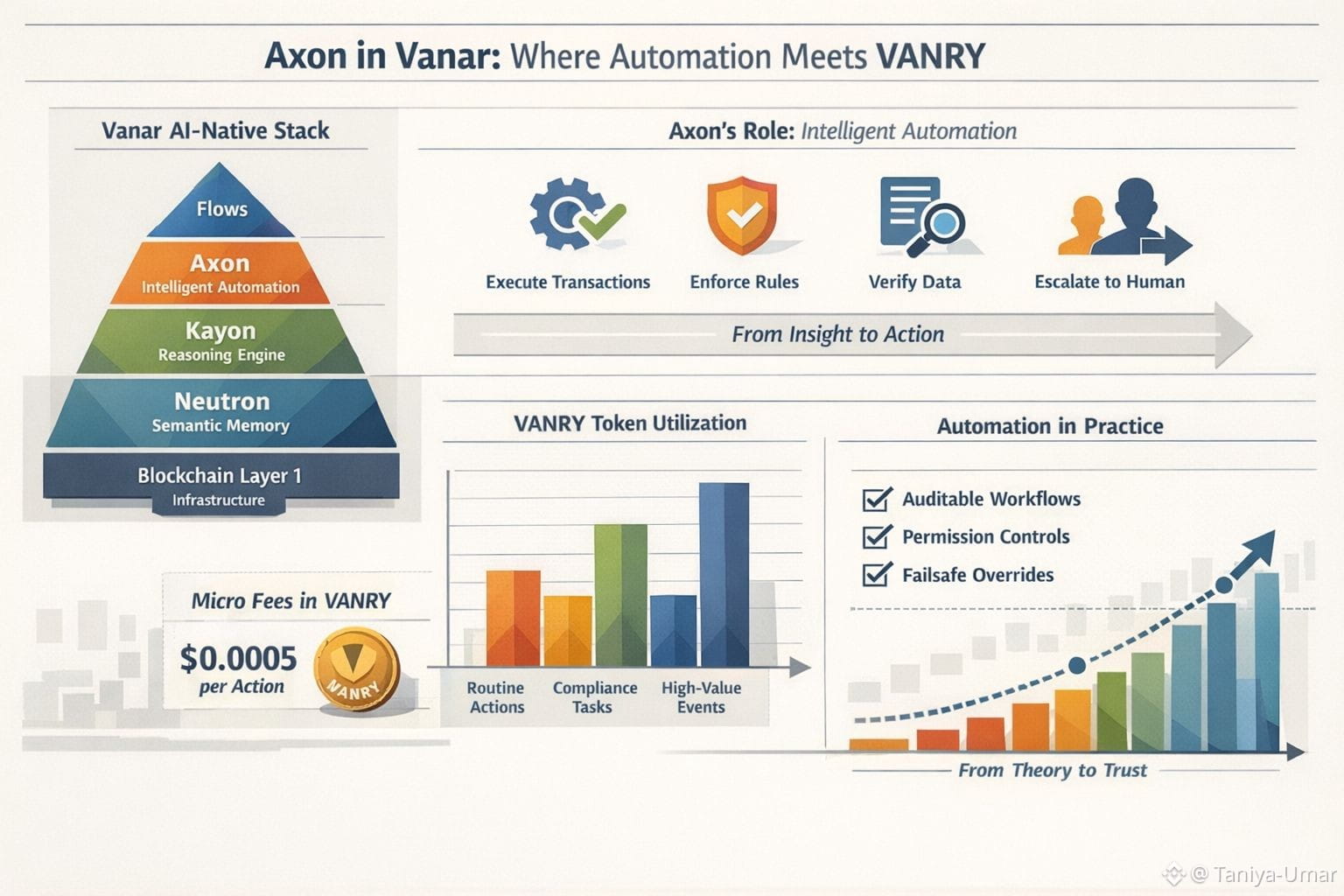
Vanar positions itself as an AI-native Layer 1, with a five-layer stack that moves from blockchain infrastructure up through Neutron (semantic memory), Kayon (reasoning), Axon (automation), and Flows (application rails). The important thing isn’t the naming; it’s the insistence that data and logic belong on the same surface where transactions happen. Neutron, for example, is described as compressing and restructuring data into programmable “Seeds” that are fully on-chain and verifiable, so context doesn’t decay into dead references.
Kayon sits above that memory layer as a reasoning engine. Vanar describes it as turning Seeds and enterprise backends into auditable insights and workflows, with use cases that include natural-language querying and compliance automation. Reasoning you can interrogate sets the bar for what “automation” should mean next. If it flags a transfer and shows its reasoning, you can have an actual conversation with the decision. You can correct it, strengthen it, or defend it with confidence. If it stays silent, automation becomes a neat way to scale mistakes.
This is the runway Axon inherits. On Vanar’s stack diagram, Axon is labeled “Intelligent Automation,” and it is still marked as coming soon, so public detail is thin. Still, the direction is clear enough to discuss without pretending we have a spec sheet. If Kayon produces structured conclusions—what is out of policy, what needs review, what can proceed—Axon is where those conclusions become execution: triggering a payment step, enforcing a rule, initiating verification, or routing a case to a human when nuance matters.
The timing is not an accident. The AI narrative has shifted from chat to agency, and enterprises are simultaneously exploring tokenized real-world assets and payment-finance systems that cannot tolerate silent, black-box automation. They demand receipts. That tension is why “reasoning plus automation” stacks suddenly feel less theoretical. Recent third-party coverage of Vanar’s RWA angle frames Axon as the automated execution layer sitting above data compression and compliance proof generation.
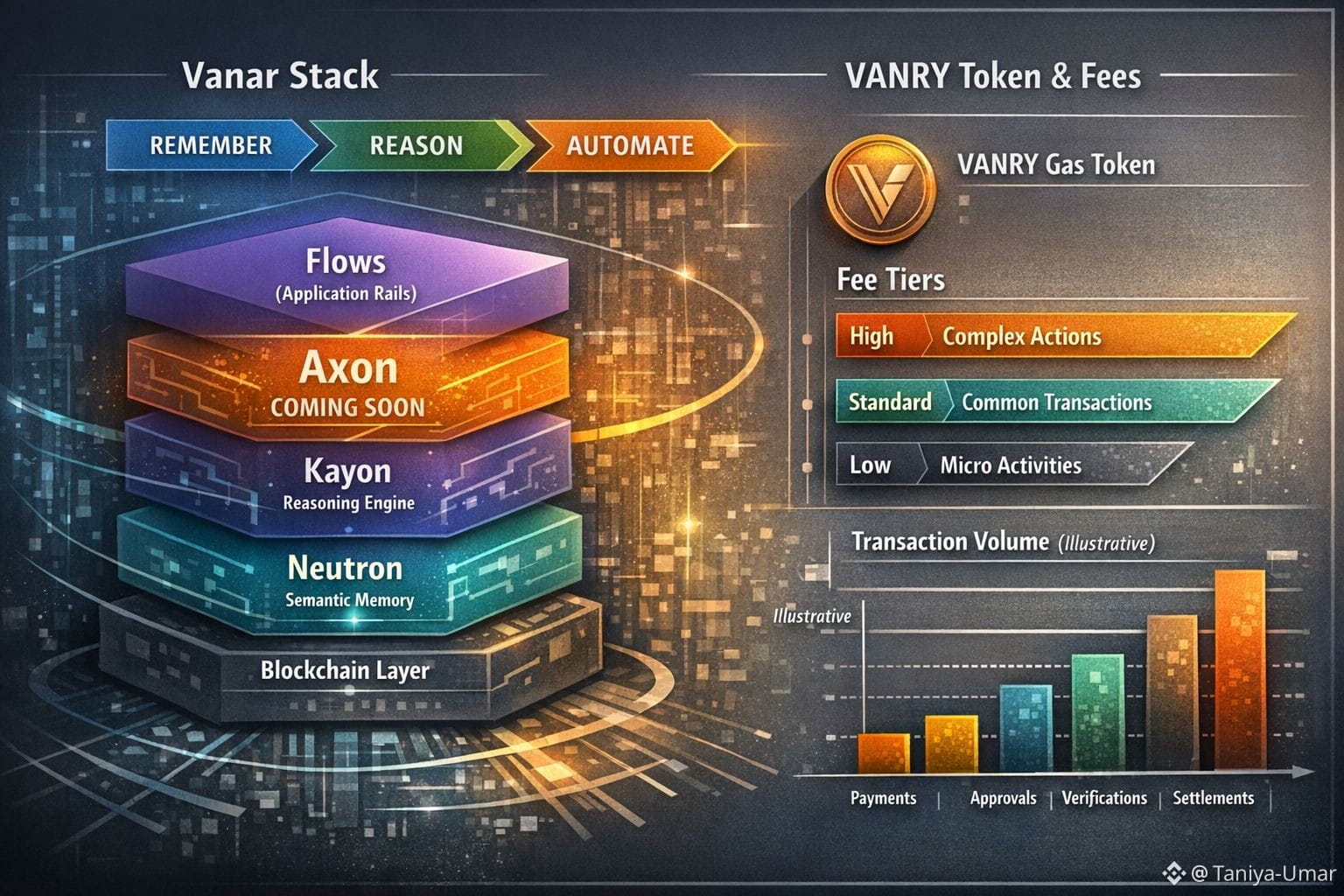
Axon also matters because it’s where architecture stops being interesting and outcomes start being obvious. An accountant doesn’t want to “query a Seed”; they want exceptions flagged and reconciliations finished. A compliance team doesn’t want a clever dashboard; they want a rule enforced consistently, with a trail that holds up on a bad day. Automation is the difference between a chain that can describe the world and a chain that can reliably do something in it.
That brings VANRY into focus. Vanar’s documentation describes VANRY as the native gas token for fees, and it ties the token to staking and governance participation. The chain also documents a tiered fee system and notes that common actions can sit in the lowest tier, priced around the VANRY equivalent of $0.0005. In plain terms, if automation leads to more small, meaningful actions—checks, approvals, alerts, routine settlements—VANRY becomes the quiet metering layer under each automated choice.
A sober view, though, is that automation layers are where projects either mature or wobble. It’s easy to promise workflows. “Boring” sounds like an insult until you’ve operated software in the real world. The best automation is boring because it’s controlled. Axon will have to explain who can authorize actions, how permissions are revoked cleanly, how failures get surfaced before they spread, and how humans can override decisions without losing accountability. That’s not fluff—that’s operational trust.
The encouraging signal is that the lower layers are already being pushed toward user-facing tools, like myNeutron’s pitch for portable memory across major AI platforms, alongside public roadmapping language about shifting AI tools toward subscription-style usage in 2026. If that trajectory holds, Axon isn’t just another module. It’s the missing link that turns stored context and explainable reasoning into repeatable action, which is what “automation meets VANRY” should mean once Axon is live and judged by outcomes.