
@Dusk There’s a point in a network’s life when casual suggestions stop being enough. Once people rely on the same chain, “we should change X” isn’t just a thought anymore—it’s a risk, a cost, and a responsibility. Dusk’s answer to that moment is the Dusk Improvement Proposal, or DIP: a document that captures what someone wants to improve, why it matters, and what the community agrees to do next. The aim is: make change understandable for everyone involved.
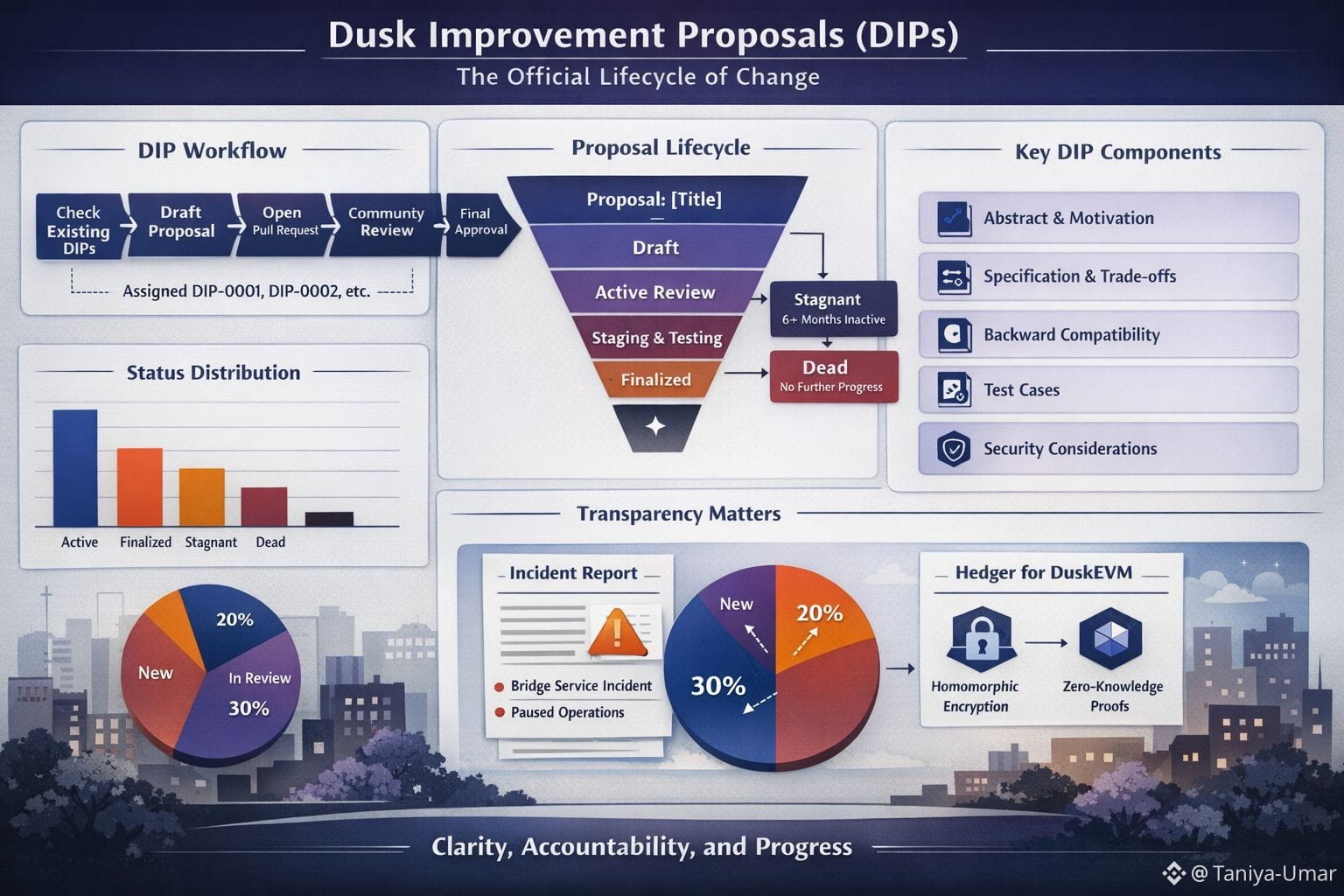
Dusk describes a DIP as a formal document for proposing a new feature, standard, or protocol adjustment, and also as a source of truth for the design decisions behind it. That second part is the real value. Technical debates often go sideways for human reasons. People remember different versions of the same discussion, or they inherit opinions without the context that shaped them. A written proposal forces clarity.
The workflow is simple on purpose. You check whether a similar proposal already exists, draft yours using the template, and open a pull request in the DIPs repository. Dusk standardizes the naming scheme—dip-0001 and so on—so proposals are easy to find and cite later. Dusk has also highlighted DIPs in its documentation revamp as the community path for submitting and implementing ideas. Review happens in the open. Editors and community members ask questions, request changes, and, if the idea holds up, accept it and assign it a number so it becomes part of the archive.
The process has a lifecycle. Dusk starts with an unnumbered “Proposal: [Title]” stage, moves into a structured draft, and expects an active feedback period where the first workable version exists. After that comes staging, which can include testing on Nocturne, Dusk’s testnet, before anything is treated as ready for production. If momentum fades, a DIP can be marked Stagnant, and after six months it may be considered Dead.
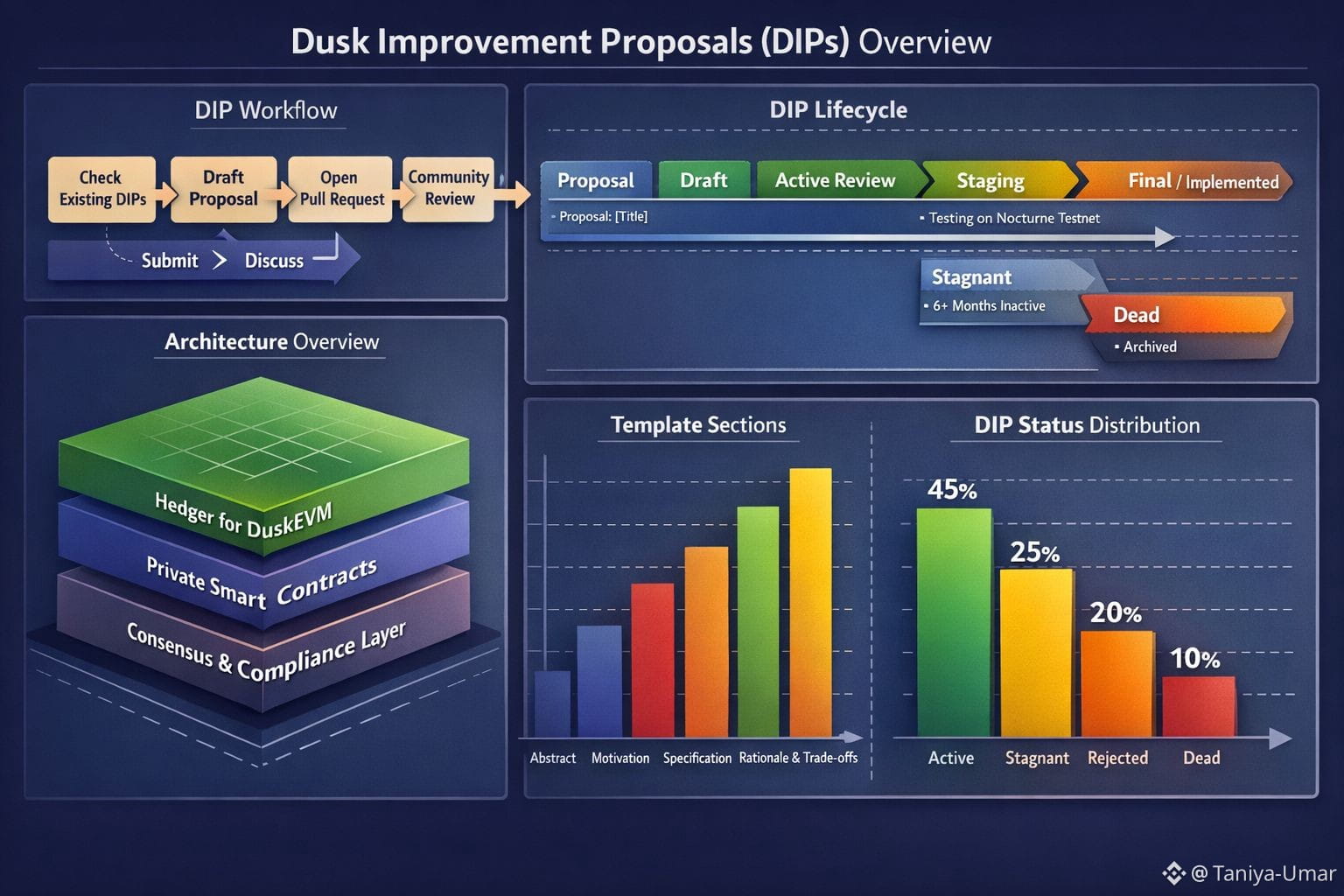
The template nudges authors toward hard questions early. Beyond the abstract and motivation, DIPs ask for a detailed specification, rationale and trade-offs, backwards compatibility notes, test cases, and security considerations. Those sections are where a proposal stops being a wish and starts being a commitment. In my view, the security and compatibility parts are where good proposals earn trust, because they show the author has thought about who might get hurt by a “small” change.
This feels timely for Dusk because the protocol is evolving in ways that make small decisions matter more. Dusk’s documentation emphasizes a modular architecture built for privacy and compliance, with core components handling different responsibilities across the stack. On the execution side, Dusk introduced Hedger for DuskEVM, a privacy engine that combines homomorphic encryption and zero-knowledge proofs so transactions can stay confidential while still supporting compliance needs. A hard balance worth documenting in writing.
Recent operational events have also made transparency feel less optional. In mid-January 2026, Dusk published a bridge services incident notice describing unusual activity involving a team-managed wallet used in bridge operations and the decision to pause bridge services as a precaution, alongside mitigation work and conditions tied to resuming parts of the rollout. It’s not a DIP, but it lives in the same family of habits: document what happened, publicly, before speculation writes the story for you.
If you’re outside the project, reading DIPs is a fast way to see what Dusk values when trade-offs get sharp. And if you’re contributing, writing one slows your thinking down until it becomes legible to other people. That slowing can feel like friction. Often, it’s the friction that prevents regret.