When I look at Plasma, I try to ignore the name, the positioning, and the usual crypto narratives. I start by asking a simpler question: what kind of financial behavior is this system designed to support, and what frictions is it actually trying to remove? From that angle, Plasma reads less like a general-purpose blockchain and more like a piece of financial plumbing built around a very specific reality — most real economic activity in crypto already happens in stablecoins.
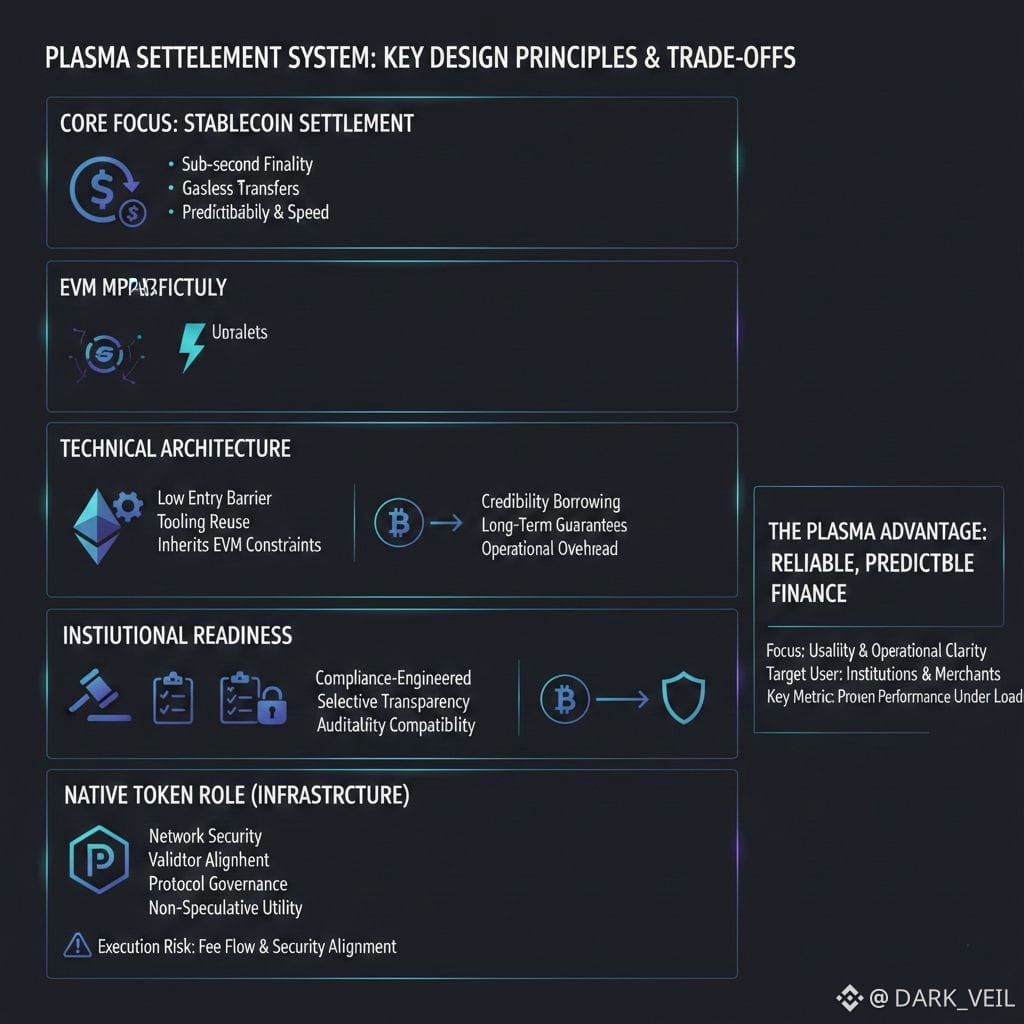
In practice, people don’t want volatility when they’re paying, settling, or moving working capital. They want certainty, speed, and clarity. Plasma’s entire design seems to accept this as a given. Sub-second finality matters here not as a technical flex, but because it changes how a transaction feels. A payment that clears almost instantly stops feeling like a speculative blockchain transfer and starts feeling like money doing what money is supposed to do. That shift in feeling is important, especially in markets where users already rely on stablecoins as day-to-day instruments rather than investment assets.
Gasless stablecoin transfers push in the same direction. Requiring users to hold a separate token just to move their own money has always been an artificial hurdle. Removing that step makes the system more legible to normal users and easier to explain to merchants or operators who don’t want to manage extra balance sheets. Of course, this convenience doesn’t come for free. Behind the scenes, someone is still paying for execution, handling relays, and managing risk. Plasma seems to accept that complexity at the protocol and infrastructure layer so users don’t have to deal with it directly. That’s a deliberate trade-off, not a shortcut.
From a builder’s perspective, full EVM compatibility is less about ideology and more about pragmatism. It lowers the cost of entry. Teams can reuse existing tools, contracts, and mental models. But it also means inheriting the constraints of the EVM, including assumptions around gas, state, and composability. Building stablecoin-first behavior on top of an EVM base requires care, because many contracts were never designed with stable-denominated fees or settlement-first usage in mind. Plasma doesn’t eliminate that friction; it just makes it manageable.
The Bitcoin-anchored security model fits the same pattern. It’s not trying to turn Plasma into Bitcoin or replace it. Instead, it borrows Bitcoin’s credibility as a neutral settlement layer to strengthen long-term security guarantees. For serious market participants, that matters more than slogans about decentralization. Anchoring introduces its own operational overhead and timing assumptions, but it also signals an understanding that settlement systems need credibility beyond fast blocks and optimistic assumptions.
Where things get more serious is at the institutional level. Payments, custody, and treasury operations live in a world of compliance, audits, and legal accountability. A chain optimized for stablecoin settlement has to coexist with those constraints, not fight them. Plasma appears to treat compliance, selective transparency, and accountability as engineering requirements rather than philosophical compromises. That doesn’t mean it’s fully solved, but it does suggest the system is designed with regulated environments in mind, not as an afterthought.
The native token, in this context, feels more like infrastructure than a speculative asset. Its role is to secure the network, align validators, and govern parameters, while actual economic activity flows through stablecoins. That structure makes sense for a settlement-oriented chain, but it puts pressure on execution. Validators need reliable incentives, and the system needs to prove that fee flows and security remain aligned over time, especially during periods of stress.
What ultimately matters is not how elegant the architecture looks on paper, but how it behaves under real usage. Can transactions stay fast and predictable when volume spikes? Do gasless transfers remain reliable, or do they degrade when infrastructure is stressed? Are anchoring and finality guarantees clear enough for risk teams to model? These are the questions institutions and serious operators will care about far more than narratives.
Plasma doesn’t present itself as a universal blockchain or a philosophical statement about the future of finance. It’s a focused attempt to make stablecoin settlement more usable, more predictable, and closer to how financial systems already operate. That narrow focus is its strength, but it also raises the bar for execution. If the system can prove reliability, operational clarity, and regulatory compatibility, it has a clear place in the market. If it can’t, no amount of vision will compensate.