
@Dusk For a long time, “compliant finance” and “blockchain” have felt like they live in different rooms. Public ledgers are excellent at proving what happened, but they’re also excellent at showing everyone everything. In real markets, that isn’t a quirky feature; it can be a deal-breaker. Trading strategies, client positions, and personal data are protected because markets rely on confidentiality as much as disclosure.
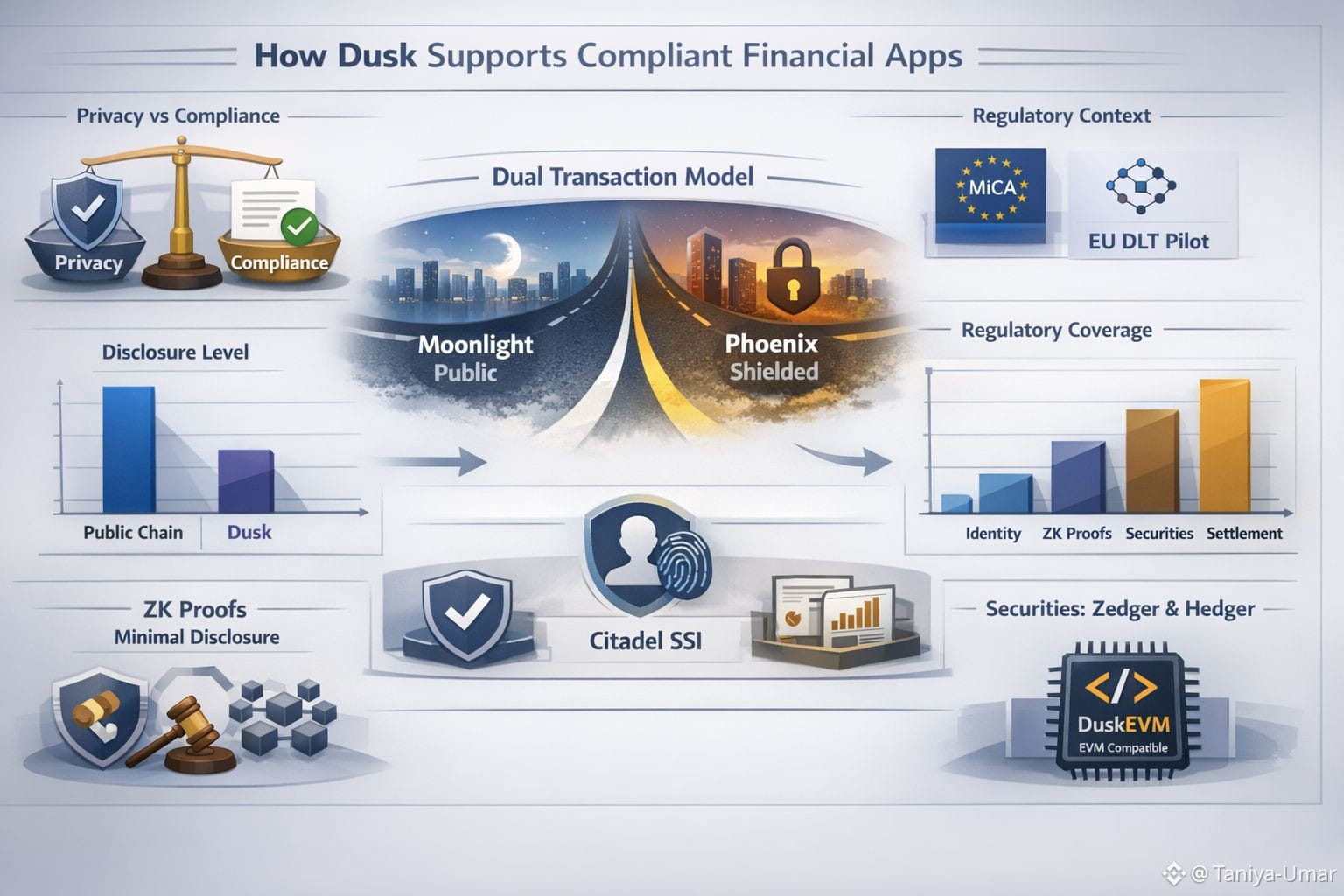
What’s different now is how concrete the tokenization conversation has become. Major institutions are experimenting with tokenized funds and more programmable settlement flows, and 2026 is widely framed as a year where tokenization starts to move from pilots to infrastructure decisions. Regulators are tightening the frame too. In Europe, MiCA is built around stronger transparency and supervision, including data standards aimed at market surveillance and comparable disclosures across firms. In parallel, the EU’s DLT Pilot Regime is testing how regulated market infrastructure can run on distributed ledgers, with the explicit possibility of extension if it proves out.
That’s the tension Dusk Network is built around. In its own documentation, Dusk describes itself as a privacy blockchain for regulated finance: a place where institutions can meet real regulatory requirements on-chain without forcing every user and every strategy into full public view. The idea isn’t to dodge oversight. It’s to avoid treating public transparency as the only path to accountability.
The most practical expression of this is Dusk’s dual transaction model. Moonlight supports public transactions for flows where transparency is the point, while Phoenix supports shielded transactions for confidential balances and transfers. Keeping both “lanes” on one network matters because regulated workflows are mixed. Some events should be plainly observable. Others should be provable without becoming public gossip or a permanent data leak.
Zero-knowledge proofs are the quiet workhorse underneath that choice. Dusk’s documentation and whitepaper describe native support for zero-knowledge proof primitives, so participants can prove a transaction followed the rules without publishing the underlying data to everyone forever. This is less “anonymity” and more “minimal disclosure.” In day-to-day compliance, most obligations are specific: prove eligibility, prove you respected a transfer restriction, prove you didn’t exceed a limit. When those checks can be enforced at transaction time, fewer problems get pushed into messy post-trade investigations and unwinds.
Identity is another pressure point that Dusk treats as part of the core problem. Its Citadel protocol is described as a self-sovereign identity system using zero-knowledge proofs, designed so identity rights can be stored privately on-chain while users can still prove specific claims when required. That lines up with the direction privacy law has been taking. Data minimisation is a core principle: collect only what is relevant and necessary for a stated purpose, and don’t keep or expose extra data “just in case.” If you’re building financial applications that must do KYC and eligibility checks, that principle isn’t academic. It changes what you can safely put on-chain, and what you should avoid making permanently linkable.
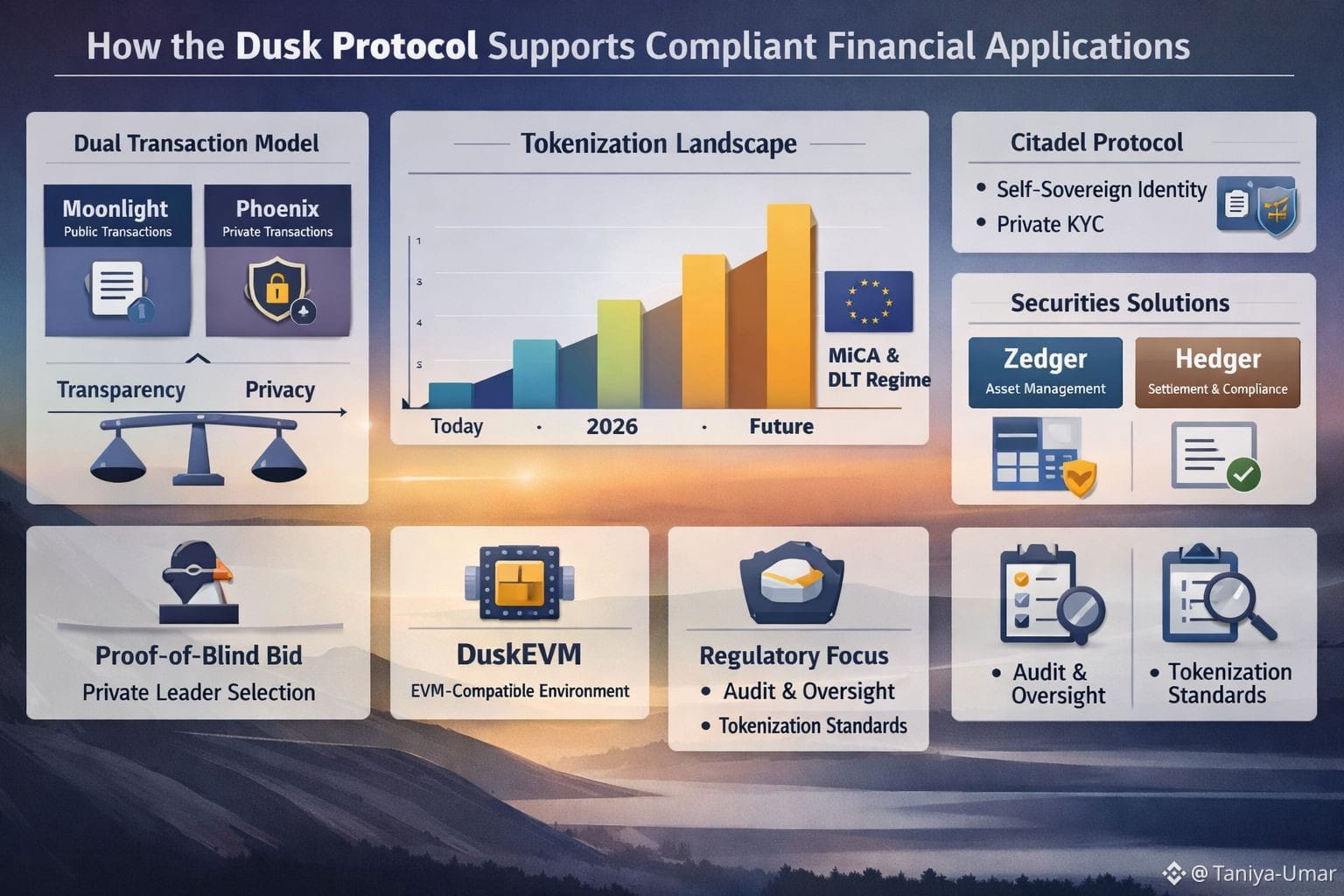
Dusk also gets unusually specific about securities use cases. Its documentation describes Zedger and Hedger as core components aimed at securities-related workflows, including lifecycle management and the compliance needs that come with regulated assets. This emphasis feels timely because regulators are starting to talk about tokenization risks in plain language. IOSCO, for example, has warned that tokenization can create investor confusion about whether they hold the underlying asset or a digital representation, and it highlights counterparty risks that can be introduced by third-party token issuers. A protocol that wants to be “finance-ready” has to assume those questions will show up in audits, disclosures, and supervisory conversations, not someday, but soon.
Even the plumbing leans into the same theme. Dusk’s whitepaper describes a privacy-preserving leader selection procedure (Proof-of-Blind Bid) inside its proof-of-stake consensus (SBA), alongside strong finality guarantees. For regulated applications, predictable settlement isn’t a nice-to-have; it’s what makes reporting, reconciliation, and operational controls tractable. And on the developer side, DuskEVM is positioned as an EVM-equivalent execution environment, which means teams can use familiar tooling while still settling to the Dusk stack and its compliance-and-privacy oriented design.
None of this magically removes the hard parts. Governance, legal clarity, and operational discipline still decide whether a system earns trust. But Dusk is easier to talk about in 2026 than it would have been five years ago because the conversation has gotten practical: privacy can’t be an afterthought, and compliance can’t be paperwork stapled on after settlement. If tokenization is going to scale, networks that are private by default, transparent when necessary, and designed with regulated markets in mind will have a serious seat at the table.