
@Walrus 🦭/acc Most of us don’t think about storage until it stops behaving like the quiet, dependable floor under everything else. A link breaks. A dataset won’t download. A video loads forever. And suddenly you’re reminded that “the cloud” is still a collection of systems with weak spots, shared dependencies, and moments where the wrong kind of failure can ripple outward.
That change in mood around storage is part of why decentralized approaches are getting another serious look right now. The work we’re doing has gotten heavier. AI pipelines pull in huge training sets and outputs. Teams ship products that are rich with media. And more organizations are under pressure to prove what data they used, when they used it, and whether it has been altered. In that environment, “safe” stops meaning “we copied it somewhere else.” It starts meaning availability when things are messy, integrity you can actually verify, and consistency that doesn’t crumble when someone tries to be clever.
Walrus Protocol is built for the kinds of files that regularly strain systems—big, messy blobs like images, videos, PDFs, and long-running archives. It’s positioned as a decentralized blob storage network from Mysten Labs (the team behind Sui), with a simple idea at the center: storage shouldn’t feel like a sealed-off box owned by one provider. It should be something apps can work with directly and predictably. The interesting bet here is not just decentralization for its own sake, but verifiability—being able to check what happened instead of trusting an operator’s promises.
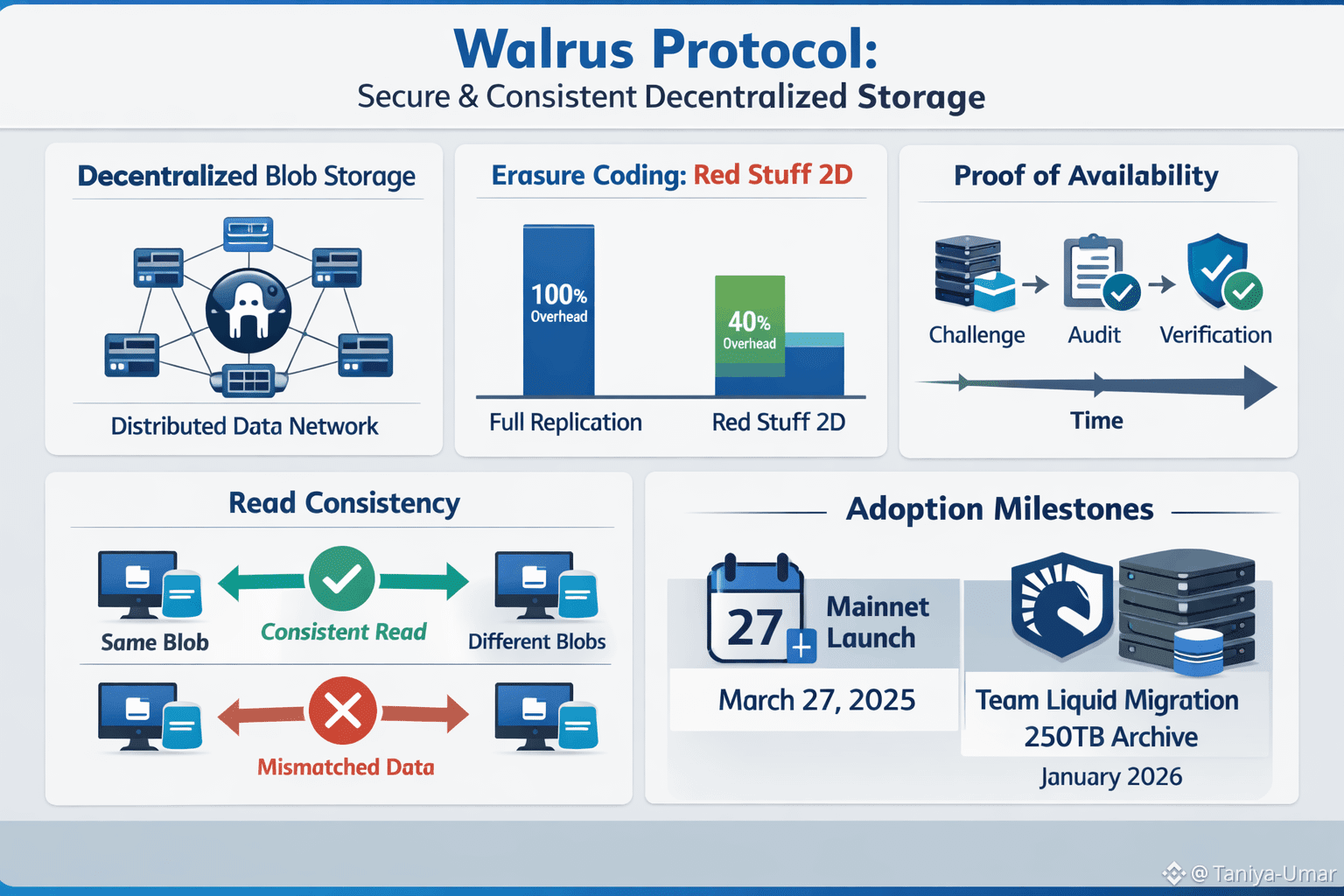
A big part of that comes down to redundancy. Many decentralized storage networks lean on full replication: store complete copies across many nodes and hope the economics work out. Walrus tries to reduce waste by splitting a blob into pieces and using erasure coding so the original can be reconstructed from a threshold of fragments. Its paper introduces a two-dimensional scheme called Red Stuff, designed to keep overhead lower while still recovering efficiently when some nodes fail or simply disappear. What I like about this framing is that it treats churn as normal. Nodes will reboot, drop off, or be replaced. A storage network that only works when participation is stable is a network that will surprise you at the worst time.
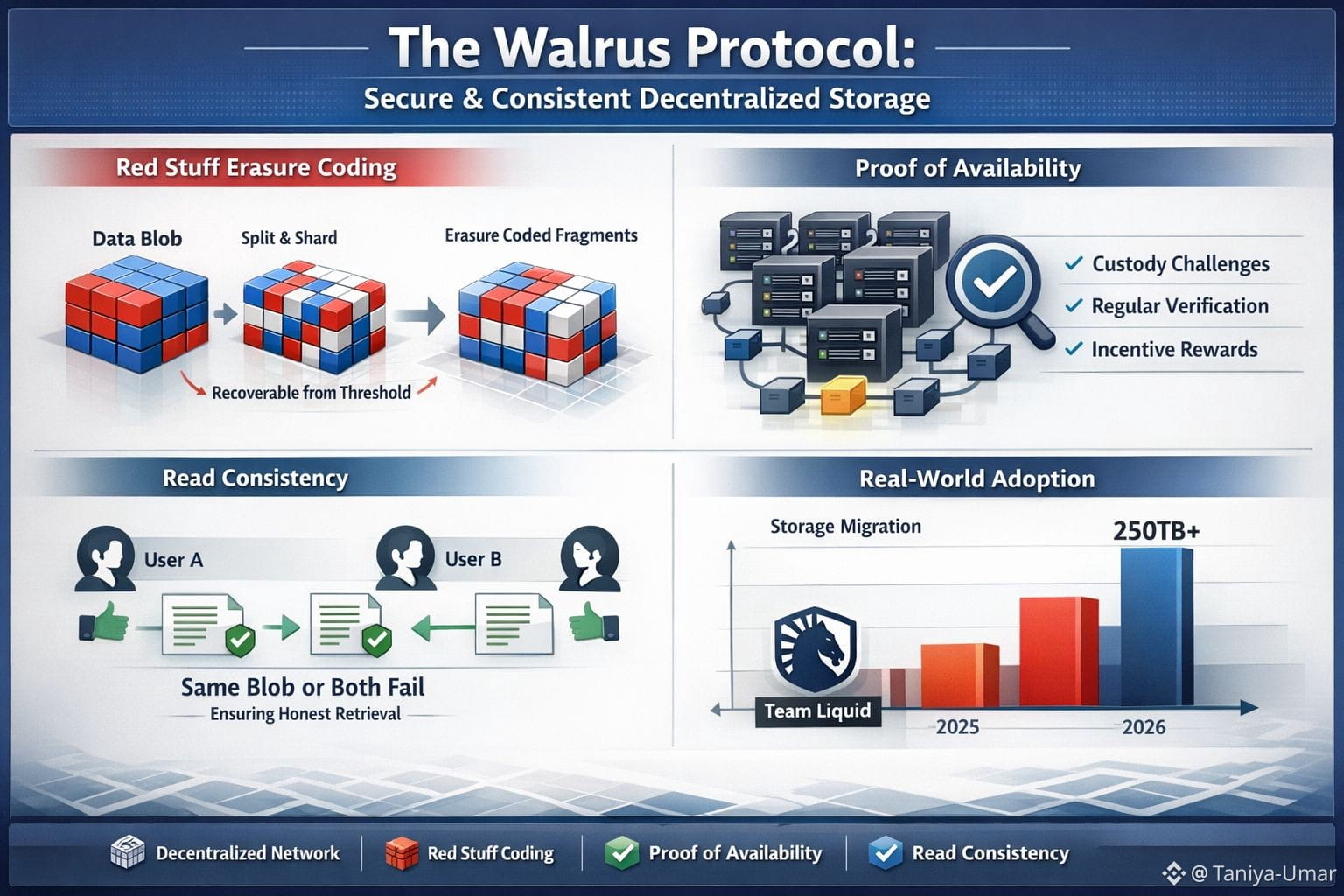
Security, in this world, also needs to be more than “we encrypted it.” Encryption helps, but it doesn’t solve the blunt problem of a node pretending to store data when it isn’t. Walrus leans on incentivized “proof of availability” ideas: storage nodes get challenged to demonstrate continued custody, in a way that’s meant to be robust even when the network is asynchronous and delays can be exploited. The point is subtle but important. If a system can be fooled by timing games, you don’t really have guarantees—just optimistic assumptions.
Then there’s consistency, which is the kind of promise people often skip past until they’ve lived through a disagreement. Walrus defines “read consistency” so that two honest readers either both retrieve the same blob or both fail, even if the writer is malicious. That might sound abstract, but it’s the difference between storage that supports trust and storage that creates disputes. If different people can be shown different “versions” of the same data, you don’t just have downtime—you have conflict.
Walrus also feels current because it’s already being used in ways that go beyond demos and test runs. Mainnet launched on March 27, 2025, and that changed the conversation from “could this work?” to “how are people using it?” Not long after, in January 2026, Team Liquid announced they were migrating a huge archive—over 250TB—onto Walrus. It’s the kind of move you only make when you’re trying to get away from brittle, siloed storage and toward something you can keep trusting as you grow. That kind of dataset is a useful reality check: it’s large, valuable, and operationally annoying to re-migrate. If decentralized blob storage can handle that smoothly, it’s a sign the category is growing up.
Walrus isn’t a silver bullet. You still need key management, access control, and basic operational discipline. But its approach—Red Stuff for efficient resilience, proof-of-availability for verifiable custody, and read consistency to keep retrieval honest—matches the direction the industry is moving. It’s less about hype and more about making storage behave like infrastructure you can reason about. In 2026, that’s not a niche concern. It’s plain risk management.