There is a particular kind of silence that only exists in serious places. Courtrooms before a verdict. Trading floors after a crash. The offices where compliance officers read regulations not as theory, but as risk. Dusk was born in that silence not from utopian dreams of financial rebellion, but from a sober realization that most of the world’s money cannot operate under a floodlight.
Public blockchains, for all their radical transparency, created a paradox the moment institutions looked closely. Every transaction visible forever. Every balance traceable. Every counterparty exposed. What works for hobbyists and retail speculation collapses under the weight of regulated finance, where confidentiality is not a luxury but a legal obligation. Dusk’s founders understood this early. In 2018, while much of the crypto world was still drunk on maximalist ideology, they asked a quieter, more dangerous question: what if finance moves on-chain only when it can keep its secrets?
That question shapes everything about Dusk. It is not a blockchain that shouts. It does not promise revolution through chaos. It behaves more like an architect invited into a centuries-old financial system and told to reinforce it without disturbing the façade. Its ambition is not to replace institutions, but to give them a new nervous system one that can feel, prove, and settle value without exposing its organs to the public eye.
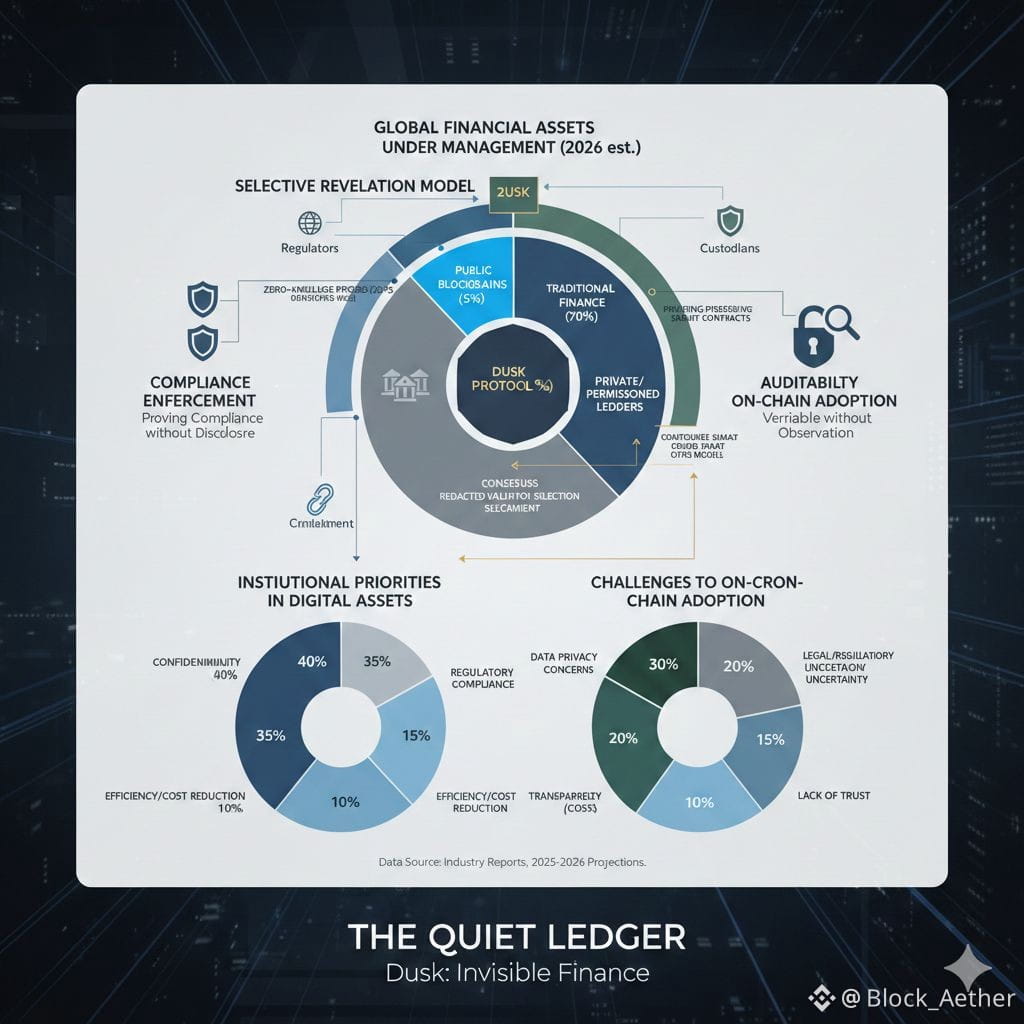
At the heart of Dusk is a philosophical compromise that most blockchains avoid. Privacy is not absolute. Transparency is not default. Instead, information becomes conditional. Data exists, but it does not automatically reveal itself. Ownership can be proven without being displayed. Compliance can be demonstrated without disclosure. This idea selective revelation is not new in cryptography, but Dusk is among the few attempting to build an entire layer-1 around it, end to end, without apology.
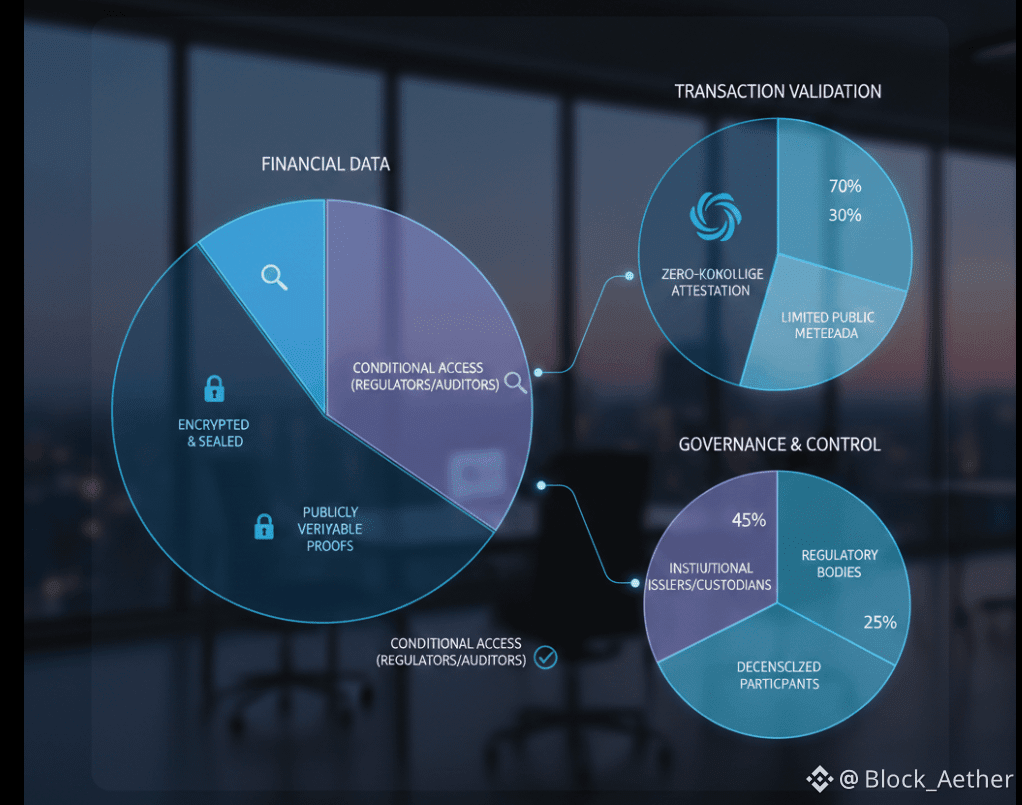
To understand why that matters, imagine a regulated asset a bond, an equity, a tokenized share in real estate. Its lifecycle is governed by rules: who can buy it, who can hold it, when it can move, how it must be reported. On a public blockchain, enforcing these rules means embedding identity, balance, and behavior into a ledger that never forgets. That is operationally reckless. Dusk’s system flips the equation. The rules are enforced cryptographically, and their enforcement can be proven, but the underlying data remains sealed unless a specific authority is allowed to see it.
This is where Dusk’s technology becomes less about code and more about power. Zero-knowledge proofs are not just math tricks here; they are instruments of negotiation. A participant can prove they are compliant without revealing why. An issuer can demonstrate lawful issuance without disclosing sensitive corporate details. A regulator can audit a transaction without opening the entire market to surveillance. Knowledge becomes granular, controlled, and critically revocable.
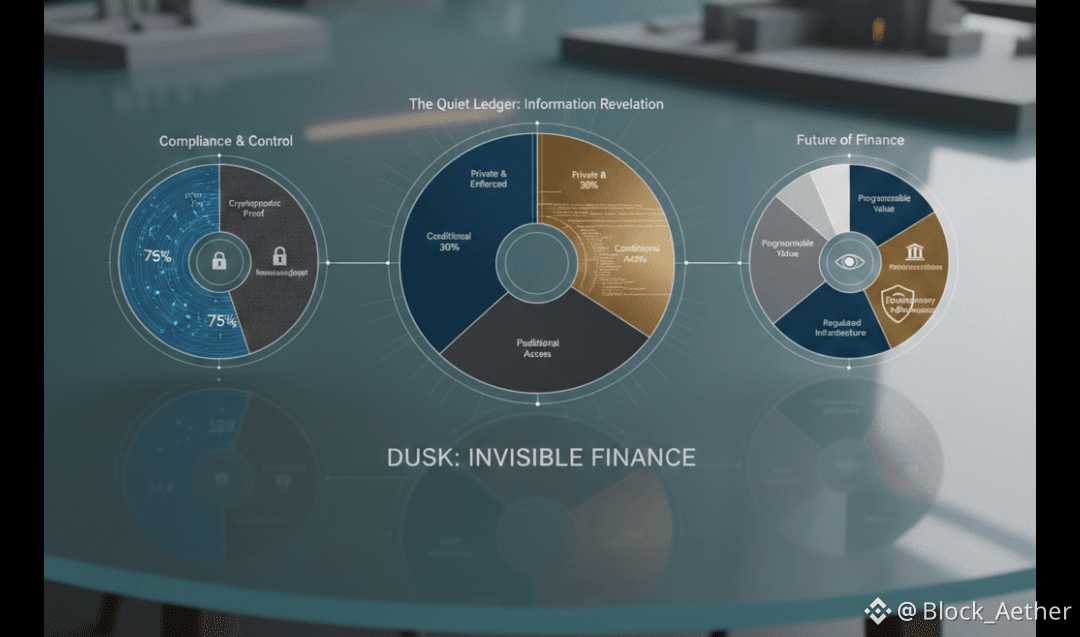
The blockchain itself reflects this mindset. Dusk does not follow the account-based model popularized by Ethereum. It leans toward a privacy-aware structure inspired by UTXOs, but adapted for regulated assets. Transactions are not simply state changes; they are cryptographic statements about legitimacy. The virtual machine is built to treat zero-knowledge verification as a native behavior, not an add-on. Smart contracts do not merely execute they attest.
Even consensus carries this restraint. Validator selection and participation are designed to reduce exposure, minimizing the ways actors can be targeted or coerced. The chain finalizes quickly, not for bragging rights, but because institutional finance does not tolerate ambiguity. Settlement delays are not philosophical debates; they are balance-sheet risks.
Yet for all its precision, Dusk is not a neutral machine. It carries tension in its design. Privacy protects institutions, but it also shelters them. Reduced transparency lowers the risk of front-running and corporate espionage, but it can also obscure systemic danger. History has shown that opacity in financial systems does not remove risk it relocates it, often into corners that collapse without warning. Dusk’s answer is auditability by proof rather than observation. Whether that proves sufficient in moments of stress remains an open question.
There is also a quieter tension between ideology and reality. Dusk does not chase the dream of radical decentralization. It accepts that certain actors regulators, issuers, custodians will always have asymmetric authority. Instead of fighting that hierarchy, it tries to encode it safely. This makes Dusk less attractive to purists and more interesting to people who actually run markets. It is a blockchain that assumes law will continue to exist.
That assumption may be its greatest risk and its greatest strength. If regulators learn to trust cryptographic proofs as legitimate instruments of oversight, Dusk becomes a bridge between centuries of financial infrastructure and programmable settlement. If they do not, Dusk remains an elegant machine waiting for permission.
The human psychology behind all of this is revealing. Institutions do not fear blockchains because they are complex; they fear them because they are too honest. Dusk offers a different kind of honesty one that speaks when asked, not constantly. It mirrors how power already operates in traditional finance, where information is shared deliberately, not freely. In that sense, Dusk is less a disruption than a mirror held up to the existing order, polished with cryptography.
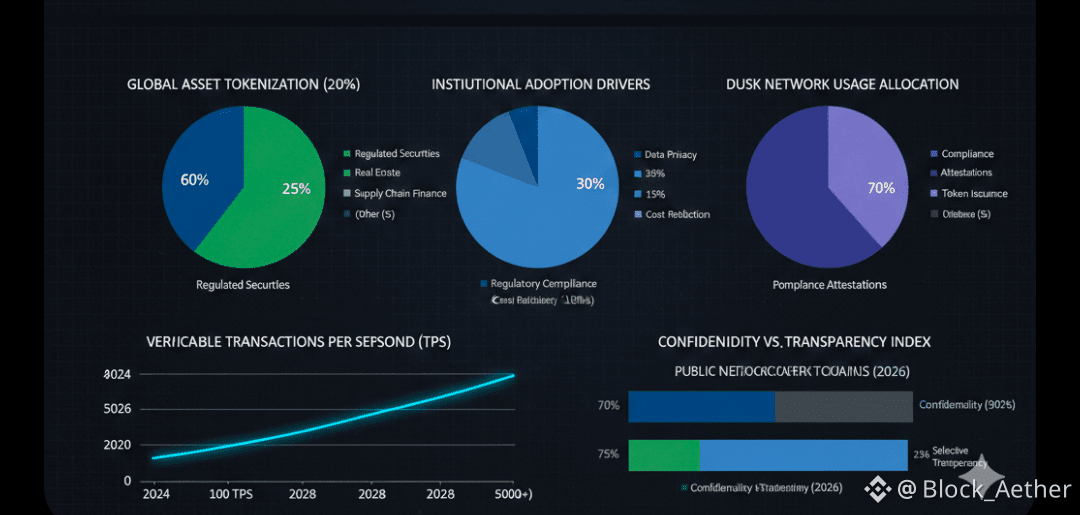
Where this leads is uncertain. Tokenized securities are still experimental. Legal recognition of on-chain proofs varies wildly by jurisdiction. Trust between governments and cryptographic systems is fragile. But the direction of travel is clear. Capital wants efficiency. Regulators want control. Institutions want discretion. Dusk sits precisely at that intersection, uncomfortable and necessary.
If public blockchains were the shouting phase of crypto loud, transparent, defiant Dusk represents the whisper that follows, when the real negotiations begin. It suggests a future where finance does not become visible to everyone, but verifiable to the right ones. A future where blockchains stop performing ideology and start performing infrastructure.
Whether that future is liberating or constraining depends on who holds the keys, who writes the laws, and who decides when the veil may be lifted. Dusk does not answer those questions. It simply builds the mechanism that makes them unavoidable.