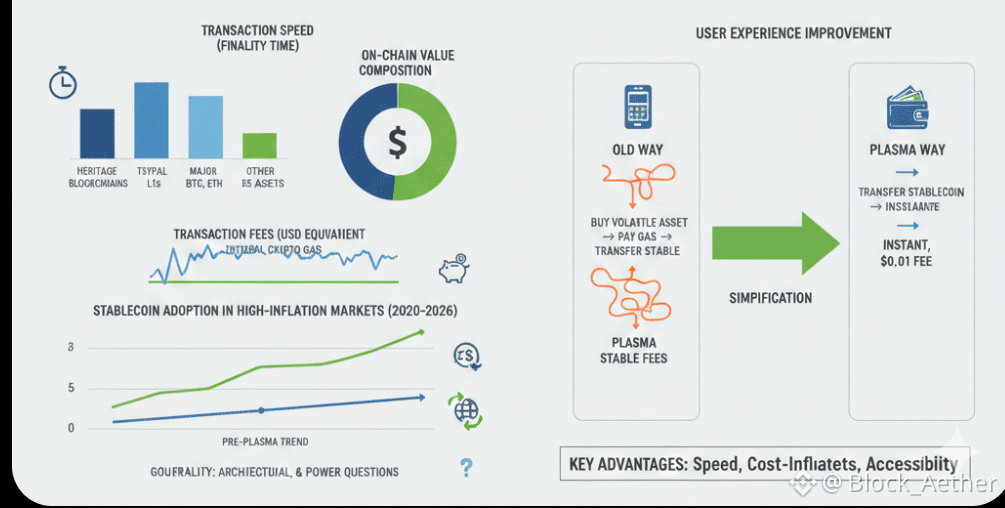
Money has always revealed its true nature not in moments of spectacle, but in moments of trust. When a payment clears instantly. When a transfer does not fail. When nothing dramatic happens at all. Plasma is built for those moments. It does not arrive waving ideology or promising a financial uprising. It arrives with something more unsettling and more ambitious: the suggestion that the future of global money will be decided not by slogans, but by settlement.
For more than a decade, blockchains have chased a certain myth. Faster chains, cheaper chains, more expressive chains. Yet beneath that race, a quieter reality formed. Stablecoins became the dominant medium of value on-chain, not because they were philosophically pure, but because they worked. Dollars, anchored imperfectly to banks and balance sheets, became the bloodstream of crypto. And yet the systems carrying them were never designed for money that wanted to behave like money. Plasma begins where that contradiction becomes impossible to ignore.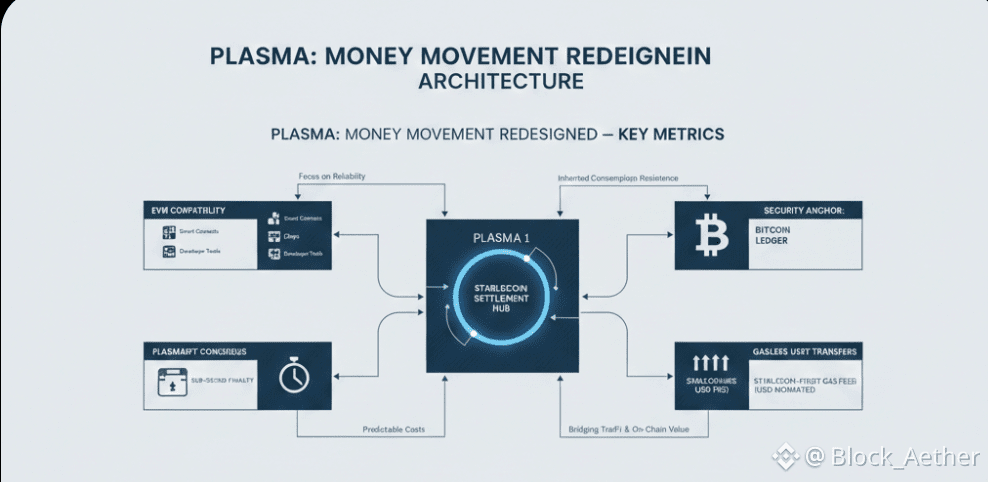
Plasma is a Layer 1 blockchain designed around a single gravitational center: stablecoin settlement. Everything else is subordinate. The choice to be fully EVM-compatible is not a nod to trend but to gravity. Developers live in Ethereum’s ecosystem. Tooling, habits, mental models are already there. Plasma does not ask them to relearn how to think; it asks them to rethink what they are building for. Its execution layer, based on Reth, carries that familiarity forward, while PlasmaBFT compresses time itself, delivering sub-second finality that makes payments feel less like transactions and more like gestures.
Speed alone would mean nothing if it were fragile. Plasma’s deeper bet is that neutrality is not a philosophical state, but an architectural one. By anchoring its security to Bitcoin, the network borrows gravity from the oldest and most battle-tested ledger in existence. This is not romanticism. It is a practical admission that censorship resistance is easier to inherit than to invent. Bitcoin becomes a silent witness, an external memory that raises the cost of rewriting history. Plasma does not replace Bitcoin’s role; it leans on it, quietly.
What makes Plasma feel different is not how fast blocks finalize, but how invisible the chain tries to become to the end user. Gasless USDT transfers are not a gimmick. They are an acknowledgment that asking people to hold a volatile asset just to move stable money is a design failure. Stablecoin-first gas reframes the economics of blockspace around human intuition. Fees priced in dollars do not fluctuate with sentiment or speculation. They behave like infrastructure costs, not casino odds. This is what it looks like when a blockchain stops performing for crypto natives and starts listening to everyone else.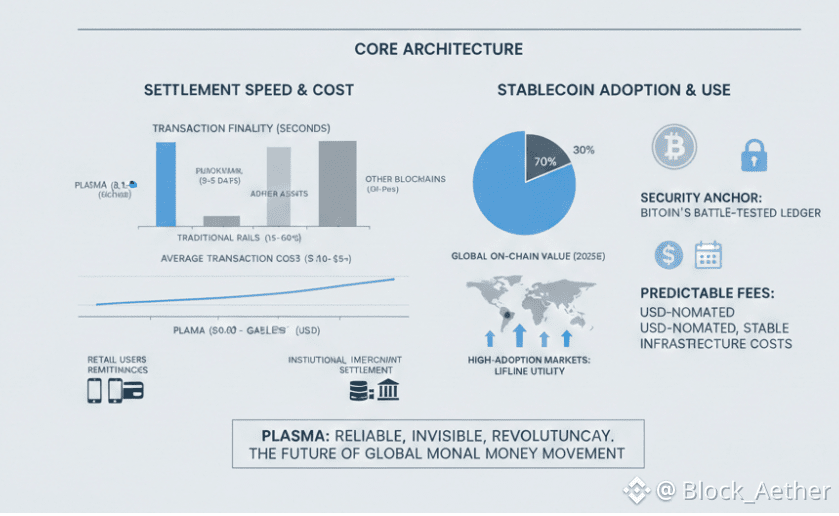
There is a reason this design resonates most strongly in high-adoption markets. In places where inflation is not theoretical and banking access is conditional, stablecoins are not abstractions. They are lifelines. Plasma’s architecture speaks directly to those realities, even if it does so without rhetoric. At the same time, its structure is legible to institutions that require predictability, auditability, and finality that means what it says. Retail users and payment desks are rarely aligned. Plasma is attempting to serve both by narrowing its focus rather than broadening it.
That focus carries tension. A blockchain optimized for stablecoins inevitably orbits their issuers. Close alignment with major stablecoin players accelerates adoption, liquidity, and trust, but it also sharpens questions about power. Who decides what is allowed to settle? Who can intervene, and under what circumstances? Plasma’s design choices do not dissolve these questions; they expose them. In doing so, the chain reflects an uncomfortable truth about money itself: neutrality is never absolute, only defended.
Consensus mechanisms like PlasmaBFT reveal another layer of this reality. Fast, deterministic finality requires coordination. Coordination requires known participants. This is not a flaw so much as a confession. Payment systems have always traded radical openness for reliability. Plasma chooses reliability, but it does so with guardrails meant to prevent quiet capture. Whether those guardrails hold under pressure is not something whitepapers can prove. It is something time will test.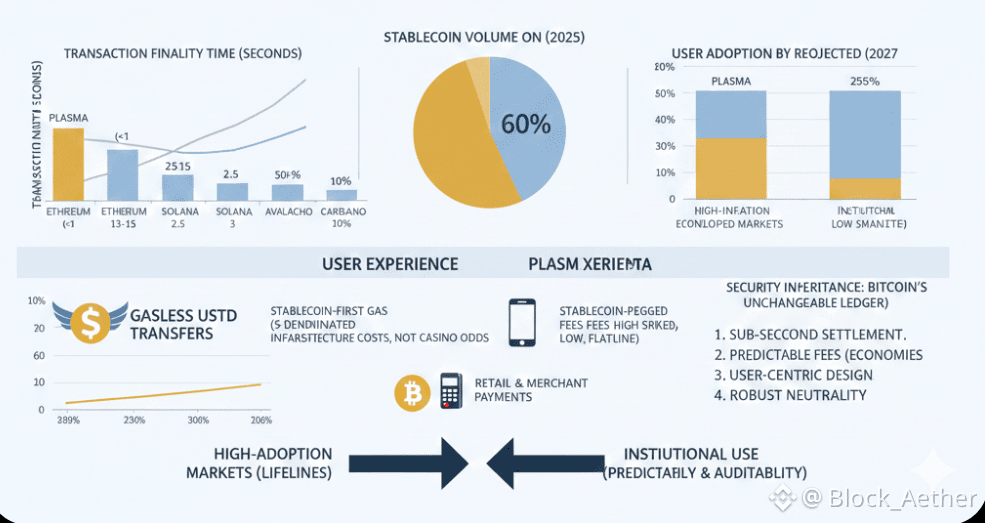
What emerges is not a utopia or a threat, but an inflection point. If Plasma succeeds, it will normalize the idea that blockchains are not destinations but rails. That their job is not to be admired, but to disappear. Remittances will not feel like crypto. Merchant settlement will not feel like finance. It will feel like infrastructure finally behaving as expected. And in that disappearance, power will shift. Not loudly, but permanently.
The risk is not failure. The risk is success without scrutiny. A world where stablecoin settlement becomes faster, cheaper, and more centralized without the governance to match its reach would simply recreate old hierarchies with new tooling. Plasma’s anchoring to Bitcoin, its EVM openness, its public posture toward neutrality are all attempts to avoid that fate. Whether they are enough depends less on code than on the culture that forms around it.
Plasma exists because the world already chose stablecoins. It exists because money does not care about ideology, only about movement. The question it poses is unsettling in its simplicity: if dollars are already on-chain, what kind of chain do they deserve? The answer Plasma offers is disciplined, restrained, and quietly radical. Not because it promises a new financial order, but because it understands that the most powerful revolutions in money are the ones that feel boring—until you realize everything has changed.