

Here’s the big idea: Dusk isn’t about chasing the latest trend or claiming to be the next Ethereum. Instead, it’s purpose-built as a blockchain designed specifically for regulated privacy—a platform where confidentiality and compliance aren’t mere add-ons, but foundational principles brought to the forefront from the very beginning.
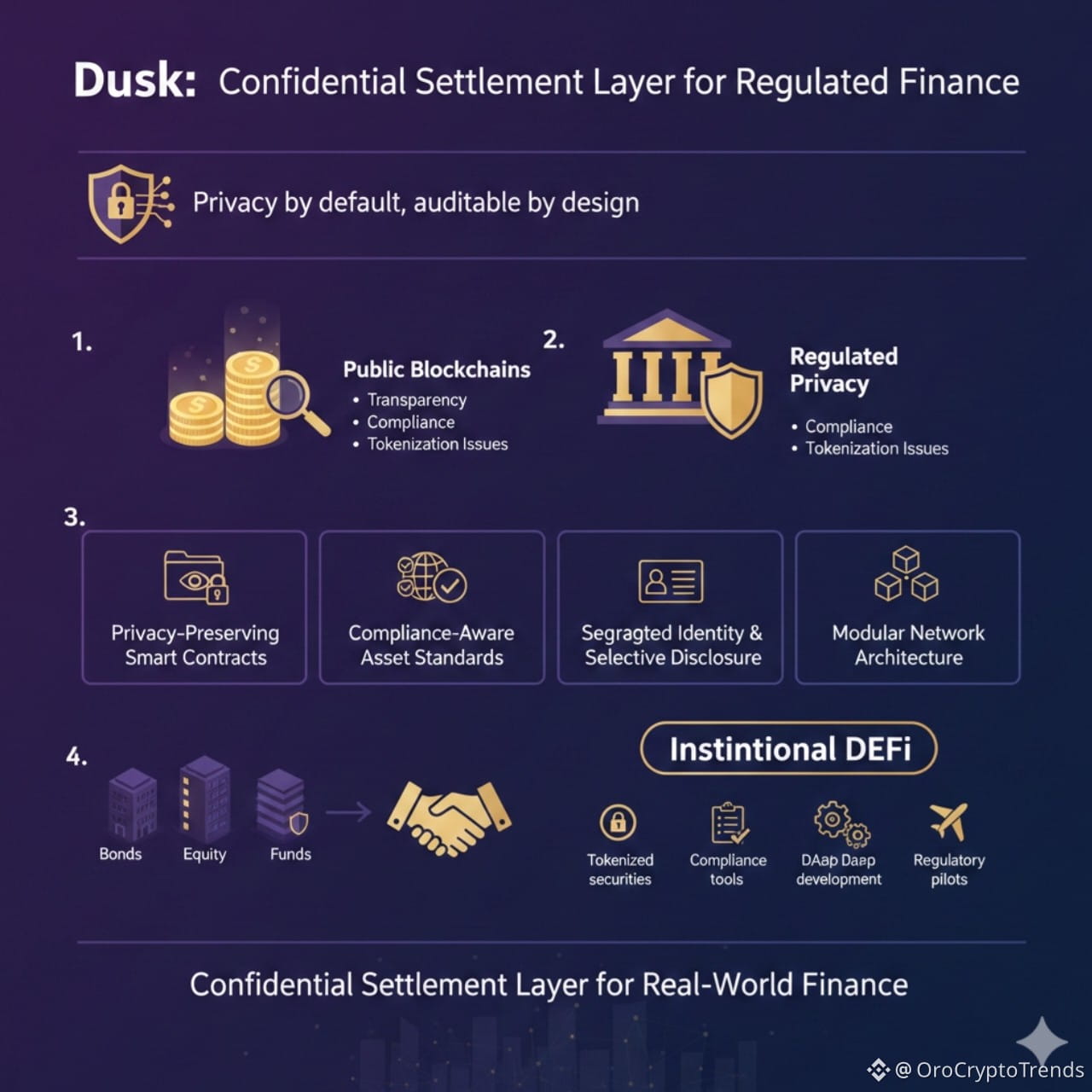 Most existing blockchains operate under the assumption that greater transparency equals greater trust. Every transaction, every wallet address, every balance is exposed for all to see, creating a system where privacy is essentially an afterthought—if you want it at all, you’re left to patch it on awkwardly, often at the cost of usability or decentralization.
Dusk completely reverses this paradigm. In the real world of finance—especially for regulated players like banks, asset managers, and other institutional entities—total transparency isn’t just impractical, it’s often impossible. These organizations have a legal and fiduciary responsibility to protect sensitive information, from trading strategies to client data. They need privacy and accountability, both seamlessly embedded into the infrastructure from the outset, not weakly layered on after the fact.
Rather than trying to retrofit compliance onto a public ledger, Dusk starts with a single, uncompromising principle:
Financial infrastructure must be private by default and auditable by design.
This approach carves out a unique position for Dusk. It doesn’t aim to be a universal blockchain that can host every conceivable application. Instead, it zeroes in on serving as the backbone for regulated markets—supporting tokenized securities, compliant DeFi protocols, and facilitating the kind of capital flows that institutions demand, all while meeting strict regulatory requirements.
—
Why Public Blockchains Are a Poor Fit for Institutions
Here’s the core issue: the architecture and assumptions behind most public blockchains fundamentally clash with what regulated finance actually requires.
Let’s break down the main pain points:
1. Excessive Transparency, Insufficient Privacy
Large institutions simply cannot afford to reveal their trading positions, counterparties, or asset allocations to the open internet. On traditional blockchains, anyone—from competitors to malicious actors—can instantly access this data. This level of transparency, while ideal for public cryptocurrencies, is a nonstarter for entities handling sensitive, high-value transactions.
2. Compliance That Sacrifices Privacy or Decentralization
Regulators worldwide demand robust KYC, AML, and other compliance measures. However, the way most blockchain identity solutions are constructed either forces users to give up their privacy entirely or relies on centralized intermediaries—undermining the very principles of decentralization and introducing new security and trust concerns.
3. Assets That Lack Enforceable Legal Controls
For real-world assets—like equities, bonds, or structured products—to exist on-chain, there must be enforceable rules governing ownership, transfer restrictions, and corporate actions. The vast majority of DeFi protocols lack the native capability to enforce these rules at the protocol level, making them unsuitable for regulated financial products.
Dusk was conceived from the ground up to address these challenges head-on, weaving privacy and regulatory compliance into the very fabric of its protocol.
—
How Dusk Works: A Deep Dive into the Tech Stack
1. Privacy-First Smart Contracts
Dusk leverages advanced zero-knowledge cryptography within its smart contract engine. This allows complex financial logic—such as order matching, settlement, and balance checking—to be executed in a way that preserves privacy. Sensitive details remain encrypted, and only parties with the appropriate permissions can access them, while the network can still verify the integrity and correctness of every transaction.
For users and developers, this emulates the confidentiality of traditional finance: business activities are shielded from public view, yet the underlying transactions are immutable and trustless, settling on-chain with full auditability.
—
2. Compliance as a Core Asset Standard
On Dusk, compliance isn’t an afterthought—it’s programmable. Token standards natively support the embedding of regulatory rules, such as transfer restrictions, whitelisting/blacklisting, and jurisdiction-based controls. These rules are enforced automatically every time an asset moves, eliminating the need for cumbersome, error-prone off-chain compliance processes.
For issuers, this means regulatory obligations are hardcoded into the protocol, significantly reducing operational risk and legal uncertainty. This opens the door for real-world securities—like stocks, bonds, and funds—to be tokenized and managed on-chain, with confidence that compliance is maintained throughout the asset’s lifecycle.
—
3. Private Identity with Selective Disclosure
Instead of forcing users to reveal their entire identity to the network, Dusk employs cryptographic proofs—such as zero-knowledge credentials—that enable selective disclosure. Participants can prove they meet regulatory requirements (for example, being an accredited investor or resident of a specific jurisdiction) without revealing their name, address, or other personal details to everyone.
The end result is a delicate balance: participants maintain their privacy and autonomy, while institutions and regulators can be certain that all actors are fully compliant. This bridges the gap between the radical openness of DeFi and the rigorous controls of traditional finance, making it possible for both worlds to interact securely.
—
4. Flexible, Modular Protocol Architecture
Dusk’s architecture is carefully modularized, with privacy mechanisms, smart contracts, and asset logic separated into distinct layers. This design allows for rapid adaptation: if cryptographic standards evolve or new regulatory requirements emerge, individual modules can be updated or replaced without disrupting the entire network.
For institutions, this modularity is essential. It means their infrastructure investment is future-proof—they’re not locked into a brittle system that could quickly become obsolete or non-compliant as the regulatory landscape shifts.
—
Dusk’s Institutional Entry Strategy
Unlike many blockchains that focus on retail adoption and speculative hype, Dusk’s rollout is deliberately targeted at institutional use cases. It’s not built for “ape in and hope” speculation, but instead seeks to solve real, high-value problems facing financial markets.
Here’s where Dusk is concentrating its efforts:
1. Tokenized Securities and Real-World Asset Issuance
Dusk is engineered to facilitate the issuance and management of regulated financial instruments—equity tokens, bonds, investment funds, and structured products. These are assets that regulators watch closely, and where compliance isn’t optional. Dusk’s ability to encode and enforce regulatory logic at the protocol level is a crucial differentiator that makes it viable for institutions.
2. Institutional-Grade DeFi
Rather than supporting the free-for-all, unregulated world of yield farming and open liquidity pools, Dusk enables permissioned and semi-permissioned DeFi protocols. Here, counterparties are verified and trusted, but sensitive details such as trade sizes, strategies, and positions remain confidential. This model appeals to institutional players who need to manage risk and comply with regulations, but still want the benefits of blockchain-based settlement and automation.
By directly addressing the unique needs of regulated entities, Dusk aims to unlock entirely new markets for on-chain finance—bridging the gap between the privacy and control that institutions require and the transparency, programmability, and efficiency that define the blockchain era.
