
Blockchain has always arrived in bursts of attention headlines, rapid adoption, excitement over possibility. In its early years, the world watched networks promise freedom, speed, and innovation. Yet beneath the surface of these promises, reality often struggled to catch up. Systems faltered under the weight of real-world expectations. Transactions were unpredictable. Privacy was optional. Reliability was secondary. The gaps between vision and practical use became apparent, particularly for institutions and regulated markets, where precision, compliance, and continuity are not luxuries they are requirements.
@Dusk moves differently. It does not seek to dazzle or impress. It exists quietly, deliberately, as a foundation beneath the surface of digital finance. It is patient. It is steady. It is deliberate. Founded in 2018, Dusk was conceived as a layer 1 blockchain for regulated and privacy-conscious spaces. Its architecture is modular, designed to support complex financial applications, tokenized assets, and compliant decentralized finance. Privacy and auditability are not features retrofitted onto the network; they are built into its core. Every transaction, every contract, every settlement is measured, predictable, and auditable. These qualities allow institutions to operate with confidence, and individuals to engage without hesitation, knowing that the network will perform as promised.
In Dusk, reliability is not accidental. The network anticipates the needs of its users, integrating automation and AI to maintain continuity and smooth operation. These systems do not act as replacements for oversight they function as silent companions. They monitor activity, anticipate bottlenecks, and adjust flows to maintain consistency. AI observes patterns, detects anomalies, and ensures that operations continue seamlessly. In doing so, the network achieves a rare balance: it is responsive, yet unobtrusive; intelligent, yet calm.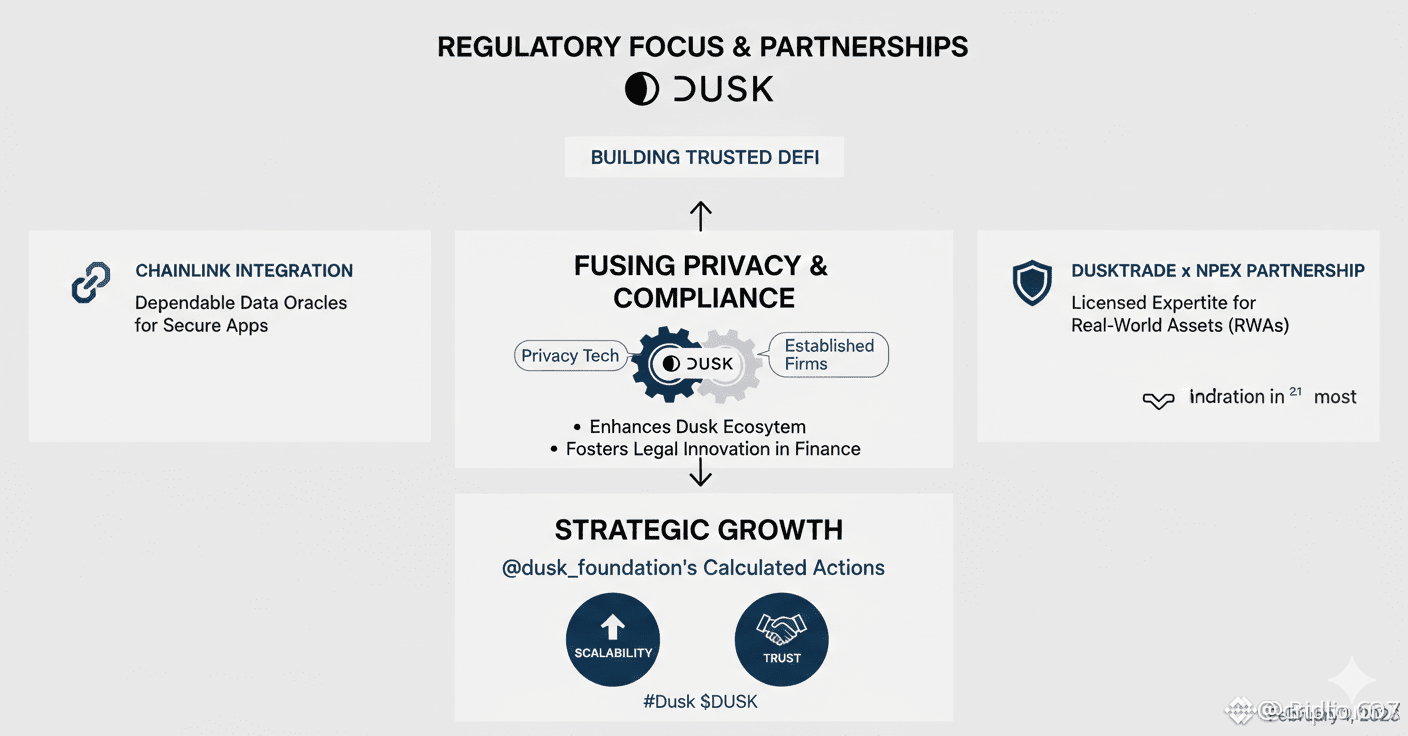
Decentralization in $DUSK is deliberate. It is not a philosophical abstraction, nor a marketing point it is a measured, purposeful choice. Autonomy is preserved, but not at the expense of predictability. Open participation exists alongside discipline. Freedom is balanced with reliability, and structure coexists with flexibility. The network operates neither as a rigid, centralized system nor as an ungoverned expanse of nodes. Instead, it functions like a living organism, each part performing its role in a larger, coordinated rhythm. The result is a system that is robust, adaptable, and enduring, capable of supporting both human activity and institutional processes without faltering.
Security, in Dusk, is both technical and philosophical. Anchored in principles that prioritize continuity, it draws strength not from flashy mechanisms but from design that anticipates the challenges of a regulated, privacy-conscious environment. Every operation is auditable; every flow of value is protected by systems that ensure compliance and reliability. Security becomes more than a technical measure it becomes a social promise. It is a form of trust communicated silently to every participant, a guarantee that the network will uphold its commitments consistently and without interruption.
The true power of Dusk is its invisibility. The most profound impact of a system like this is rarely seen in a single transaction or moment of attention. Adoption is not explosive; it is gradual, patient, cumulative. Every successful, unnoticed interaction reinforces trust. Every moment of frictionless operation builds confidence. Every unseen correction, every automated adjustment, adds to the quiet reassurance that the network will continue to function as expected. In these invisible moments, the architecture of trust is constructed, layer by layer, until it becomes a natural part of human and institutional life.
Dusk’s design also reflects a broader understanding of how finance operates in the real world. Stable operations, predictable outcomes, and compliance are not features they are necessities. Tokenized real-world assets can flow seamlessly across the network. Financial applications can operate with certainty, even as complexity increases. Privacy ensures that sensitive data remains protected, and auditability allows institutions to maintain oversight without compromising confidentiality. These principles allow Dusk to support both human-scale and enterprise-scale activity, bridging the gap between blockchain’s promise and the practical demands of regulated finance.
In this, there is a lesson for the broader future of blockchain. Systems that endure are rarely those that seek attention. Their value lies not in speed, novelty, or spectacle, but in predictability, reliability, and thoughtful design. Technology becomes meaningful not when it is visible, but when it works unnoticed, consistently, and faithfully. Dusk embodies this philosophy. Its greatest achievements are the moments when it functions seamlessly, without fanfare, supporting life, commerce, and institutional operations alike.
Automation and AI, here, are not tools of efficiency alone—they are instruments of resilience. By observing patterns, predicting disruptions, and adjusting flows, the network sustains itself while remaining unobtrusive. Participants rarely notice these interventions, yet their presence is felt in the smooth continuity of operations. Decentralization, similarly, is not an abstract ideal. It is an enabler, ensuring freedom while preserving the consistency required for trust. In Dusk, technology does not dominate human activity—it harmonizes with it, operating silently in the background, allowing commerce, connection, and creativity to unfold without disruption.
The quiet constancy of Dusk also teaches us that adoption is a slow and deliberate process. Regulatory frameworks, institutional participation, and human confidence cannot be rushed. True adoption is built transaction by transaction, interaction by interaction, over time. The network earns trust not through announcements, hype, or dramatic demonstration, but through repeated proof that it can be relied upon. In this sense, Dusk is not just a network it is a philosophy of patience, a framework for sustained confidence in the digital era.
Ultimately, Dusk gestures toward a future of blockchain that is both technical and human. It demonstrates that networks can be decentralized and predictable, private and auditable, intelligent yet unobtrusive. It reminds us that infrastructure is most valuable when it is invisible, and trust is most profound when it is earned quietly, steadily, and consistently. In Dusk, technology becomes a partner, not a spectacle; a pulse beneath the digital economy, not a flash of attention.
In its calm, persistent rhythm, Dusk shows us a path forward: a blockchain designed for the realities of financial life, for systems that endure, for trust that is tangible yet invisible. It is a network built to support human and institutional activity alike, quietly, reliably, and with purpose. Its greatest achievement is its consistency, its most profound gift is the confidence it inspires, and its deepest promise is the assurance that the digital systems we rely upon will continue to function, faithfully and unobtrusively, for years to come.
In this steady presence, the essence of blockchain’s future is revealed not in speed, spectacle, or fleeting excitement, but in networks that endure, adapt, and earn trust quietly. Dusk is that network. It is the silent pulse beneath the digital world, the foundation for a future in which technology serves life, commerce, and humanity without interruption, without fanfare, and with unwavering constancy.
