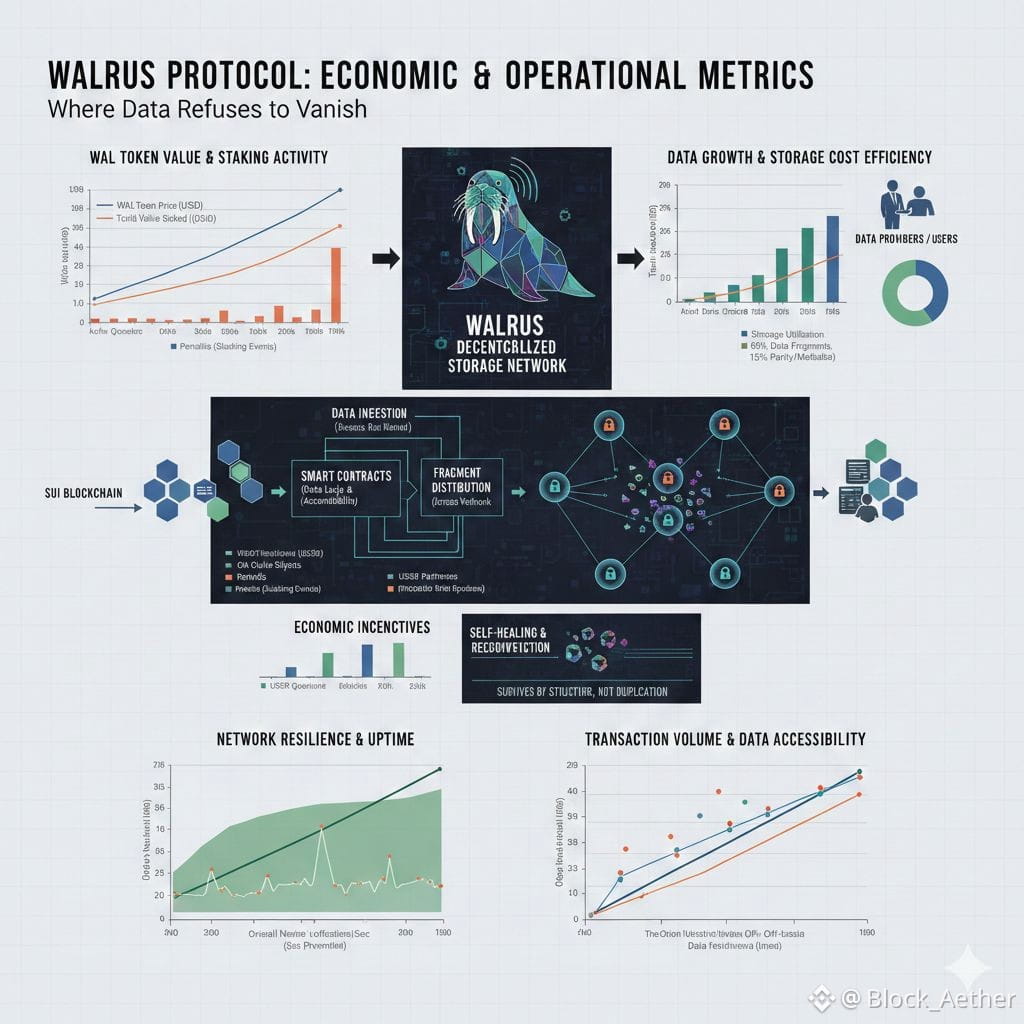
There is a moment, often invisible, when the internet reveals its true shape. It happens not when a message is sent or a payment is made, but when something heavy is moved a video uploaded, a dataset shared, a model stored, a digital memory preserved. In those moments, the sleek promise of decentralization tends to buckle. Blockchains boast trustlessness and transparency, yet quietly rely on centralized clouds to hold what they cannot carry. Walrus was born in that fracture.
Walrus does not try to compete with blockchains. It accepts their limits. Ledgers are precise, fast, and expensive. They are not meant to hold the bulk of human digital life. But Walrus asks a sharper question: if storage must live off-chain, why should it be blind, unverifiable, and owned by a handful of companies? Why should the most valuable part of digital infrastructure remain governed by trust when everything else is governed by proof?
At its core, Walrus is an attempt to give weight to data without giving up control. It treats storage not as a passive warehouse, but as an active, accountable system. Files are broken apart, not copied endlessly, but encoded mathematically reshaped into fragments that only make sense when enough of them come together. These fragments are scattered across a decentralized network, each node holding a piece of something larger than itself. No single machine knows the whole story. No single failure can erase it.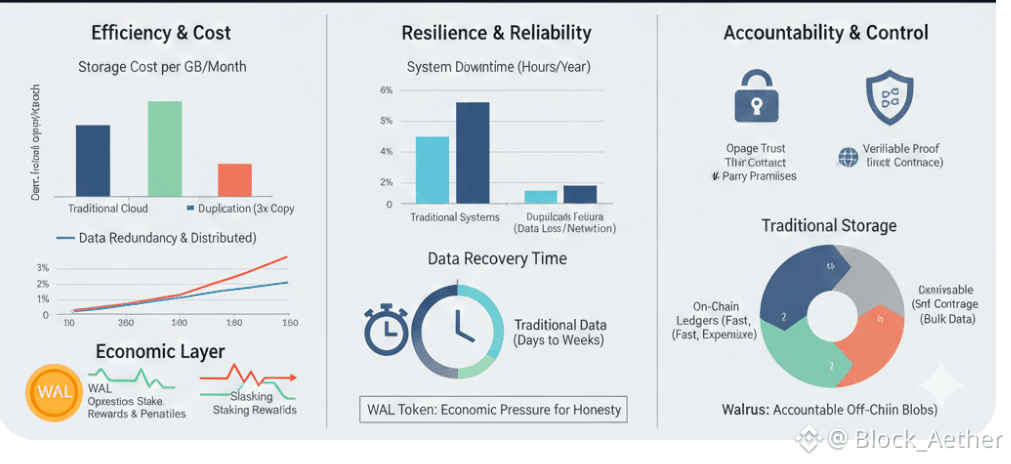
What makes this approach different is not just efficiency, though efficiency matters. Traditional systems survive by duplication: store everything three times, hope one survives. Walrus survives by structure. Its encoding method allows the network to heal itself when pieces disappear, pulling only what is missing instead of rebuilding from scratch. The result is quieter resilience. Less noise. Less waste. A system that assumes failure as a normal state rather than an exception.
But data does not live in isolation. It is created, referenced, updated, expired. Walrus ties its storage layer to the Sui blockchain, not to burden the chain with heavy files, but to give those files a verifiable shadow. On-chain objects point to off-chain blobs. Rules are written in code: how long the data should live, who pays for it, what happens if a node lies about storing it. Storage becomes something a smart contract can reason about. Something developers can compose into applications without trusting an external provider’s promises.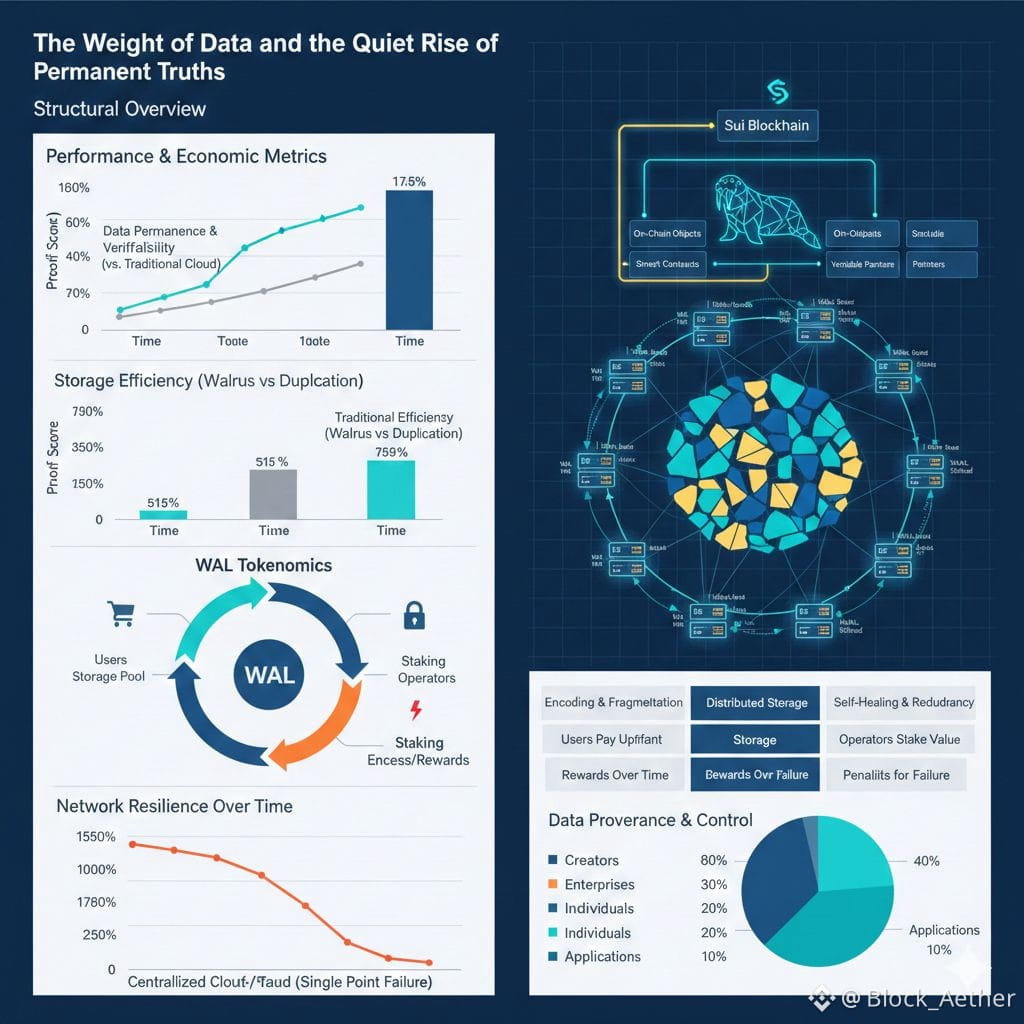
This is where Walrus begins to feel less like infrastructure and more like a philosophical stance. It assumes that storage should be accountable. That claiming to hold data should be provable. That economics, not goodwill, should keep systems honest. The WAL token exists for this reason. It is not decoration. It is pressure. Users pay upfront for storage. Operators stake value to participate. Rewards flow slowly over time, while penalties strike sharply when commitments are broken. The network is not polite. It is designed to remember.
There is a certain tension in that design. Turning storage into an economic system means exposing it to speculation, governance disputes, and power concentration. Tokens attract capital, but capital seeks leverage. Large operators may find efficiencies that small ones cannot. Voting power can cluster. These are not hypothetical risks; they are patterns repeated across decentralized networks. Walrus does not escape them. It confronts them, imperfectly, with slashing, governance rules, and the hope that transparent incentives will outperform opaque trust.
The implications stretch beyond crypto-native use cases. As artificial intelligence grows more data-hungry, questions of provenance and permanence become harder to ignore. Who owns a dataset? Who stored it? Was it altered? Walrus offers a model where data can be referenced, verified, and paid for without surrendering it to a single gatekeeper. For creators, this hints at new forms of control. For enterprises, it suggests redundancy without dependency. For individuals, it raises an unsettling idea: data that does not forget unless explicitly told to.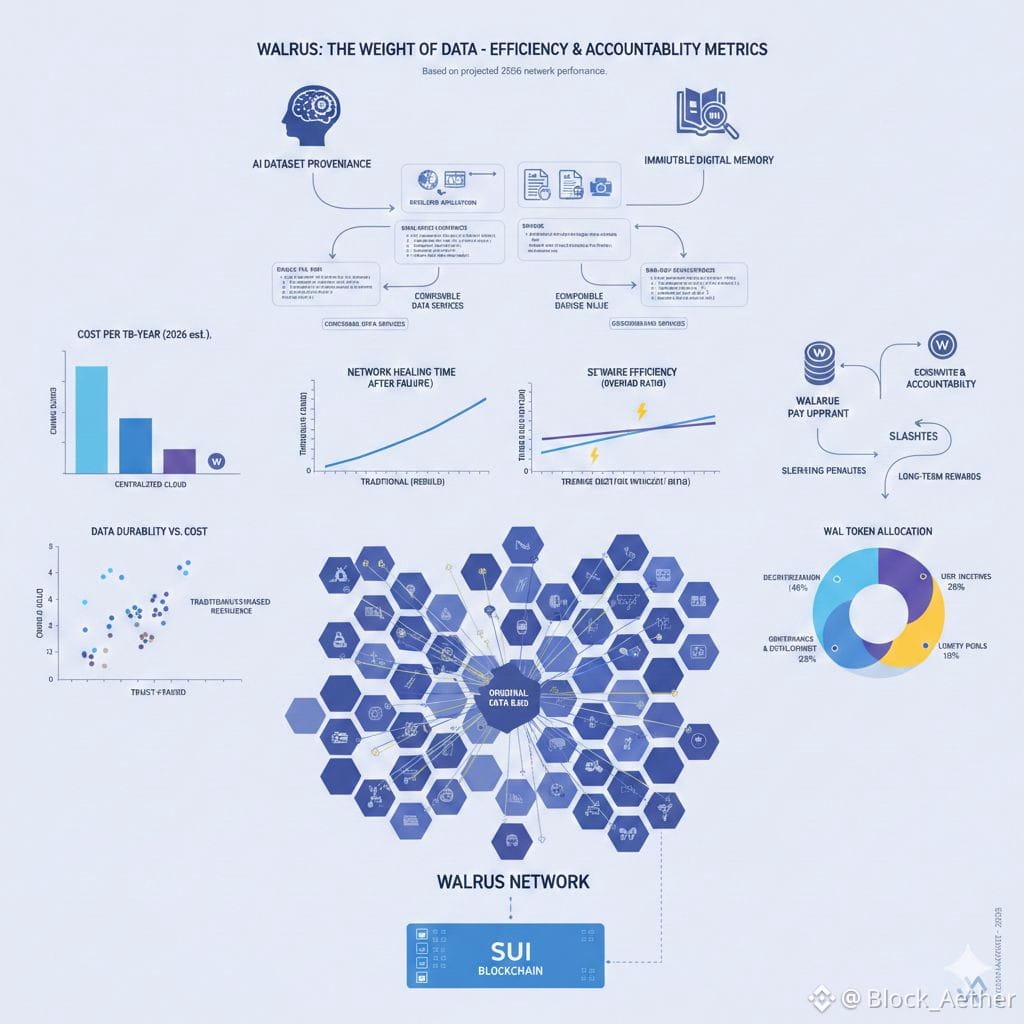
Yet permanence is a double-edged concept. Censorship resistance protects speech, but also shelters abuse. A system that makes deletion expensive forces society to grapple with what should be immutable and what should not. Walrus cannot solve this through code alone. No protocol can. It pushes these questions upward, into governance, law, and culture. In doing so, it exposes the cost of pretending storage is neutral.
What makes Walrus compelling is not that it promises a perfect solution, but that it accepts the complexity of the problem. It does not shout about revolution. It works quietly, reshaping incentives, reducing inefficiencies, and insisting that data deserves the same rigor as money and computation. Its success, if it comes, will not be announced with fireworks. It will be noticed when systems stop breaking, when applications scale without silent central dependencies, when storage fades into the background precisely because it can be trusted.
In the end, Walrus feels less like a product and more like a posture heavy, deliberate, built to endure cold waters and long migrations. In a digital world obsessed with speed and spectacle, it chooses something rarer: weight.