
Dusk was born from a feeling that many people carry but rarely say out loud. The feeling of being watched. The feeling that money on a public chain can turn into a spotlight you never asked for. And when you sit with that fear for a moment, you start to understand why the usual crypto story does not fit real finance. Because real finance is full of private moments. Salaries. Savings. Business payments. Client portfolios. Trading plans. Things that should not become public gossip. Dusk was founded in 2018 with one clear goal: build a layer 1 blockchain for regulated finance where privacy is normal, but accountability is still possible. And that single idea changes everything. It is not privacy to escape rules. It is privacy to protect people and institutions while still respecting the rules that keep markets stable.
If you have ever looked at a public blockchain explorer and felt a strange discomfort, you already know the heart of the problem. On many chains, money movement is like walking through a city made of glass. Anyone can stare. Anyone can connect dots. Anyone can build a story about you, even if they are wrong, even if they are harmful. For some people that is only uncomfortable. For others it is dangerous. And for companies and institutions it can be impossible, because they have legal duties and real consequences if they expose client data or business sensitive activity. So when Dusk says privacy focused and regulated by design, it is not a trendy slogan. It is a quiet promise that says you should not have to choose between using modern rails and keeping your financial life safe.
Now let us slow down and make the big idea simple. Dusk is trying to combine two things that often get pushed apart: privacy and auditability. Privacy means sensitive details are not shown to everyone. Auditability means the system can still prove that actions were correct and rules were followed. In real finance, both are needed. If privacy is missing, people feel exposed and unsafe. If auditability is missing, regulated players cannot participate. So Dusk tries to build a middle path where the chain can keep secrets that deserve protection, while still giving the right proofs when proof is required. It becomes a system that can say, this happened correctly, without shouting every detail to the whole world.
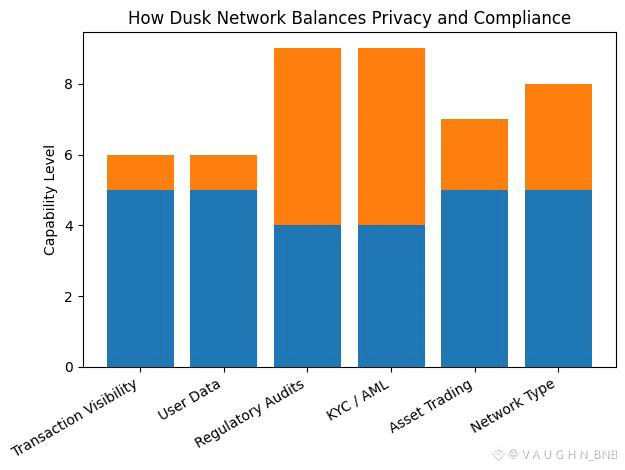
A big reason Dusk feels different is that it respects one honest truth: finance is not one single thing. Some value behaves like cash. It moves from person to person, and most of the time nobody should need to know anything except that the transfer was valid. Other value behaves like regulated instruments, where ownership, permissions, and transfer rules matter deeply. These assets have life rules, and those rules are not optional. They include who can hold the asset, who can receive it, what happens during special events, and what must be provable later. Dusk does not pretend one transaction style can serve both worlds perfectly. Instead, it supports different models so each kind of value can live in a home that fits.
For private transfers of the native asset, Dusk uses a privacy focused model often called Phoenix. The easiest way to feel it is to imagine sending value without turning your entire history into a public map. With this approach, the network can still check that what you did is valid, but it does not force you to reveal everything about your balances and relationships. That might sound like a technical detail, but emotionally it is relief. It is the feeling that you can participate without becoming a target. It is the feeling that your money can move without dragging your identity behind it like a shadow.
Then comes the part that matters for regulated assets, often described through a model called Zedger. This is built for tokenized real world assets and other instruments that must follow strict rules. Here the goal is not only privacy, it is controlled behavior. Assets can require permissions, checks, and clear records that authorized parties can rely on. Zedger is designed to support that reality while still protecting confidentiality where it belongs. And this is where you can sense the project’s personality. It is trying to be grown up infrastructure, the kind that can sit in the same room as compliance teams and auditors without everyone feeling nervous. It becomes a bridge between private finance needs and regulated oversight needs, without making either side feel betrayed.
When people hear privacy, they sometimes assume it means nobody can ever see anything. But Dusk aims for something more realistic and more responsible: selective disclosure. That means you do not reveal everything to everyone, but you can reveal the right pieces to the right authorized party when required. This matters because rules exist for reasons. Markets need guardrails. Clients need protection. Oversight needs facts. So the ideal future is not a chain where secrets hide wrongdoing. The ideal future is a chain where everyday privacy is protected, while legitimate checks and audits are still possible. If you care about the future of finance, this is one of the most important emotional balances to understand. Privacy without accountability can rot trust. Accountability without privacy can crush dignity. Dusk is trying to build a system where both can live.
Another part of Dusk that matters is how it is built in layers. People call this modular architecture, but you do not need the jargon to understand the feeling behind it. A stable foundation is comforting. It means settlement and security can stay strong and predictable. Then, on top of that stable base, different execution environments can be built to support apps and financial logic. This is especially useful because finance changes. Regulations change. Products change. But the core need for reliable settlement does not change. A layered approach can help the system evolve without constantly shaking its foundations.
Dusk also supports an EVM style environment, which is important for a simple reason: developers build what they can build. If builders are forced to learn an entirely new world from zero, many will never start. When they can use familiar tools, they can move faster, experiment faster, and ship real products sooner. That matters because a chain becomes valuable when people build things on it that solve real problems, not when it has perfect theory. It becomes a place where applications for compliant finance can actually grow instead of remaining a concept.
And then there is a word that does not sound emotional at first, but it truly is: finality. In finance, finality is the feeling of done. Not maybe done. Not probably done. Done. When a trade settles, when an asset moves, when a transaction completes, the system must be able to say with confidence that it is final. This is not just a technical preference. It is peace of mind. It reduces fear. It reduces operational risk. It makes infrastructure feel safe enough for serious use. Dusk is designed with this kind of settlement mindset, because regulated markets live and die by clarity.
Now let us talk about why people even care about regulated and privacy focused infrastructure in the first place. It comes down to a simple human reality: money is not only numbers. Money is identity. Money is safety. Money is power. Money is vulnerability. When a system forces everyone to reveal everything, it rewards the watcher and punishes the ordinary person. And when a system hides everything with no way to prove fairness, it invites distrust. So the future that many people quietly hope for is a future where on chain finance can grow up. Where tokenized real world assets can exist in a way that respects rules. Where institutions can participate without risking clients. Where normal users can move value without being exposed. Where privacy is not treated like suspicious behavior, but like the basic dignity it really is.
This is where the Dusk vision becomes more than technology. It becomes a statement about how financial systems should treat people. It says you should not have to sacrifice privacy to join modern infrastructure. It says regulation does not have to be the enemy of innovation. It says proof can be built in without turning everyone into a public record. And it says a blockchain can be designed for the world as it is, not only for the world we wish existed.
I also want to keep you grounded, because warm does not mean blind. Building this kind of chain is hard. Adoption is slow. Real financial systems move carefully. Trust takes time. Tools must be stable. User experiences must feel safe. Developers must keep showing up. Institutions must do the hard work of testing, integrating, and learning. None of that is automatic. But Dusk is at least fighting the right battle, the one most chains avoid. Theyre trying to solve the real problem that sits between crypto and regulated finance: how to protect private data while still making a system provable and trustworthy.
If you are reading this and you feel that little pull in your chest, the one that says yes, this is the kind of future I want, then you already understand why Dusk exists. It exists for people who want finance to modernize without becoming cruel. It exists for markets that need rules without giving up privacy. It exists for builders who want to create real applications for real assets, not only for speculation. And if that vision lands, it will not feel like a loud revolution. It will feel like something quieter and better: a world where privacy is normal, compliance is possible, and on chain finance finally starts to feel safe enough for real life.
