In the late 2010s, as blockchains were loudly promising to remake the world through radical transparency, a quieter question lingered beneath the noise. What happens to finance when everything is visible? Not the idealized finance of slogans and whitepapers, but the real one, built on discretion, contracts, reputations, and law. Banks do not operate in public. Asset managers do not broadcast their positions. Regulators do not need spectacle; they need assurance. Somewhere between the chaos of total opacity and the rigidity of full transparency, there was a missing system. Dusk emerged in that gap.
Founded in 2018, Dusk did not begin as a rebellion against the financial system. It began as an attempt to understand it more deeply than most blockchain projects were willing to. Its premise was almost unfashionable at the time: that regulation is not an enemy of innovation, and privacy is not a cover for wrongdoing. Instead, both are structural necessities of modern markets. Dusk set out to build a layer 1 blockchain that could speak the language of institutions without betraying the ethos of cryptography. Not louder. More precise.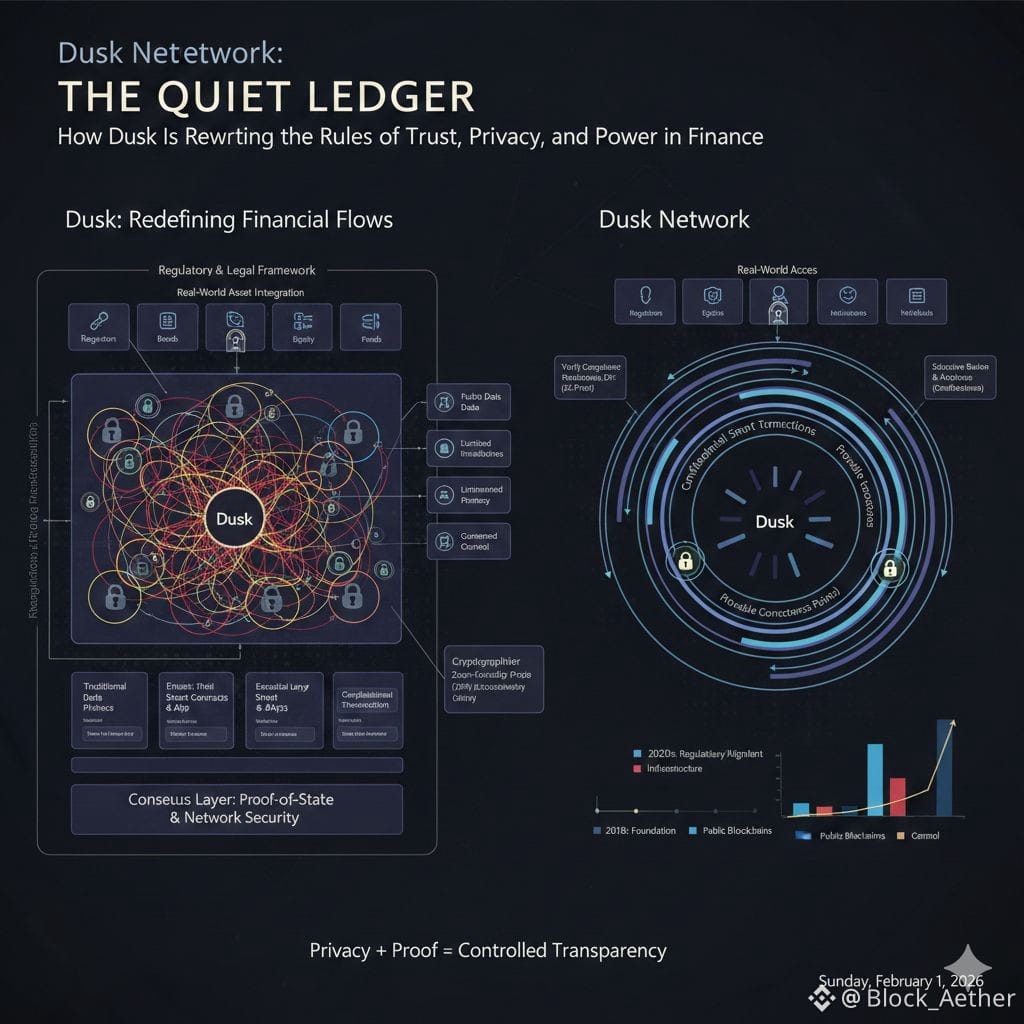
To understand Dusk, it helps to imagine finance as a series of locked rooms connected by hallways. Inside those rooms are sensitive details: ownership records, credit exposures, private agreements, personal data. Traditional finance works because access to each room is controlled. Public blockchains, by contrast, removed the doors entirely. Every room became a glass box. That transparency was revolutionary, but it was also naïve. Dusk’s ambition was to rebuild the doors without returning to darkness. To create a system where information could remain private, yet provably correct.
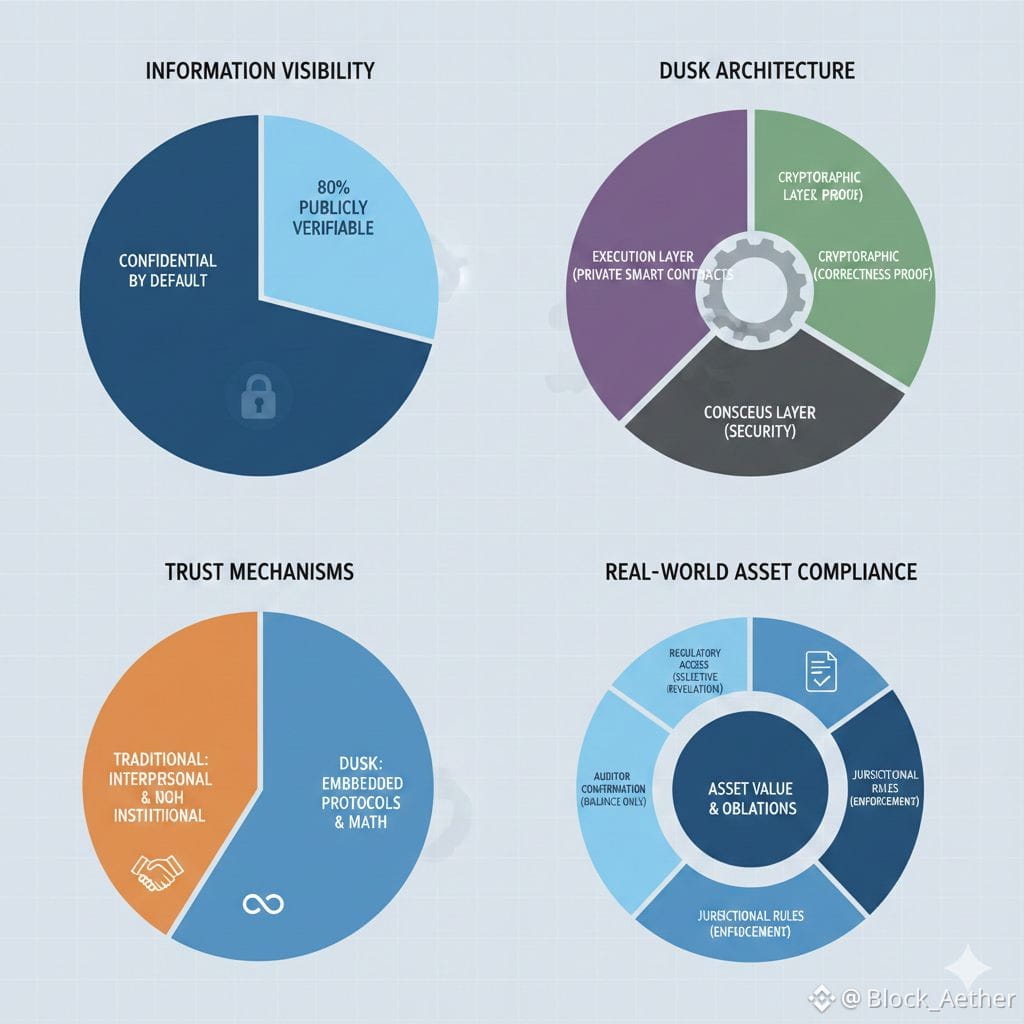
At the core of Dusk is a simple but difficult idea: transactions should be confidential by default, but verifiable by design. This is where zero-knowledge cryptography stops being an abstract concept and becomes a narrative engine. In Dusk’s world, assets can move without revealing their contents, identities can remain shielded without being unaccountable, and rules can be enforced without being exposed. The system does not ask participants to trust silence. It asks them to trust proof.
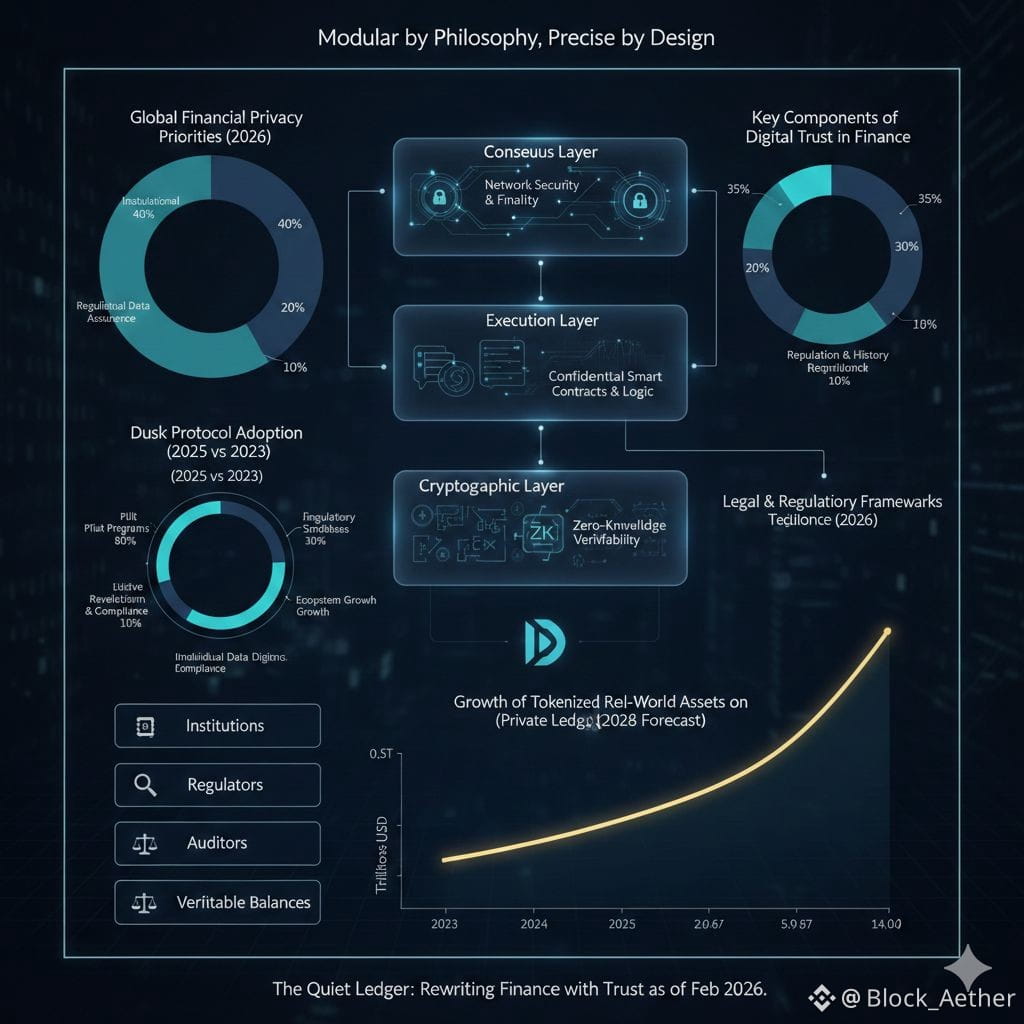
The blockchain itself is modular, not as a stylistic choice, but as a philosophical one. Finance is not a single machine; it is a layered system of custody, settlement, compliance, and enforcement. Dusk mirrors this structure. Its consensus layer secures the network. Its execution layer handles smart contracts designed with privacy at their core. Its cryptographic layer ensures that even when data is hidden, correctness is never optional. These components are not stacked carelessly. They are negotiated, like clauses in a contract.
This architecture matters most when real-world assets enter the chain. Tokenized bonds, equity, funds, and debt instruments are not just bits of value; they are legal objects with obligations attached. They require auditability. They require compliance with jurisdictional rules. They require the ability to answer uncomfortable questions. Dusk approaches this not by forcing disclosure, but by enabling selective revelation. Regulators can verify that requirements are met without accessing everything. Auditors can confirm balances without seeing counterparties. The system treats privacy as something to be governed, not bypassed.
There is an emotional undercurrent to this design that often goes unnoticed. Privacy is not only about secrecy. It is about dignity, leverage, and safety. For individuals, it means not having their financial lives exposed to the world. For institutions, it means operating without broadcasting strategy. For regulators, it means gaining confidence without resorting to invasive surveillance. Dusk attempts to encode these tensions into software, knowing full well that software cannot resolve them completely. It can only make abuse harder and responsibility clearer.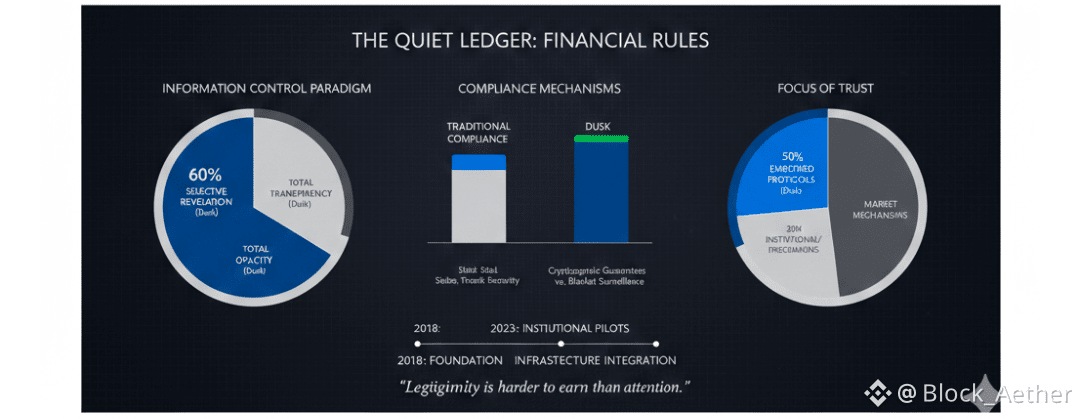
This is also where the risks begin. Any system that promises privacy within regulation walks a narrow ridge. Too much opacity, and it becomes a haven for manipulation. Too much compliance, and it becomes another instrument of control. Dusk does not pretend to escape this paradox. Instead, it builds mechanisms where power leaves a trace. Access to private data is governed by cryptographic permissions. Disclosure is not casual; it is provable, logged, and constrained. The system assumes that humans and institutions will still wield power, but it insists that they do so visibly, even when the data itself remains hidden.
Unlike many blockchain projects, Dusk does not rely on spectacle. There is no mythology of sudden revolution. Progress comes through slow alignment with custodians, legal frameworks, and financial operators who measure risk in decades, not market cycles. This makes Dusk less visible, but also more dangerous in the long run. Quiet systems that fit into existing power structures tend to last. They become infrastructure.
The future Dusk gestures toward is not utopian. It is more subtle, and in some ways more unsettling. A world where financial privacy is preserved not by obscurity, but by math. Where compliance is enforced not by blanket surveillance, but by cryptographic guarantees. Where trust is no longer interpersonal or institutional alone, but embedded into protocols that can be inspected, challenged, and proven. Such a world would change how markets behave. It would alter how risk is priced, how capital moves, how accountability is demanded.
Yet nothing about this outcome is guaranteed. Adoption depends on law, politics, and the willingness of institutions to accept new forms of proof. Regulators may resist tools they do not fully control. Markets may prefer simplicity over nuance. And the technology itself must withstand adversarial pressure in an environment where failure is expensive. Dusk operates with the understanding that legitimacy is harder to earn than attention.
What makes Dusk compelling is not that it promises to fix finance, but that it refuses to caricature it. It treats regulation as a constraint to be engineered around, not a villain to be defeated. It treats privacy as a right with conditions, not an absolute. And it treats blockchain not as an end, but as a medium through which old systems might evolve without collapsing.
In the end, Dusk is less about secrecy than about control. Who controls information. Who is allowed to know what, and why. These are ancient questions, now reframed in code. The ledger it builds does not shout its truth to the world. It whispers it to those who are entitled to hear it, and proves, with quiet certainty, that the whisper is real.