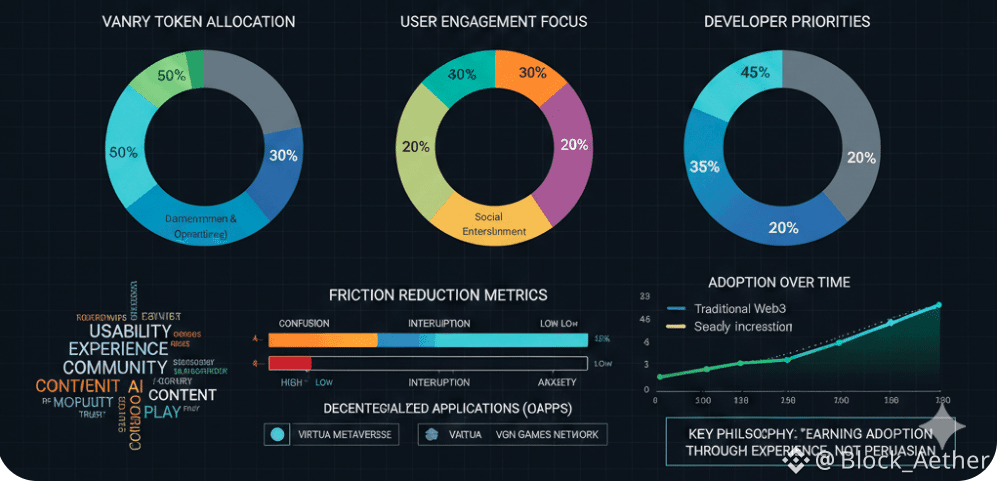
Most blockchains are born loud. They arrive with promises of revolution, radical freedom, instant wealth, and total disruption. Vanar arrived differently. Not quietly, but deliberately. It did not begin with an obsession over charts or slogans. It began with a question that many in Web3 avoid because it is uncomfortable and complex: what would a blockchain look like if it were designed for normal people, not just crypto natives?
Vanar is a Layer 1 built with the assumption that Web3 will not succeed by convincing the world to change its habits, language, or expectations. It must adapt instead. That belief shapes everything about the network, from its architecture to its product choices. The team behind Vanar did not come from financial engineering or academic cryptography circles alone. Their background is rooted in games, entertainment, digital worlds, and brands that survive only if millions of users show up every day and actually enjoy what they are using. That history matters. It shows up in the way Vanar thinks about scale, experience, and patience.
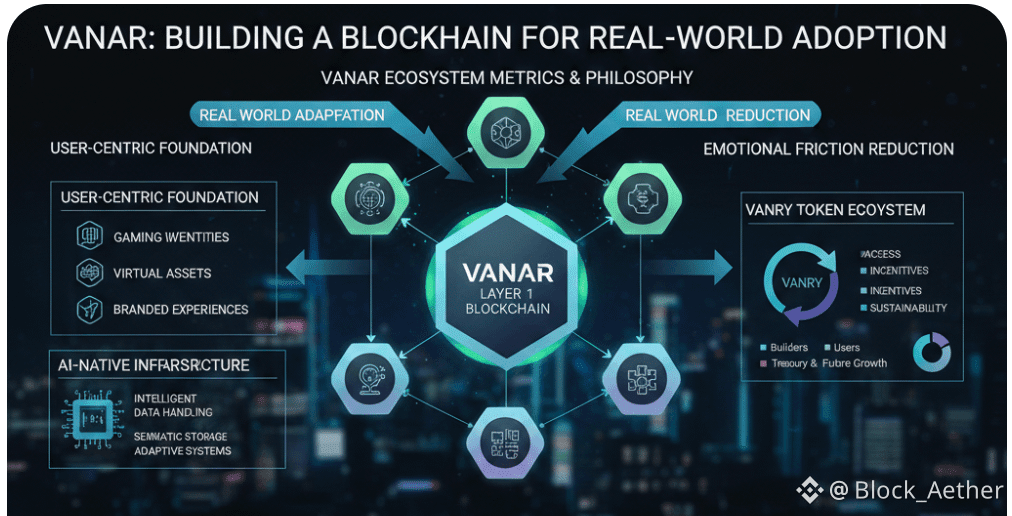
At its core, Vanar is not trying to be the fastest chain or the cheapest chain in isolation. It is trying to be a usable chain. That distinction sounds subtle but it is profound. Usability in Web3 is not just about low fees or fast confirmations. It is about emotional friction. It is about how often a user feels confused, interrupted, or anxious. It is about whether a developer can build something complex without assembling a fragile stack of off-chain services that quietly reintroduce centralization. Vanar’s design choices are shaped by these realities rather than theoretical ideals.
One of the most unusual aspects of Vanar is how seriously it treats content and interaction as first-class citizens on the blockchain. Most L1s are optimized for finance. Everything else is treated as an afterthought. Vanar reverses that assumption. It was designed with gaming worlds, digital identities, virtual assets, AI-driven interactions, and branded experiences in mind from the beginning. This is why products like the Virtua Metaverse and the VGN games network are not side experiments but central expressions of the chain’s philosophy. They are stress tests. If a blockchain cannot support living, breathing digital worlds with persistent users, it cannot reasonably claim readiness for mainstream adoption.
The technical ambition goes deeper with Vanar’s focus on AI-native infrastructure. Rather than bolting artificial intelligence onto decentralized apps as an external service, Vanar attempts to embed intelligent behavior into the structure of the chain itself. This is not about replacing human agency with algorithms. It is about reducing the cognitive burden placed on users and developers. Intelligent data handling, semantic storage, and adaptive systems aim to make decentralized applications feel responsive rather than rigid. In practice, this could mean game environments that remember player actions without centralized servers, or brand platforms that verify authenticity and ownership through logic embedded directly in the network.

But intelligence on-chain comes with tension. Computation costs money. Storage has weight. Every design decision becomes an economic decision. Vanar’s ecosystem revolves around the VANRY token, which quietly governs access, incentives, and sustainability. Tokens are often framed as symbols of community, but they are more accurately instruments of discipline. They decide what behaviors are encouraged, what is expensive, and what fades away. Vanar’s challenge is to ensure that VANRY supports long-term participation rather than short-term extraction. This is not a solved problem in crypto. It is an ongoing negotiation between builders, users, and markets that rarely behave as predicted.
There is also a human tension running through Vanar’s story. The team wants to onboard the next three billion users, but those users do not care about block times or consensus mechanisms. They care about whether something works, whether it feels safe, and whether it respects their time. Vanar’s background in entertainment gives it an advantage here, but it also raises the stakes. Games and brands are unforgiving environments. If experiences feel clumsy or slow, users leave without explanation. There is no ideological loyalty. Adoption must be earned repeatedly.
The broader Web3 ecosystem watches experiments like Vanar closely because they expose uncomfortable truths. Decentralization is not free. Intelligence is not neutral. Scale is not guaranteed. Every attempt to make blockchain technology more human introduces new layers of responsibility and risk. Governance becomes harder. Compliance becomes more complex. The line between protocol and platform grows blurry. Vanar does not escape these issues; it steps directly into them.
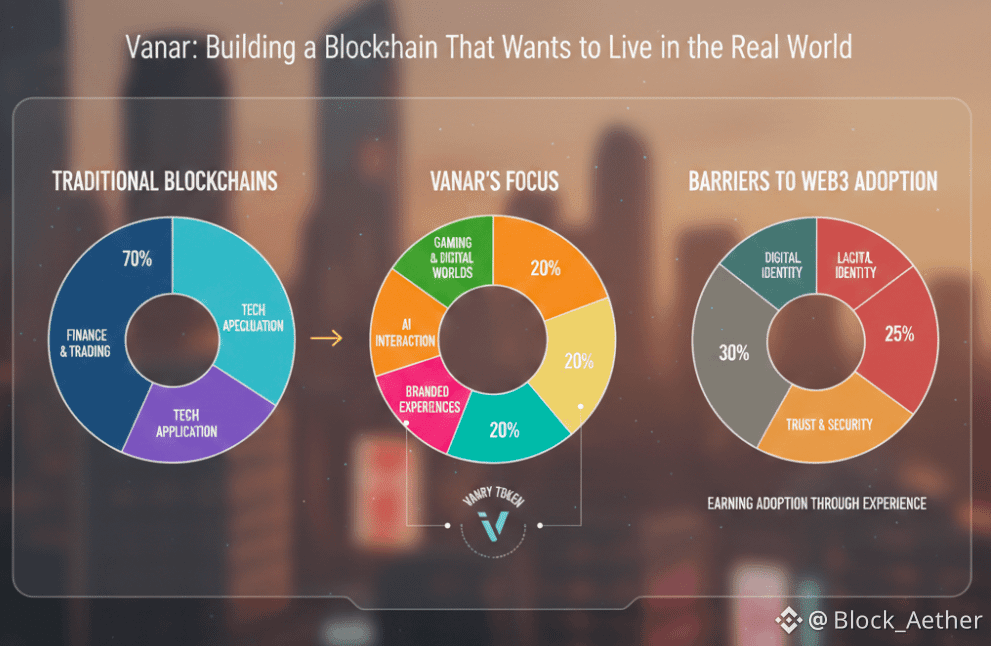
What makes Vanar compelling is not certainty, but intent. It is a blockchain that seems aware of its own fragility and ambition. It does not promise a clean future where technology solves everything. Instead, it offers a working hypothesis: that Web3 can grow up without losing its principles, that decentralized systems can support creativity and commerce without collapsing into abstraction, and that intelligence, if handled carefully, can make blockchains less alien rather than more opaque.
Whether Vanar succeeds will depend on forces larger than its codebase. Markets will test it. Regulators will scrutinize it. Users will ignore it unless it earns their trust quietly, through experience rather than persuasion. But regardless of outcome, Vanar represents a meaningful shift in how blockchains are imagined. It is less interested in proving what is possible in theory and more interested in discovering what can survive in reality.
In a space often obsessed with speed and spectacle, Vanar’s bet is slower and riskier: that the future of Web3 will be built not by shouting louder, but by listening more closely to how people actually live, play, and create.