
Most people misclassify Walrus by focusing on what it stores rather than what it enables. That confusion is common across crypto infrastructure. Anything that touches data tends to get grouped into the same mental bucket as generic storage. The issue is that storage, as a category, commoditizes quickly. Infrastructure does not.
Walrus is not trying to compete on cheap storage per gigabyte. Its objective is to make data assumable at the application layer. That distinction matters. When applications can rely on data being available later provable, retrievable, and coordinated the system stops behaving like a service and starts behaving like a base layer.
This is where Walrus quietly diverges from most decentralized storage designs.
That divergence is rooted in its encoding model. Red Stuff is not simply an efficiency improvement; it represents a different approach to reliability. Traditional replication brute-forces safety by copying data repeatedly and hoping cost curves remain viable. Walrus treats loss as a recoverable state rather than a failure. Recovery bandwidth scales with what is missing, not with the full dataset. That difference becomes meaningful once reliability is priced. Reliability is the real cost center in decentralized storage, and most systems leak value there without recognizing it. Walrus is explicitly engineered around that pressure point.
That design choice shapes everything downstream, particularly economics.
Walrus does not ask the market to believe a story about future importance. It asks users to prepay for persistence. Storage is purchased for time, not sentiment. Fees are distributed gradually. Operators and stakers are compensated from usage that has already occurred rather than speculative expectations. This structure smooths a pricing problem that quietly undermines many storage networks: when the token rises, usage becomes unaffordable; when it falls, operators churn. Walrus is designed to dampen both dynamics.
From a market perspective, this creates an unusual situation. The token does not trade like a mature infrastructure primitive, yet it is not dead liquidity. Trading volume relative to market capitalization suggests disagreement rather than apathy. That is typically where mispricings form—not where narratives are loud, but where the market has not yet settled on what something is.
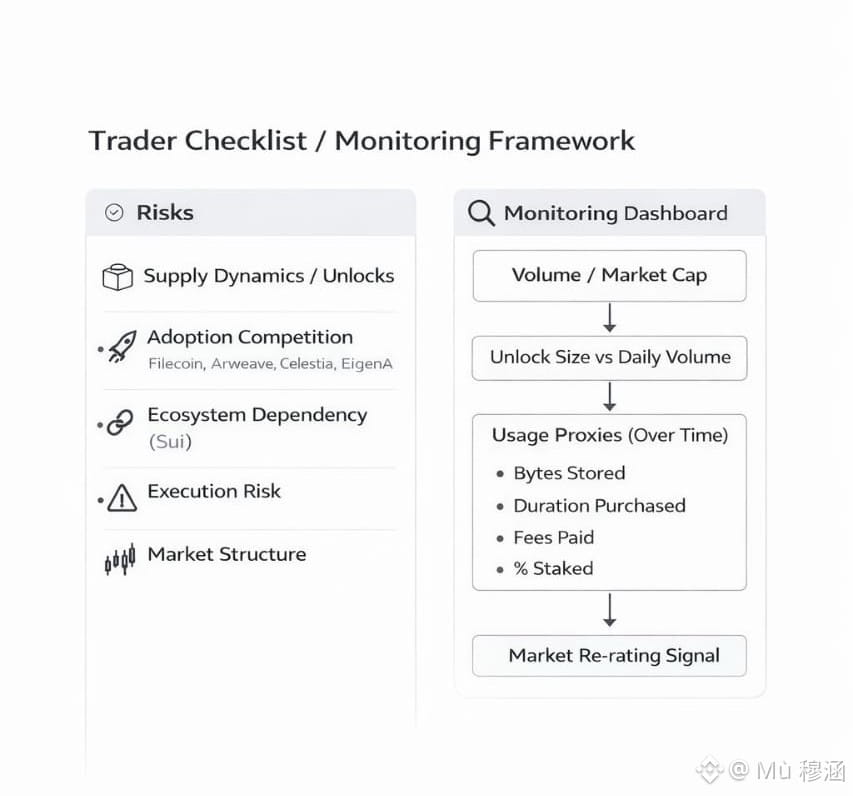
A realistic upside case does not rely on aggressive adoption assumptions. It requires a re-rating from an optional storage experiment to a usage-linked infrastructure asset. That shift does not appear first in headlines. It shows up in operational metrics: paid storage increasing, average reservation durations extending, fees flowing consistently, and staked supply rising relative to liquid supply. When those indicators move together, price stops leading and starts lagging.
The downside case is equally straightforward. Walrus can be technically sound and still underperform if usage fails to scale faster than supply unlocks. Circulating supply remains a fraction of total supply, which makes time itself a risk factor. Unlock schedules do not kill projects; misaligned demand does. If developers remain anchored to incumbents due to tooling familiarity, or if data-availability use cases consolidate elsewhere, Walrus can settle into an awkward middle ground not failing, but not forcing repricing either.
There is also concentration risk. Coordination currently lives within a single ecosystem. That is efficient, but it is not free. If activity there slows, Walrus inherits that slowdown regardless of its own technical merit. Over time, credibility across ecosystems will matter more than raw throughput metrics.
This is why trader behavior matters as much as technical design. Walrus is not a token analyzed through slogans. It is monitored through dashboards: volume relative to market capitalization to gauge attention, unlock size versus daily liquidity to assess absorption, and usage metrics mapped directly against valuation to test whether value capture is real or assumed. When those signals converge, narratives become unnecessary. The market builds one on its own.
What makes Walrus interesting is not that it stores data. Many systems do. What makes it interesting is its attempt to turn data persistence into a programmable assumption rather than a fragile dependency. If that attempt succeeds, applications stop treating storage as an external risk and start treating it as internal infrastructure.
At that point, the token no longer trades like a theme.
It trades like plumbing slow, quiet, and earned.
That is usually the kind of outcome markets underestimate until they don’t.

