


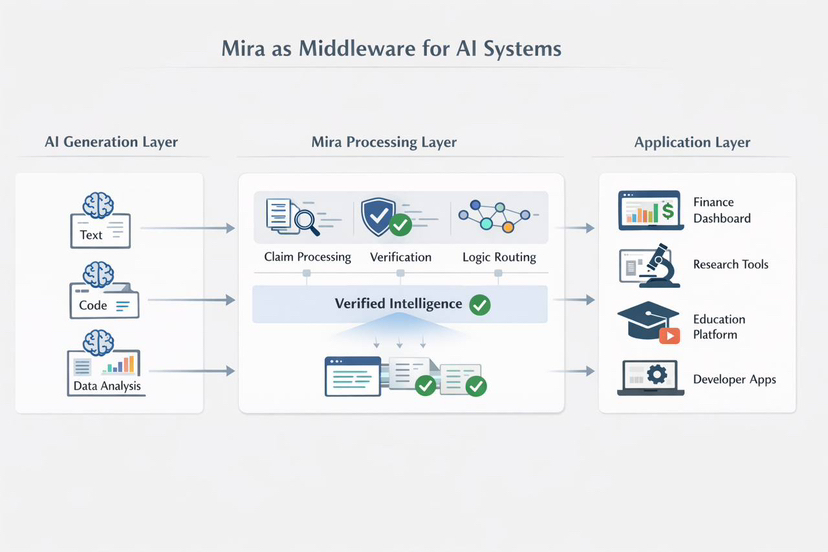
Let’s look into something deeper: converting AI responses into programmable processes.
The majority of us imagine AI as an application that just provides answers. You ask a question, the model answers and that is it. However, Mira appears to take AI as infrastructure. Rather than considering AI output as the endpoint, it considers it as the start of a process, which can be verified, analyzed, and incorporated into other systems. It is this change of mind that led to my closer examination of the project.
Among the factors that caught my eye is the way Mira is intended to facilitate customizable AI processes on the part of developers. In the current AI platforms, developers are creating applications directly on a single model. The model creates a response and the application just utilizes this response. The issue is that this renders a weak system. In case the AI response is wrong, biased, or incomplete, the error is inherited by the application. Mira presents a new thing. The network provides APIs and developer tools to enable developers to integrate verification and logic directly into the process of an AI application.
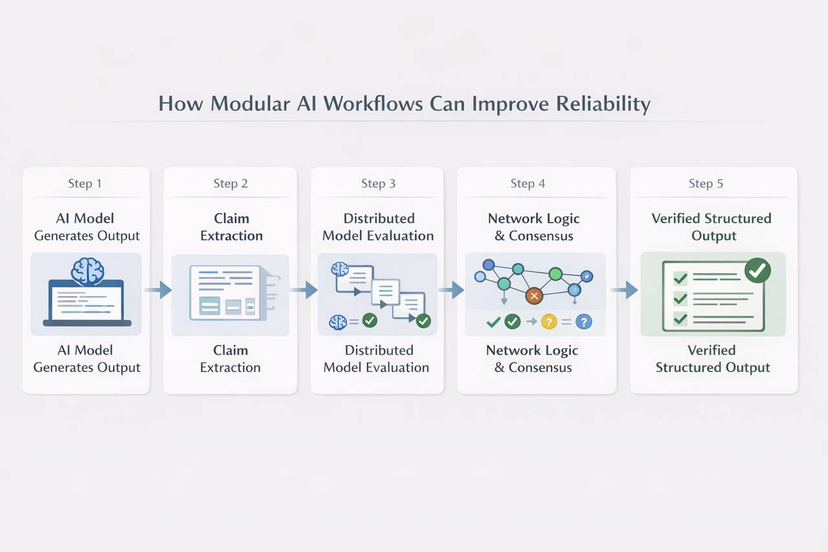
I see this in a pragmatic way and it reminds me of the way that the modern software systems developed. Internet applications were centralized and at early stages of development. As time went, developers had started to develop layered systems in which each service had a different task to undertake. Mira appears to introduce such an architectural reasoning to AI. Rather than having a single model that can perform all the tasks, the system divides the process into steps. The information is created by AI, verified and processed through a network, and the verified output is consumed by applications.
The other functionality that interests me is that Mira allows developers to create modular AI logic. Since the protocol splits outputs into smaller chunks and executes them over the network, developers have more opportunities to construct more complex programs of reasoning. As an example, an application can use one model to create information, use the Mira network to check certain claims, and then cause other calculations or decisions to be made using the checked results. This actually converts AI outputs into a format that can be processed by software as structured data as opposed to unstructured text.
I also observed that the project also gives attention to developer accessibility. The network would offer software development kits and APIs, through which applications can add verification directly into their systems. In my opinion, this is significant, since technologies begin to be significant only when developers have an opportunity to build on them. The problem is that most blockchain and AI projects outline grand plans, which are mostly hypothetical. It is tools that enable developers to experiment and come up with new applications that make an idea an ecosystem.
The more I consider this, the more Mira begins to resemble an attempt at creating middleware of artificial intelligence. Traditional computing Middleware is used to bind together various services and to make sure they can interact in a proper fashion. Mira seems to assume a similar role to the AI models and applications. It lies between information creation and information utilization and is used to coordinate verification, logic and processing.
In my opinion, it can be one of the more intriguing lines of AI infrastructure. Greater size or more training data may not be the sole determinants of the future of AI. It might rely on the construction systems which coordinate the production, scrutiny and utilization of the intelligence. The approach by Mira is that it may not be the generation of knowledge, but the creation of networks that facilitate the movement of knowledge through networks in a consistent manner.
Viewing it this way, Mira seems not like another AI crypto project but like a prototype of how AI-native infrastructure could be like in the future.