


I needed to pace myself down to know what I actually think about Fabric Protocol.
The crypto robotics and AI arena is highly noisy. Each week a new project says it is going to create the future machine economy. The words are never small, with such giant phrases as intelligent agents, autonomous systems, and decentralized infrastructure. However, on further inspection, the majority of them simply stick a token onto an idea and leave the rest of the story to do that.
Fabric did not feel, like other people do
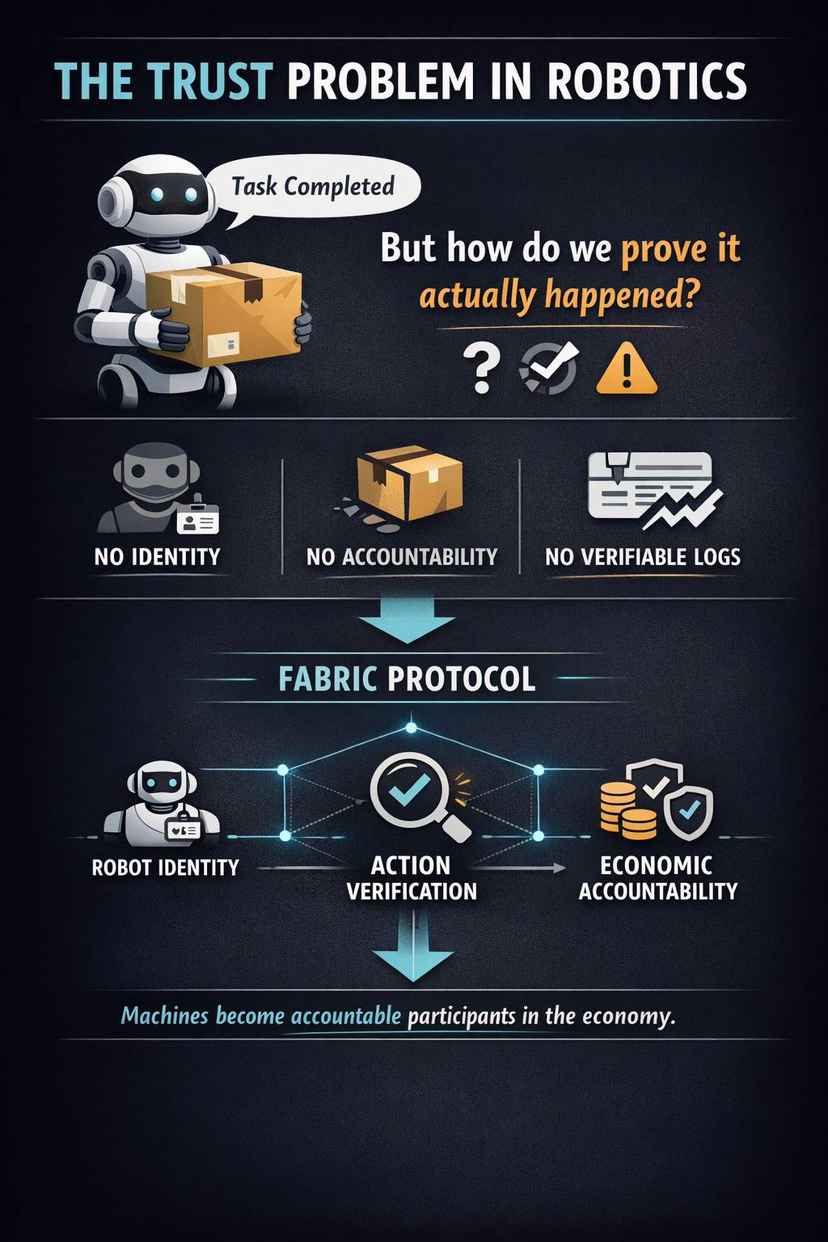
It was not about smarter robots- everybody vows that. It was not about the hyping of AI, which is so ubiquitous and yet so rarely delivers tangible outcomes. The issue that attracted my attention was the particular problem that Fabric specializes in. Neither intelligence, nor hardware, not even payments initially.
Trust!
It may sound easy but the more I thought of it, the more serious it became.
Robots are no longer restricted to the labs and factories but are being brought to the streets, warehouses, hospitals and homes. That changes everything. In the real world, however, an error is not simply a bug in the software but an actual physical thing that can result in the loss of something, the damage of something, or a failure
When there is a failure, there is only one question that arises
Who is responsible?
It is difficult to answer that question when robots are self-acting. Who is held accountable in case a delivery robot does not deliver a package? The robot is operated by the company? The maker? Who trained it? the programmer? Or the information that it based its decisions on?
Laws and finances are not designed to be automatic machines but to be used by humans. They presuppose that a human being possesses identity, ownership and responsibility. Robots don’t fit that. They do not carry any passports, bank accounts, and legal identities.
Fabric is attempting to bridge that gap!
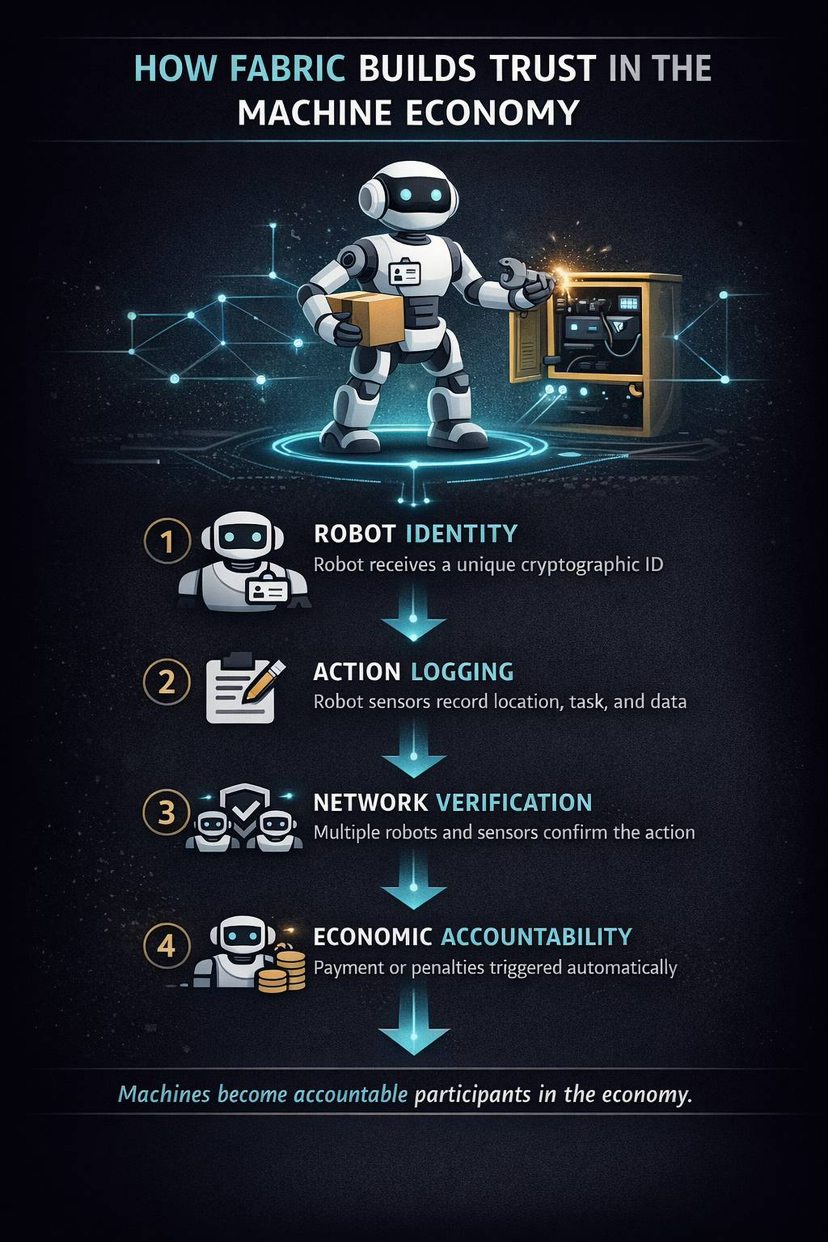
Fabric opines that robots must be given digital identities which can be checked within a common network. Each robot is given an identity that is attributed to its actions, owner, and location as opposed to remaining anonymous behind the company walls. Everything is founded on that identity.
With an identity, a robot is able to be tracked and identified by its behavior
This renders Fabric more interesting. The network records the actions of robots and even makes sure that they do what they claim to have done. Hardware can be safely used to handle sensor data. Various robots and sensors can certify on the events of each other like a witness. Privacy-preserving proofs also allow tasks to be authenticated without the disclosure of any private information.
In the most simple words, the system shifts to the case where the robot says that it did something and the network, in turn, demonstrates that it happened.
That distinction is bigger than that appears
When the actions are verifiable, there exists accountability. Economic systems are able to develop around machines with accountability. It is possible to stake collateral on the robots operated by operators. In the event that a robot acts rightly, it is rewarded. In the event of failure or cheating, such collateral may be removed.
I find this intriguing as robots are not merely used but are a participant in it. The network makes operators take a chance, rather than a leap of faith. Good will develop reputation and value in the long run whereas bad will cost money.
It is a very simple thought, and strong
The further I consider the more I realize that robots cannot be useful at scale simply because of their intelligence. Even with a very powerful machine, there is a lack of responsibility structure that can bring chaos. Fabric examines the infrastructure underneath robot capability: identity, verification and financial responsibility.
That infrastructure may not sound appealing when compared to fancy robots, however it might be more valuable
Consider the possibility of millions of autonomous machines in dozens of companies The lack of common identity and responsibility norms makes every encounter weaker. The confidence is restored to closed systems of the company and collaboration among the networks would be almost impossible.l
Fabric is not interested in that because it constructs a trust layer of machine activity.
Naturally, this is yet to happen. Concepts are not as difficult as implementation. It is difficult to prove true events. Sensors are hackable, settings are different and rewards introduce new vulnerabilities. It will be just able to demonstrate itself when the system is out of the theory
Nevertheless despite that uncertainty I am intrigued by the direction.
Not that it is a sure way to succeed. Nothing in this space does.
However, due to Fabric having the task of working on a piece that is not done by most projects. It is not making robots smarter.
It is holding robots responsible. This may be the more significant problem to solve in case machines will work around us on a daily basis.