
There’s a scenario around $ROBO that I rarely see discussed.
Not because it’s impossible.
But because it’s… inconvenient to think about.
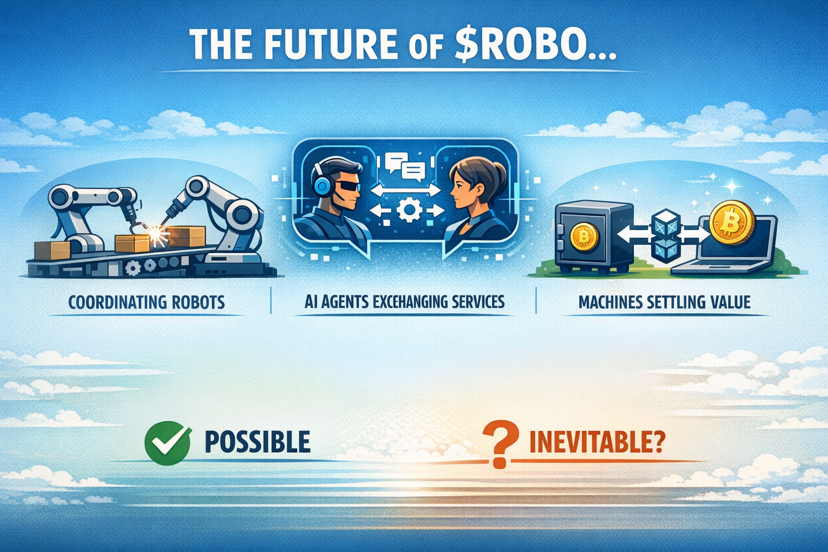
The Fabric Foundation assumes a world where autonomous systems eventually interact across open environments. Robots coordinating work. AI agents exchanging services. Machines settling value without needing a centralized intermediary.
That world feels plausible.
But plausibility isn’t the same as inevitability.
Here’s the part I keep circling back to.
What if machine economies do grow… but they grow inside alliances rather than open networks?
Large AI providers already control models.
Hardware companies control robotics platforms.
Cloud providers control infrastructure.
If those players begin linking their ecosystems together through private agreements, the coordination layer might never become public infrastructure.
It might become something closer to a consortium.
Closed enough to control.
Open enough to cooperate.
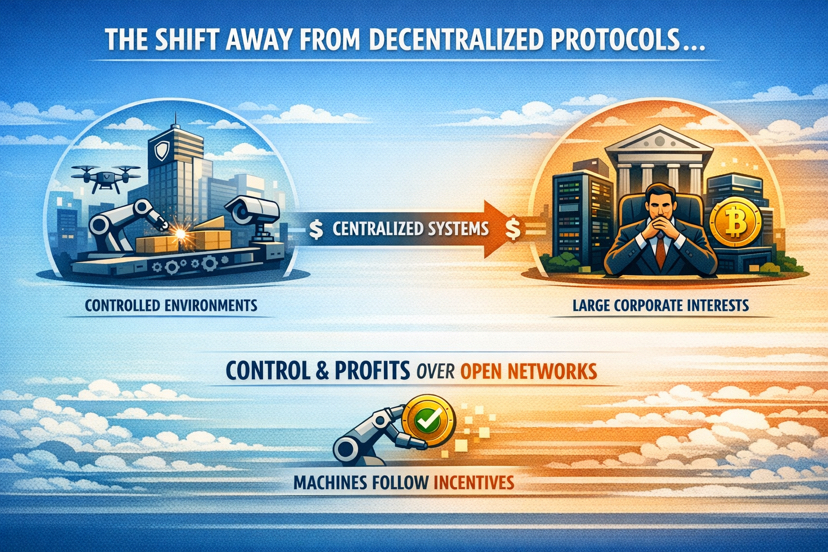
In that scenario, decentralized coordination protocols suddenly become less necessary.
Not because they’re technically inferior.
But because the incentives of large actors prefer controlled environments.
And machines don’t argue with incentives.
This doesn’t invalidate the architecture Fabric is building.
But it changes the conditions under which it becomes essential.
Instead of being the default coordination layer, it becomes an alternative one.
And alternatives have a much harder path to adoption than necessities.
That’s the tension I keep feeling when evaluating $ROBO.
The logic is sound if autonomous systems need neutral rails.
But that “if” carries more weight than people like to admit.
Because history shows that large technological ecosystems often consolidate first and open later.
Sometimes much later.
Another thing that complicates this is how invisible early machine coordination really is.
When humans adopt a system, you see it.
Communities form.
Metrics appear.
Growth becomes visible.
When machines adopt infrastructure, the signals are quieter.
A new integration here.
A workflow adjustment there.
A backend dependency forming without anyone announcing it.
Those are the moments that eventually matter.
But they’re almost impossible to track in real time.
So I find myself watching this thesis with a certain level of unease.
Not because it lacks logic.
But because the future it assumes depends heavily on how power structures in technology decide to organize themselves.
If autonomous systems move toward open interaction, Fabric’s architecture starts looking prescient.
If they remain coordinated through centralized alliances…
Then the problem Fabric is solving might never become urgent enough.
That’s the scenario I don’t think we’ve stress-tested enough.
Not the failure of the technology.
But the possibility that the environment it expects develops differently.
Right now, both paths still exist.
And until we see clear signals of which direction machine ecosystems actually prefer…
This entire thesis remains suspended in a strangely uncertain place.
I’m still watching.
But I’m not pretending the outcome is obvious.
#Robo @Fabric Foundation $ROBO #MetaPlansLayoffs
