
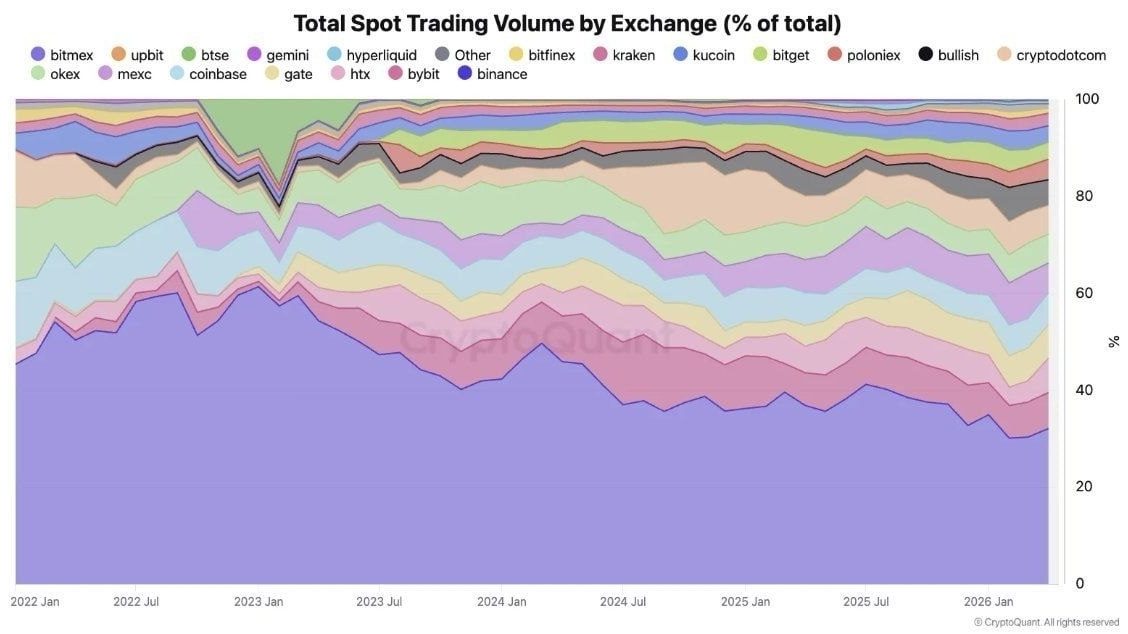


People love calling every slowdown a sign that power is shifting, but when I look at where real capital still chooses to trade, Binance keeps showing up at the center of the market.
Even in a cooler environment, the exchange is still holding the deepest concentration of activity. Recent 2026 market-share data shows Binance capturing roughly the mid-30% range in both spot and derivatives among leading exchanges, while its Q1 derivatives volume reached about $4.9 trillion. In spot, its share stayed around 34% to 35% through the first quarter, even as overall volumes contracted.
When markets slow down, liquidity matters more than narratives
Bull markets make everything look liquid. A weak token can rally, a second-tier venue can look busy, and traders start believing volume is everywhere. But once momentum fades, the market becomes more honest. That is when traders stop chasing noise and start prioritizing where execution is actually reliable.
That is exactly why Binance keeps its edge. When liquidity thins out, traders do not just want access to markets. They want tighter books, faster fills, less slippage, and confidence that size can still move efficiently. The platforms that keep order flow during risk-off periods are usually the ones that already have the strongest infrastructure and deepest liquidity pools. The recent data reflects that pattern clearly, with Binance’s share holding firm while overall market activity softened.
Derivatives are still where the real fight happens
The bigger story is not just that Binance remains large. It is that futures and derivatives continue to be the core engine of crypto trading, and Binance is still leading there by a wide margin.
According to recent 2026 exchange market-share research, Binance held about 34.9% of Q1 derivatives volume among top exchanges, ahead of the next major competitors by a meaningful gap. Its derivatives volume alone exceeded the combined totals of some lower-ranked top venues, which says a lot about where serious directional and hedging activity still concentrates.
That matters because derivatives are usually the clearest signal of where sophisticated capital prefers to operate. Spot trading tells you where assets are changing hands. Derivatives tell you where traders are expressing conviction, hedging risk, managing leverage, and reacting fastest to market structure. If Binance remains dominant there, it means the platform is still the main arena for price discovery in crypto’s most active segment.
Dominance is not just about size, it is about trust in execution
A lot of people reduce exchange leadership to branding or user count, but in reality, trading dominance is earned through execution quality. Deep liquidity is sticky. Once traders know a venue can absorb volume efficiently, that advantage reinforces itself.
That is why Binance’s position is harder to challenge than people think. Liquidity attracts traders, traders attract market makers, and market makers improve execution, which then attracts even more capital. It becomes a loop. And in a market where overall centralized spot and derivatives activity can cool off sharply month to month, that loop matters even more. Data from recent industry reviews shows centralized venues still dominate crypto trading broadly, while Binance remains the leading single venue inside that structure.
This is also why “volume decline” and “Binance weakness” are not the same thing. The market can slow and Binance can still strengthen its position relative to everyone else. In fact, that is often when leadership becomes most visible.
The market may be cooling, but the hierarchy has not changed
What stands out to me is that despite all the talk about fragmentation, the market still tends to consolidate around the exchanges that offer the least friction for capital. In theory, traders have more options than ever. In practice, size still flows to where execution feels safest and most efficient.
Binance’s spot share staying in the mid-30s while derivatives remain near the same level suggests its dominance is not just a leftover from a previous cycle. It is still actively being chosen by the market. That is a big difference. Legacy dominance fades when users are forced to stay. Real dominance persists when users keep returning because the platform still solves the trading problem better than the alternatives.
Final thought
To me, this is the real takeaway: a slower market has not weakened Binance’s role. It has actually made its role easier to see.
When excitement drops, the fluff disappears. What remains is infrastructure, liquidity, and execution. And that is exactly where Binance continues to lead.
The market may cool off. Volumes may shrink. Narratives may rotate. But as long as traders keep choosing depth over distraction, Binance still looks like the main liquidity hub of crypto.