
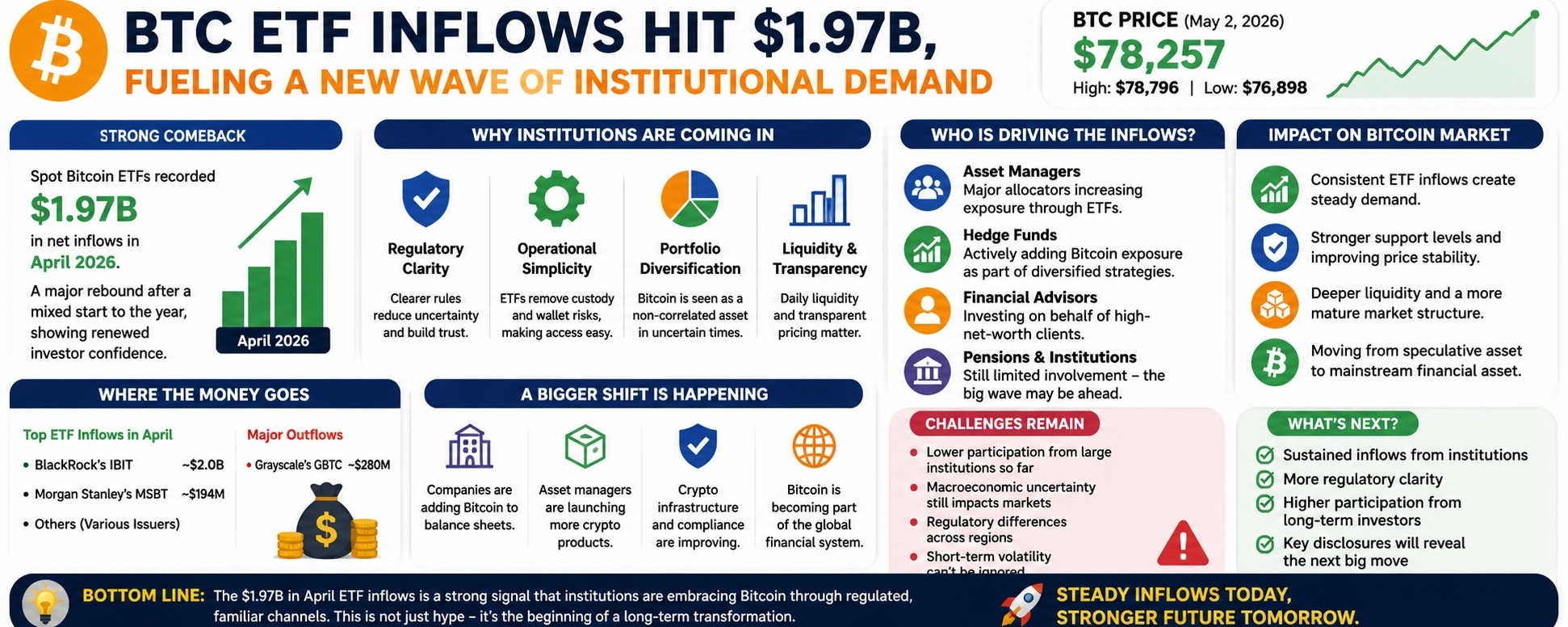

The crypto market has seen its share of hype cycles, but what’s happening now feels different. In April 2026, spot Bitcoin ETFs pulled in an impressive $1.97 billion in net inflows, a number that signals more than just short-term excitement. It reflects a steady and growing shift—large investors are no longer watching from the sidelines; they’re stepping in with real capital.
At the center of this movement is Bitcoin, which continues to evolve from a speculative asset into something far more structured and widely accepted.
A Strong Comeback After a Shaky Start
The year didn’t begin on a particularly strong note for Bitcoin ETFs. Early months saw mixed flows, with investors pulling money out during periods of uncertainty. Concerns around interest rates, global markets, and profit-taking created hesitation.
But April changed the tone.
The near-$2 billion inflow marked a clear rebound, suggesting that confidence is returning. It wasn’t just a one-off spike—it was a coordinated wave of capital entering the market, indicating that investors had been waiting for the right moment.
Why Institutions Are Finally Getting Comfortable
For a long time, institutions avoided direct crypto exposure. Managing private keys, dealing with unregulated exchanges, and navigating unclear rules made it difficult to justify large allocations.
Bitcoin ETFs solved many of those problems in one move.
They offer a familiar structure—something institutions already understand. Instead of dealing with crypto wallets and custody risks, investors can now access Bitcoin the same way they would buy stocks or traditional funds.
That simplicity matters more than it seems.
It removes friction, reduces risk, and allows decision-makers to treat Bitcoin like any other asset in a portfolio.
Not All Money Is Equal
One interesting detail behind the $1.97 billion figure is where the money is coming from.
A significant portion is being driven by asset managers, hedge funds, and financial advisors. Many of these advisors are investing on behalf of wealthy clients who want exposure but prefer a regulated route.
At the same time, some of the biggest long-term players—like pension funds and large institutions—are still only lightly involved.
That’s important because it suggests the current wave might just be the beginning. If those larger players enter the market more aggressively, the scale of inflows could grow significantly.
The Quiet Impact on Bitcoin’s Price
ETF inflows don’t just sit in a vacuum—they directly influence Bitcoin’s price behavior.
When billions of dollars flow into ETFs, those funds typically need to buy actual Bitcoin to back their holdings. That creates consistent demand.
And consistent demand changes how an asset behaves.
Instead of sharp, unpredictable spikes driven by retail traders, the market starts to feel more stable. Prices still move, but they tend to find stronger support levels.
This is exactly what has been happening recently. Even with occasional pullbacks, Bitcoin has held its ground better than in previous cycles.
A Bigger Shift Is Happening
ETF inflows are just one piece of a larger puzzle.
Across the financial world, Bitcoin is being taken more seriously. Companies are adding it to their balance sheets. Asset managers are building new products around it. Infrastructure—like custody and compliance—is improving quickly.
All of this points to the same conclusion: Bitcoin is no longer an outsider asset.
It’s becoming part of the system.
But It’s Not Fully Mature Yet
Despite the progress, the market isn’t completely stable or predictable.
There are still moments of volatility. Investor sentiment can shift quickly. And regulatory approaches vary depending on the region.
More importantly, the deepest pools of institutional capital haven’t fully committed yet.
That means the market is in a transition phase—growing, but not fully developed.
What to Watch Next
The coming months could be crucial.
Investors will be watching for signs of continued inflows, especially from larger institutions. Financial disclosures and portfolio reports may reveal whether long-term players are increasing their exposure.
If they are, it could mark the next major step in Bitcoin’s evolution.
Final Thoughts
The $1.97 billion flowing into Bitcoin ETFs in April isn’t just a statistic—it’s a signal.
It shows that institutional demand is not only real, but growing. And more importantly, it suggests that Bitcoin is slowly finding its place in mainstream finance.
The story isn’t about sudden hype anymore.
It’s about steady adoption—and that tends to last much longer.