
One thing I’ve noticed in technology markets is that people usually focus on visible breakthroughs first.
The interface. The product. The consumer experience. The thing that creates immediate excitement.
Infrastructure usually gets ignored until systems become large enough that coordination problems start breaking everything underneath.
You could see this pattern in cloud computing. In internet scaling. In payment systems. Even in financial markets.
At first, growth hides structural weaknesses.
Then eventually, complexity forces infrastructure back into focus.
I think AI may be entering a similar phase now.
Right now, most of the market’s attention still revolves around models themselves.
Which AI is smartest. Which one generates better outputs. Which one attracts the most users.
But the more I think about where AI is heading, the less convinced I am that intelligence alone will be the defining bottleneck.
Because once autonomous systems begin interacting with each other economically, coordination may become far more important than raw capability.
That sounds abstract at first.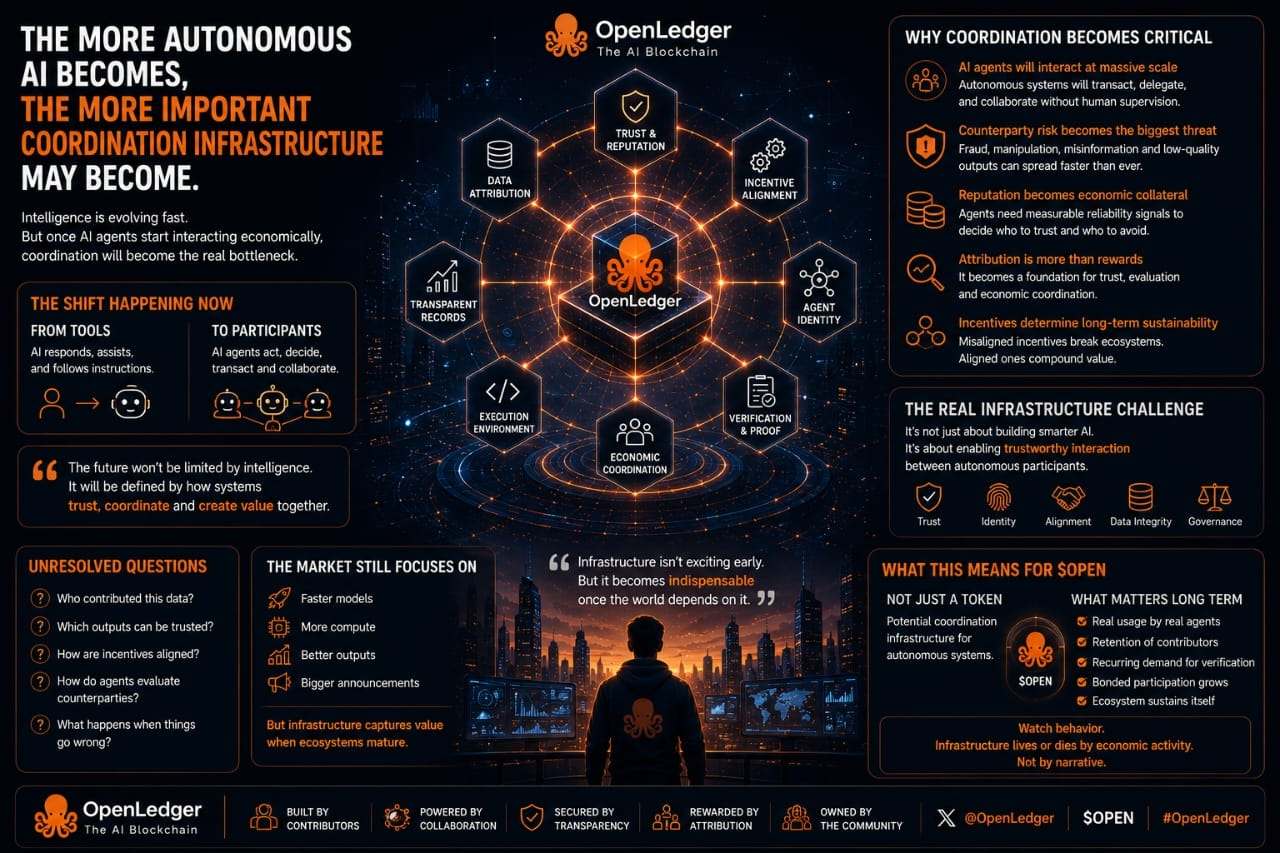
But I don’t think it stays abstract for long.
Imagine a future where AI agents: purchase services, exchange data, perform transactions, delegate workflows, coordinate logistics, manage portfolios, or execute decisions continuously across decentralized environments.
At that point, intelligence becomes only one layer of the system.
The larger challenge becomes: how do these systems trust each other?
Not philosophically. Economically.
And honestly, I think the market still underestimates how difficult that problem becomes at scale.
Humans already struggle with coordination in digital systems.
Fraud exists. Manipulation exists. Information asymmetry exists. Counterparty risk exists.
Now imagine autonomous systems operating millions of times faster, interacting continuously without human supervision.
The infrastructure requirements become enormous.
Because autonomous agents need more than intelligence.
They need: identity, reputation, verification, attribution, economic incentives, governance, and transparent execution environments.
Without those layers, large-scale AI economies probably become unstable very quickly.
That’s one reason OpenLedger caught my attention.
At first glance, it looks easy to categorize.
AI blockchain. Data attribution. AI infrastructure. Token incentives.
Standard crypto framing.
But the more I think about it, the more it feels like the deeper idea may actually revolve around coordination.
Especially as AI systems become increasingly autonomous.
One thing I keep returning to is the concept of attribution.
Most people interpret attribution mainly as a reward mechanism.
Contributors provide value. Contributors receive rewards.
Simple enough.
But attribution may become much more important than compensation alone.
It may become part of the trust layer itself.
Because once autonomous systems begin consuming external data, models, and services, they need ways to evaluate reliability.
Where did this information originate? Who contributed to the model? What is the historical quality of those contributors? How do counterparties price execution risk?
These questions start resembling economic coordination systems more than traditional software architecture.
And honestly, I think that distinction matters.
Crypto markets often become obsessed with throughput and technical specifications while underestimating the importance of incentive structures.
But incentives usually determine whether systems remain sustainable long term.
Especially decentralized systems.
Another thing I find interesting is how AI agents may fundamentally alter the meaning of reputation itself.
Historically, reputation belonged mostly to humans and institutions.
People built trust through identity, history, and social verification.
But autonomous economies may require machine-native reputation systems.
Not reputation as marketing.
Reputation as economic collateral.
That changes how I think about tokens like $OPEN.
Because if AI ecosystems eventually require participants to signal reliability economically, bonded participation may become structurally important.
Not because staking sounds attractive in theory… but because autonomous systems may need measurable counterparty guarantees before interacting with each other at scale.
And honestly, that creates a very different way of evaluating AI infrastructure projects.
Instead of asking: “Does this AI sound impressive?”
The better question may eventually become: “Does this ecosystem produce trustworthy coordination between autonomous participants?”
That’s a much harder problem.
And probably a much more valuable one long term.
I also think the market still underestimates how messy autonomous ecosystems may become operationally.
People often imagine AI systems functioning with near-perfect efficiency.
But historically, every large economic system creates: misaligned incentives, spam, manipulation, quality degradation, and coordination friction.
AI ecosystems probably won’t be different.
In fact, they may amplify these issues because autonomous systems can operate at enormous scale and speed.
That means future AI infrastructure may need mechanisms that continuously filter, evaluate, verify, and economically align participants.
Which again brings infrastructure back into focus.
And honestly, infrastructure narratives rarely look exciting early.
Most people prefer visible applications because they’re easier to understand emotionally.
But over time, infrastructure tends to capture increasing value as ecosystems mature and dependency grows.
You could see that historically across: cloud providers, payment rails, data infrastructure, operating systems, and internet protocols.
The visible layer attracts users first.
The coordination layer quietly becomes indispensable later.
That’s partly why OpenLedger feels interesting to me.
Not because I think every AI narrative automatically succeeds.
Most won’t.
And not because AI agents alone guarantee sustainable token demand.
That still depends on actual usage, retention, and economic behavior.
But because the project seems directionally aligned with a problem that may become increasingly important: how autonomous systems coordinate trust, incentives, attribution, and execution at scale.
And honestly, I suspect that problem becomes much larger than most people currently realize.
Especially once AI systems stop functioning primarily as tools… and start functioning as participants inside digital economies.