
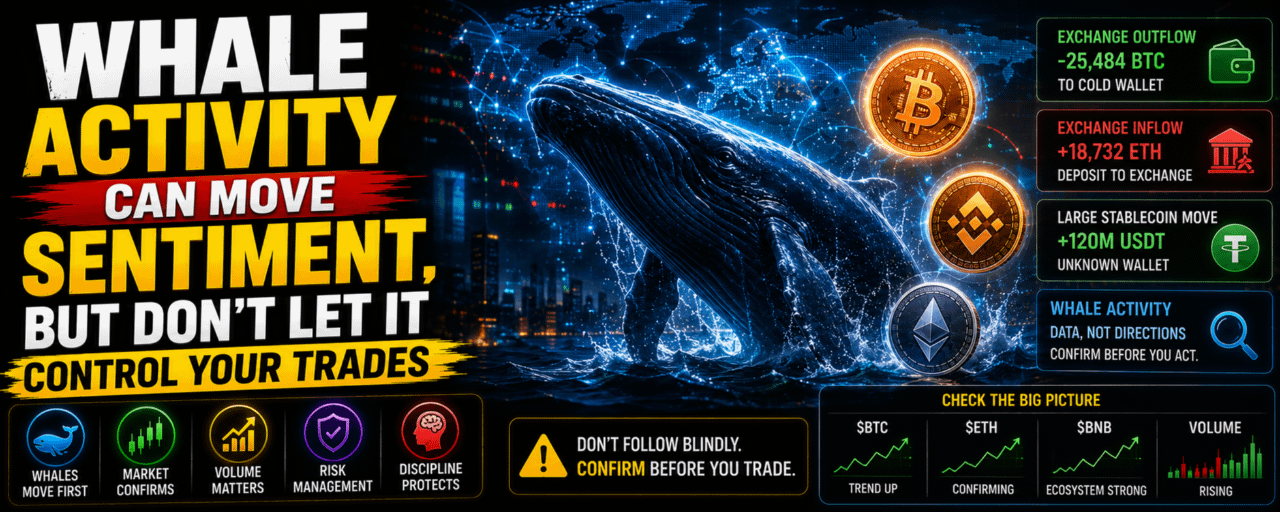
Whale activity is one of the most watched signals in crypto.
Whenever a large wallet moves Bitcoin, Ethereum, stablecoins, or a major altcoin, the market reacts quickly. Screenshots spread across social media. Traders start guessing whether the whale is buying, selling, transferring to an exchange, moving funds to cold storage, or preparing for something bigger.
It is easy to understand why people pay attention.
Large wallets can influence short-term sentiment. A major inflow to an exchange can make traders nervous. A large withdrawal can be interpreted as accumulation. A stablecoin transfer may suggest capital is preparing to enter the market.
But here is where many beginners make a mistake:
They treat every whale movement as a direct trading signal.
That is not how whale data should be used.
A whale transfer does not always mean immediate buying or selling.
Sometimes funds move for custody reasons.
Sometimes assets are transferred between internal wallets.
Sometimes institutions rebalance positions.
Sometimes large holders move assets for OTC deals, liquidity management, security, or operational reasons.
And sometimes, yes, whale activity does come before meaningful market movement.
The problem is that you rarely know the full reason immediately.
This is why whale activity should be treated as market context, not a complete trading plan.
When I see whale-related news, I usually do not ask, “Should I buy or sell now?”
I ask better questions.
Where did the funds move?
Was it an exchange inflow or an exchange outflow?
Did price react immediately?
Did volume increase after the transfer?
Is $BTC supporting the broader market direction?
Are other major assets like $ETH and $BNB confirming the move?
Is the market already emotional, or is the reaction still calm?
These questions help separate useful information from noise.
For example, a large transfer to an exchange may create selling pressure concerns, but if price does not break down and volume remains controlled, the market may not be reacting as strongly as expected.
On the other hand, if whale movement appears together with rising volume, stronger price action, and broader market confirmation, then the signal becomes more interesting.
The key is confirmation.
Whale activity alone is not enough.
Price reaction matters.
Volume matters.
Liquidity matters.
Market structure matters.
The behavior of $BTC matters.
For beginners, this is one of the most important lessons in crypto: do not blindly follow large wallets.
Whales can be early, but they can also be strategic.
They can move markets, but they can also mislead impatient traders.
Retail traders should not try to copy every whale movement. Instead, they should use whale data as one layer of analysis.
Think of it like this:
News tells you what happened.
On-chain data shows you where capital may be moving.
Price action shows you how the market is responding.
Volume shows whether traders are participating.
Risk management protects you when your interpretation is wrong.
That combination is much stronger than reacting to one wallet alert.
The crypto market rewards context, not panic.
So the next time you see a whale transfer trending, slow down.
Do not ask only whether the whale is buying or selling.
Ask whether the market is confirming the story.
That is where better decisions begin.
If you are new to Binance, you can register with referral code WENDYYY to receive a 20% fee rebate on Spot and Futures trading.
Referral link: https://www.binance.com/join?ref=WENDYYY
Follow the data, but trade with discipline.