
Most blockchain projects talk about privacy as if it were a switch: on or off. Either everything is transparent, or everything is hidden. That framing works in experimental crypto environments, but it breaks down the moment real financial regulation enters the picture. This is where Dusk quietly stands apart, by anchoring its entire design around regulated privacy rather than ideological secrecy.
Regulated privacy is not about hiding activity. It is about controlling who can see what, when, and under which legal conditions. Financial institutions operate inside this framework every day. Dusk is one of the few blockchains that treats this reality as a starting point instead of an inconvenience.
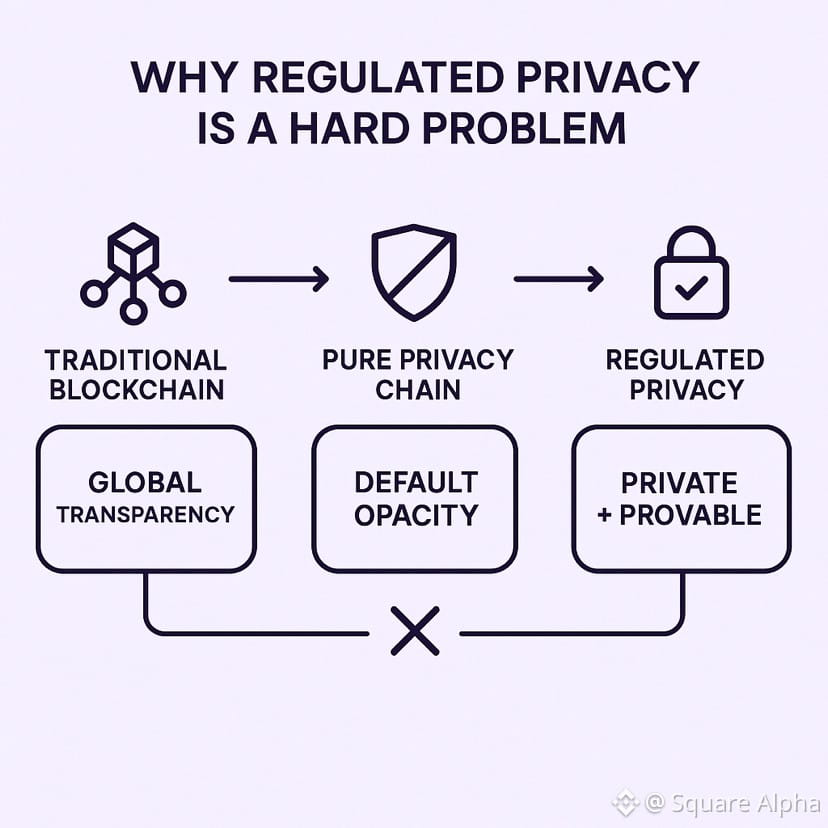
Why Regulated Privacy Is a Hard Problem
Traditional blockchains expose transaction data globally. That creates transparency, but also introduces risks that regulated actors cannot accept: front-running, exposure of positions, competitive intelligence leaks, and compliance violations.
Pure privacy chains attempt to solve this by making transactions invisible by default. Regulators see that as opacity, not compliance. Once regulators cannot verify correctness, settlement legality, or reporting accuracy, the system becomes unusable for licensed entities.
Dusk’s approach to regulated privacy avoids both extremes. Transactions can remain private to the public while still being provable and auditable under defined conditions. This distinction is subtle, but it changes everything.
How Dusk Implements Regulated Privacy at the Protocol Level
Unlike networks that bolt privacy onto smart contracts, Dusk embeds privacy directly into its protocol design. Confidential data is protected through cryptographic proofs, while transaction validity is still verifiable by the network.
This means regulated privacy is not optional middleware. It is enforced by consensus. Validators do not need to see sensitive data to confirm correctness, and compliance does not require public disclosure.
From a system design perspective, this reduces attack surfaces and removes reliance on off-chain trust assumptions. That is exactly what institutions look for when evaluating blockchain infrastructure.
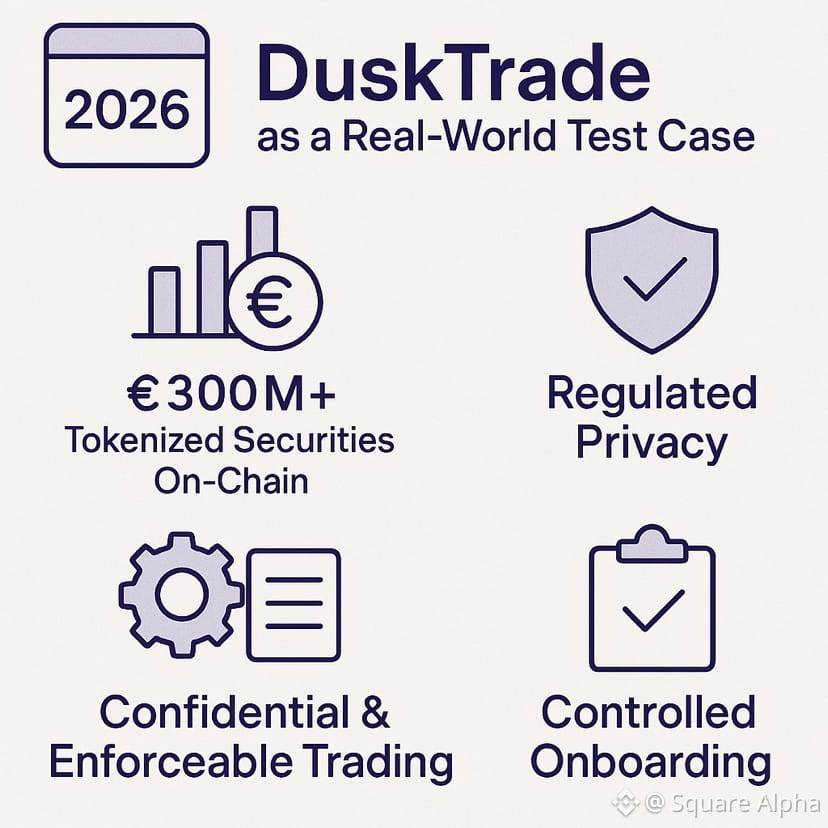
DuskTrade as a Real-World Test Case
The relevance of regulated privacy becomes obvious when looking at DuskTrade, scheduled for launch in 2026. Tokenizing and trading regulated securities is not a theoretical exercise. It involves licenses, audits, reporting obligations, and legal accountability.
DuskTrade aims to bring more than €300 million in tokenized securities on-chain in collaboration with a licensed exchange. That scale cannot exist without regulated privacy. Public settlement would be unacceptable. Black-box privacy would be illegal.
Dusk’s architecture allows trading activity to remain confidential while still being enforceable under financial law. The January waitlist signals that this is moving beyond internal development into controlled onboarding.
DuskEVM: Making Regulated Privacy Accessible
Regulated privacy alone is not enough. Developers and institutions also need familiar execution environments. DuskEVM solves this by enabling Solidity-based smart contracts to settle on Dusk’s Layer 1.
This matters because adoption depends on familiarity. By separating execution familiarity from settlement guarantees, Dusk allows developers to work within known tooling while benefiting from regulated privacy at the base layer.
The result is a system where compliance does not require custom engineering or exotic development practices. That lowers adoption risk significantly.
Where DUSK Fits Into the Picture
In a network focused on regulated privacy, the role of $DUSK becomes functional rather than speculative. $DUSK supports transaction execution, staking, and network security across privacy-aware applications.
As regulated activity increases — particularly through DuskTrade and EVM-based applications — DUSK demand is tied to actual network usage. This creates a slower, but more structurally grounded demand profile.
That does not guarantee price outcomes, but it does align incentives with real adoption instead of attention cycles.
Final Perspective
Dusk is not trying to redefine privacy for crypto users.
It is redefining privacy for financial systems.
By focusing on regulated privacy, Dusk positions itself where blockchain and law intersect — a place most networks avoid because it is complex, slow, and unforgiving.
That choice limits hype.
But it maximizes relevance.
And in regulated finance, relevance is what lasts.