
Walrus exists because Web3 hit a wall it can no longer ignore: execution scaled faster than data reliability. Blockchains became faster, cheaper, and more parallelized, but the data those systems depend on remained fragile. In practice, decentralization stopped at the smart contract boundary. Walrus is an attempt to extend decentralization into the layer Web3 quietly depends on the most — data availability.
At its core, Walrus is not competing for attention. It is competing for dependency.
Why Walrus Is an Infrastructure Project, Not a Feature
Most crypto projects market features. Infrastructure projects solve constraints.
Walrus addresses a constraint that grows more severe as ecosystems mature: large-scale data cannot live directly on-chain, yet applications increasingly rely on that data as if it were guaranteed. NFT media, AI datasets, game assets, historical state, compliance records — all of it shapes user trust, but much of it still sits on centralized servers.
Walrus positions itself as the layer that absorbs this pressure.
Rather than pretending data is static, Walrus treats data as something that must survive churn. Nodes go offline. Costs change. Demand spikes. Systems that assume stability eventually fail. Walrus is designed around instability as the default condition.
Walrus on Sui: A Structural Fit
Walrus is deeply tied to the Sui ecosystem, and that choice is structural, not cosmetic.
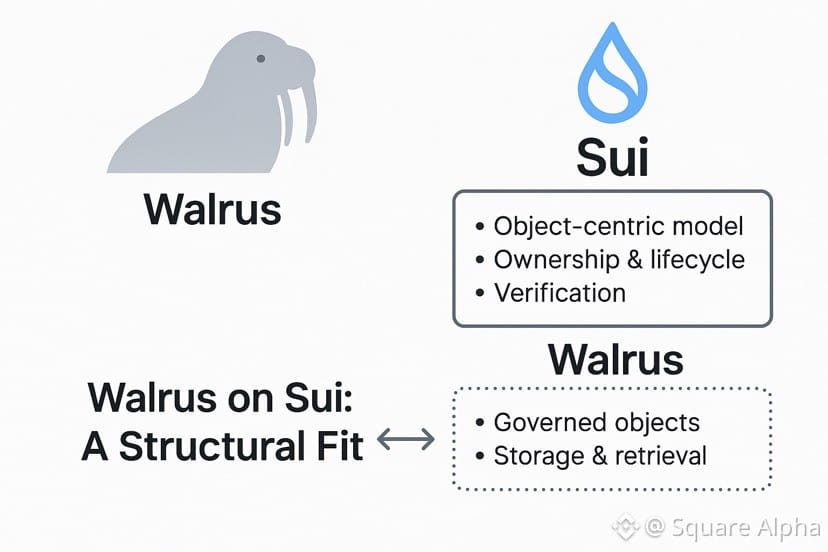
Sui’s object-centric model allows precise control over ownership, lifecycle, and verification. Walrus leverages this by managing blobs as governed objects rather than passive files. The blockchain coordinates the rules, while the Walrus network handles efficient storage and retrieval.
This separation matters. Sui provides deterministic control and composability. Walrus provides scalable data availability. Together, they form a coherent stack where applications can reason about data guarantees instead of hoping infrastructure behaves.
That coherence is rare in Web3.
Availability Is the Product
Many storage systems optimize for capacity. Walrus optimizes for availability under stress.
This distinction becomes obvious during churn — the moment when providers leave, incentives shift, or demand becomes uneven. In those moments, systems that rely on assumptions degrade quietly. Walrus enforces availability continuously, not retroactively.
From an application perspective, this changes risk calculations. Data is no longer “best effort.” It is something the protocol actively maintains.
That reliability is what infrastructure buyers actually pay for.
Walrus and the Economics of Persistence
The role of $WAL fits directly into this design.
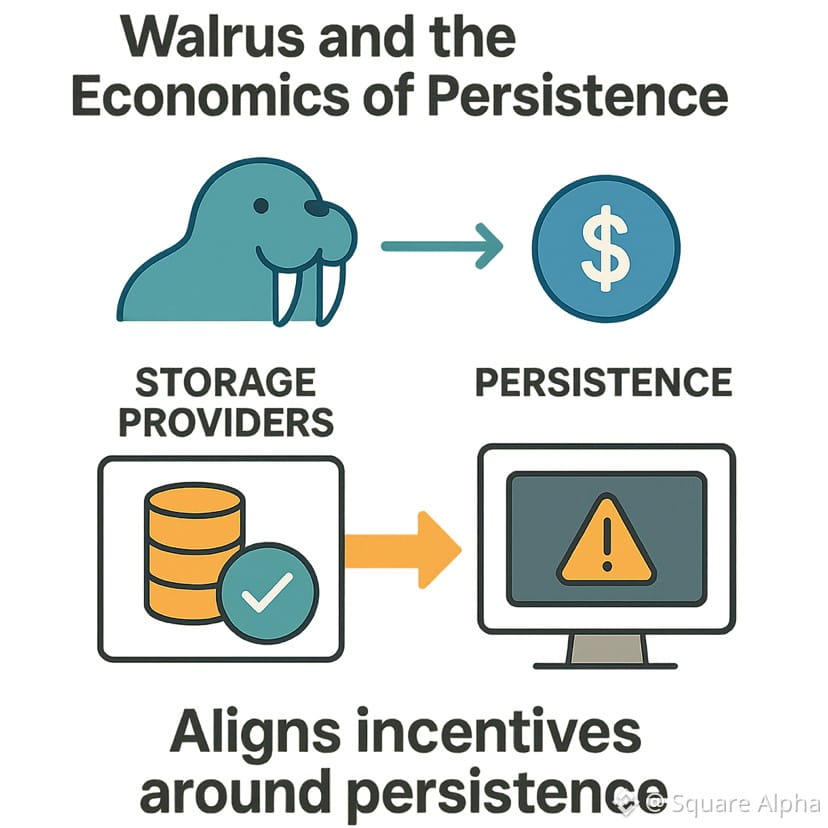
Instead of existing as a speculative centerpiece, WAL aligns incentives around persistence. Storage providers are rewarded not just for capacity, but for remaining available when conditions are unfavorable. This is subtle, but critical.
Infrastructure fails when incentives collapse under pressure. Walrus attempts to bind economic value to long-term reliability rather than short-term participation. That makes WAL less exciting in narrative terms — and more credible in operational terms.
This is how infrastructure tokens are supposed to work.
Where Walrus Actually Gets Used
Walrus adoption will not start with retail enthusiasm. It will start with necessity.
The strongest use cases are applications where missing data equals failure:
NFT platforms that cannot afford broken media
Games that rely on persistent world assets
AI agents that depend on historical datasets
On-chain systems that need verifiable off-chain data
Compliance-heavy projects storing records and proofs
In all of these cases, centralized storage introduces a single point of failure that contradicts the rest of the stack. Walrus offers an alternative that aligns with decentralized execution.
Once integrated, storage is rarely replaced. That is why infrastructure adoption is slow — and why it is sticky.
Decentralization That Reduces Risk
Decentralization is often framed as ideology. In infrastructure, it is risk management.
Centralized storage is efficient until it isn’t. Outages, policy changes, pricing shifts, and access restrictions all introduce uncertainty. Walrus reduces that uncertainty by distributing responsibility across a network designed to tolerate failure.
For developers, this is less about philosophy and more about predictability. Systems that behave consistently under stress are easier to build on than systems that fail silently.
Walrus targets that exact pain point.
What Success Looks Like for Walrus
If Walrus succeeds, it will not dominate narratives. It will disappear into workflows.
Developers will stop talking about storage choices publicly. Applications will assume data availability as a baseline. Users will stop encountering broken references. Over time, the dependency will become invisible.
Invisible infrastructure is the most successful infrastructure.
Conclusion
Walrus is not trying to redefine Web3. It is trying to finish it.
By extending decentralization into data availability, @Walrus 🦭/acc addresses a structural weakness that has existed since the first smart contract was deployed. $WAL exists to sustain that layer through real-world conditions, not idealized assumptions.
This is not a short-term story. It is an infrastructure story.
And infrastructure, once adopted, tends to stay.
🦭 #walrus