
@Plasma is not trying to onboard institutions into crypto. Plasma is trying to give institutions a way to avoid crypto altogether while still using blockchains.
That sounds contradictory — and that’s exactly why it matters.
Most blockchain projects assume institutional adoption means convincing banks, funds, and enterprises to embrace crypto-native behaviors: wallets, gas management, composability, on-chain experimentation. Plasma is built on the opposite assumption. It assumes institutions do not want to learn crypto. They want infrastructure that behaves like the systems they already trust.
This single assumption explains Plasma more accurately than any technical overview.
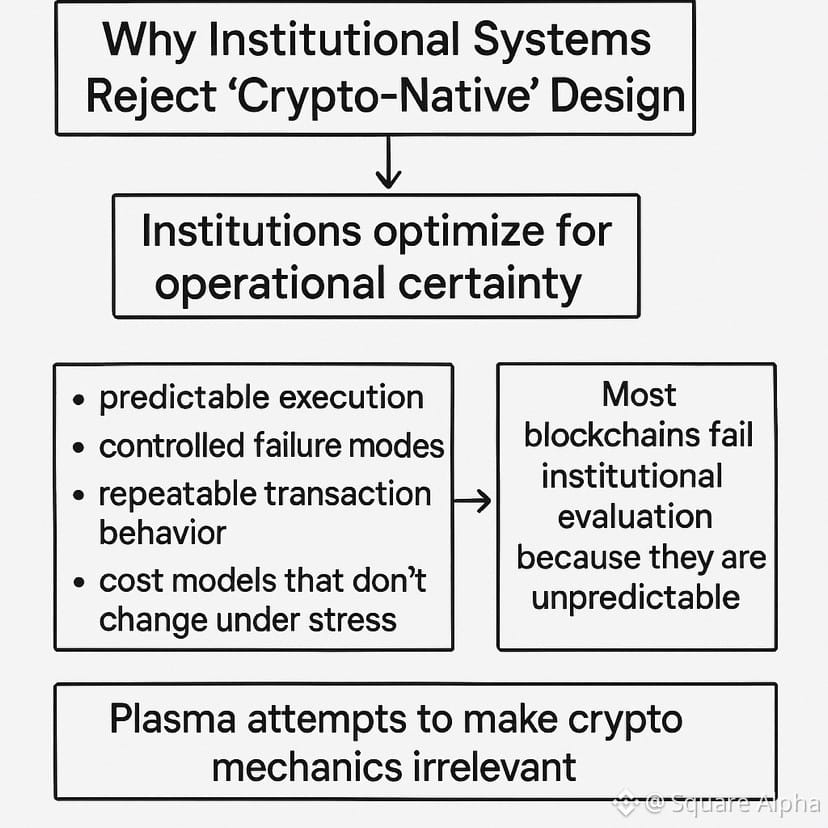
Why Institutional Systems Reject “Crypto-Native” Design
Institutions do not optimize for innovation velocity. They optimize for operational certainty.
Their priorities are boring but rigid:
predictable execution
controlled failure modes
repeatable transaction behavior
cost models that don’t change under stress
Most blockchains fail institutional evaluation not because they are decentralized, but because they are unpredictable. Volatile fees, shifting execution behavior, and incentive-driven congestion are unacceptable in environments where accountability exists.
Plasma’s design implicitly acknowledges this. It does not attempt to make institutions fluent in crypto mechanics. It attempts to make crypto mechanics irrelevant.
That is a deeply contrarian position in this market.
Plasma Is Not Competing With Blockchains — It’s Competing With Internal Ledgers
Here’s the mistake most analysts make: they compare Plasma to L1s and L2s.
Institutions are not choosing between chains. They are choosing between:
keeping value movements internal
relying on legacy settlement rails
or exposing themselves to public infrastructure
Plasma’s real competition is internal databases and reconciliation-heavy workflows, not Ethereum rollups. Its value proposition is not expressiveness — it is external settlement without losing control.
This is why Plasma does not over-optimize for composability or experimentation. Those traits are liabilities in institutional contexts. What matters is that transactions behave the same way every time, under scrutiny.
That is the lens Plasma is built through.
Why “Less Flexibility” Is a Feature, Not a Weakness
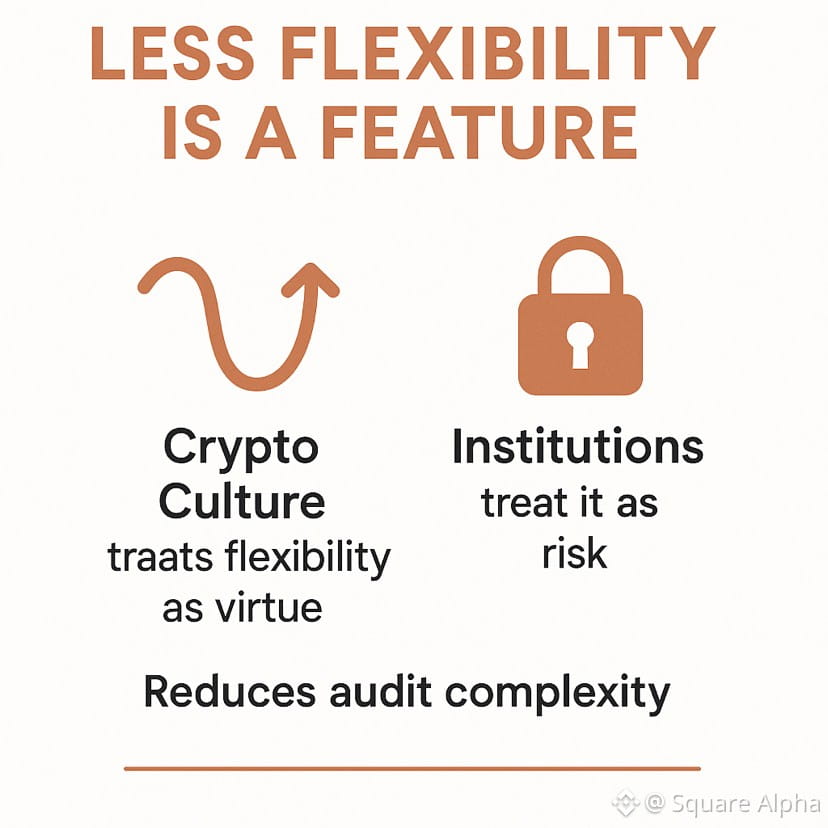
Crypto culture treats flexibility as virtue. Institutions treat it as risk.
Plasma’s restrained execution environment is not an accident. It narrows the space of possible behavior to reduce audit complexity and operational surprises. This makes the system less exciting for builders — and more legible for compliance, risk, and finance teams.
In institutional systems, fewer options often mean fewer failure paths. Plasma leans into that trade-off instead of pretending it doesn’t exist.
That choice will never trend.
But it will pass due diligence more often.
The Quiet Role of XPL
From an institutional lens, $XPL is not meant to be a speculative signal. It functions as a network-aligned asset, not a growth narrative. Plasma avoids using the token to manufacture activity because artificial volume destroys the very predictability institutions require.
This is why Plasma feels slow. It is waiting for usage that is defensible, not usage that is loud.
Institutions do not reward speed. They reward survivability.
Why Plasma Scores Poorly in Creator Metrics — and Why That’s Telling
Creator ecosystems reward visibility, novelty, and engagement loops. Plasma intentionally deprioritizes all three. That makes it difficult to score well in creator-focused frameworks, but aligned with how infrastructure adoption actually happens.
Institutions don’t discover systems through content. They discover them through reliability under constraint. By the time attention arrives, the decision is already made.
Plasma is building for that moment — not the lead-up.
Conclusion
Plasma’s core insight is uncomfortable for crypto:
institutional adoption does not look like adoption at all.
It looks like crypto disappearing behind predictable behavior, controlled execution, and boring reliability. @Plasma is not trying to teach institutions how blockchains work. It is trying to ensure they never have to care.
If that bet is right, Plasma will never feel early.
It will only feel obvious — later.
That’s why #Plasma is best understood not as a product, but as a refusal to play crypto’s favorite game.