
In the current blockchain ecosystem, most new L1s compete on speed, ecosystem size, and token hype. In an AI-driven era, that focus is misplaced. Autonomous systems do not care about flashy launches or marketing narratives. They care about infrastructure that is reliable, continuous, and economically meaningful. @Vanarchain is one of the few platforms to recognize this shift, and its $VANRY token is designed not as a speculative asset, but as the backbone of real AI-native activity. #vanar
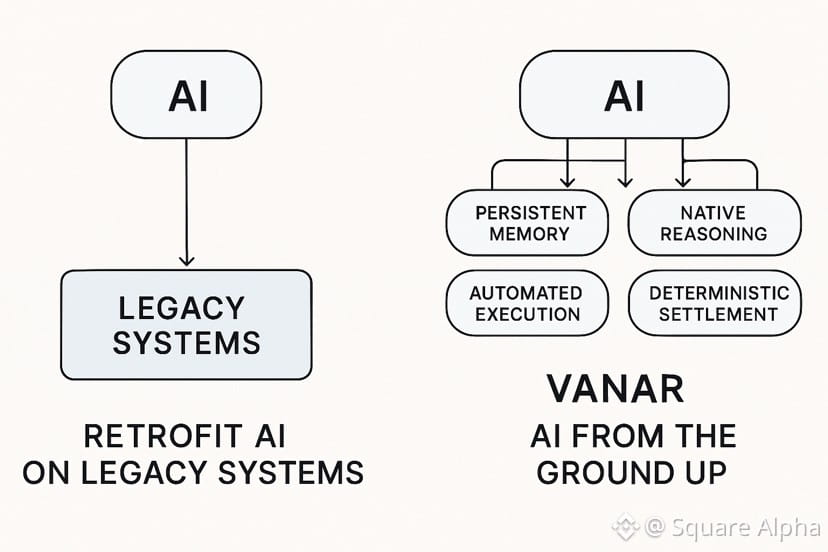
Vanar’s approach is contrarian. Whereas most chains retrofit AI on top of legacy systems, Vanar assumes intelligence from the ground up. This means persistent memory, native reasoning, automated execution, and deterministic settlement are built directly into the architecture. By designing for AI-native systems rather than human users, Vanar creates an environment where autonomous agents, enterprise systems, and regulated actors can operate reliably. The result is infrastructure that institutions can adopt without uncertainty, and a token economy that reflects actual usage, not hype.
Institutions do not make adoption decisions based on narrative or early-stage excitement. They require auditability, predictable execution, and measurable economic activity. Vanar aligns with these requirements because each interaction — whether an agent accessing memory, executing a decision, or settling a transaction — translates directly into $VANRY value. This design ensures that adoption scales with real-world activity, not speculative interest. In effect, VANRY is embedded into the operational logic of the chain, making it inseparable from infrastructure utility.
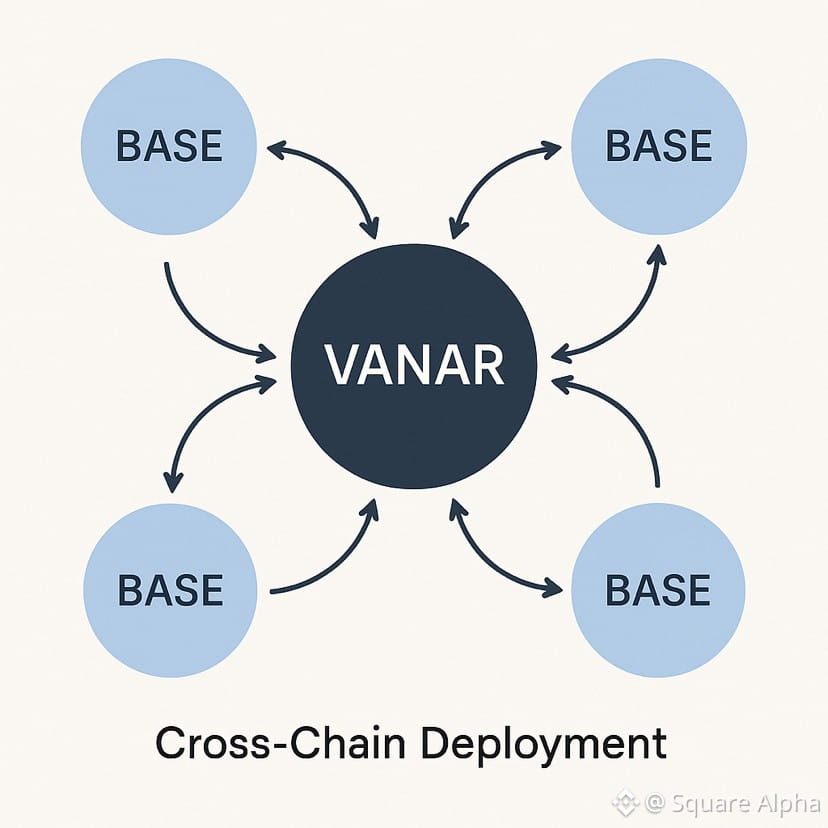
A major differentiator for Vanar is cross-chain deployment. Autonomous systems cannot remain siloed on a single network. Starting with Base, Vanar extends its AI-native infrastructure across ecosystems, enabling agents to operate and settle value seamlessly. This interoperability increases both adoption and token velocity. By supporting cross-chain coordination, Vanar demonstrates that AI-first infrastructure cannot be isolated and that its economic activity scales naturally beyond any single L1.
The market is littered with chains that prioritize marketing over function. Vanar flips this approach, focusing on readiness, reliability, and economic alignment. Autonomous agents reward infrastructure that can operate under real-world constraints, and Vanar ensures that VANRY reflects this reality. Instead of chasing trends, the platform positions itself where institutional adoption, intelligent automation, and economic settlement converge.
Vanar’s live ecosystem proves readiness rather than promises it. Systems like myNeutron establish persistent memory, allowing agents to retain context over time. Kayon embeds explainable reasoning, so autonomous decisions are auditable and verifiable. Flows enables automated execution, translating intelligence into controlled, predictable outcomes. Each layer of Vanar’s stack reinforces the others, creating a holistic environment for AI-native systems. These are not theoretical features; they are operational primitives that institutions, developers, and enterprises can rely on.
The long-term advantage of Vanar is structural. New L1s may compete on attention today, but in an AI-first economy, infrastructure that cannot support autonomous reasoning, memory, execution, and settlement will quickly become obsolete. Vanar is designed to grow in utility as AI adoption accelerates, and VANRY captures that economic activity naturally. In a world increasingly defined by autonomous systems, Vanar transforms intelligence into real-world value.
The AI era exposes the weakness of hype-driven chains. Institutions and intelligent systems will gravitate toward infrastructure that is predictable, scalable, and economically meaningful. Vanar provides this foundation, with VANRY as the token that reflects usage, trust, and adoption. It is infrastructure built for the realities of AI, not the narratives of marketing cycles.
@Vanarchain | $VANRY | #vanar