
@Plasma is not built to convince institutions that crypto is safe. It is built so that institutions can prove to themselves that nothing unexpected happened.
That distinction is subtle — and decisive.
Most blockchain narratives aimed at institutions focus on access: access to liquidity, access to programmability, access to new markets. Plasma takes a colder view. It assumes institutions already have access. What they lack is certainty. Certainty about execution. Certainty about costs. Certainty about post-factum explanation.
Plasma is designed around that gap.
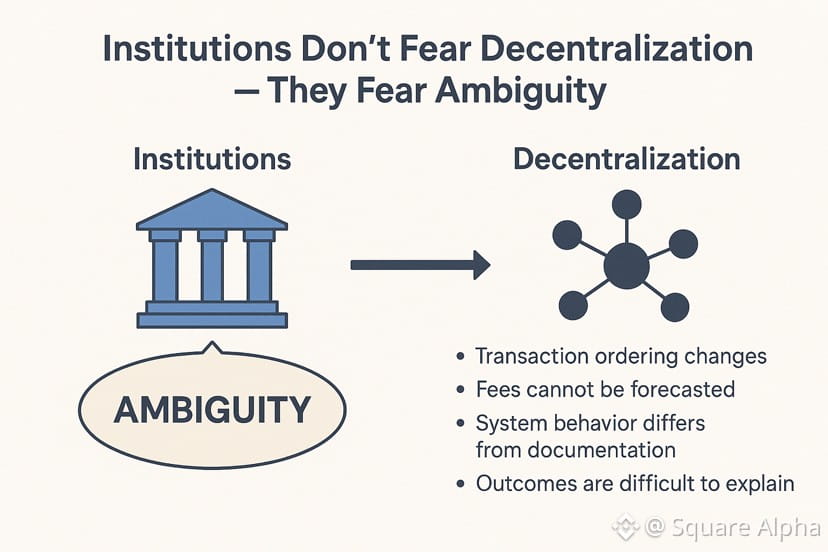
Institutions Don’t Fear Decentralization — They Fear Ambiguity
From an institutional lens, decentralization is not the primary concern. Ambiguity is.
Ambiguity shows up when:
transaction ordering changes under load
fees cannot be forecasted
system behavior differs from documentation
outcomes are correct but difficult to explain
Most blockchains tolerate these properties because crypto-native users accept them. Institutions do not. Every ambiguous outcome becomes a compliance question, an audit exception, or a governance issue.
Plasma’s architecture is shaped by the assumption that every transaction must be explainable after the fact. That assumption naturally limits design freedom — and that’s intentional.
Why Plasma Treats Execution as a Compliance Surface
Execution environments are usually discussed as developer tooling. Institutions see them as compliance surfaces.
Plasma’s restrained execution model reduces the number of possible states a transaction can pass through. Fewer states mean fewer interpretations. Fewer interpretations mean fewer problems during review. This is not about being less powerful — it is about being more legible.
While Plasma supports familiar execution paradigms, it does not maximize expressiveness for its own sake. It optimizes for deterministic behavior that survives scrutiny weeks or months later.
That is a very different success metric.
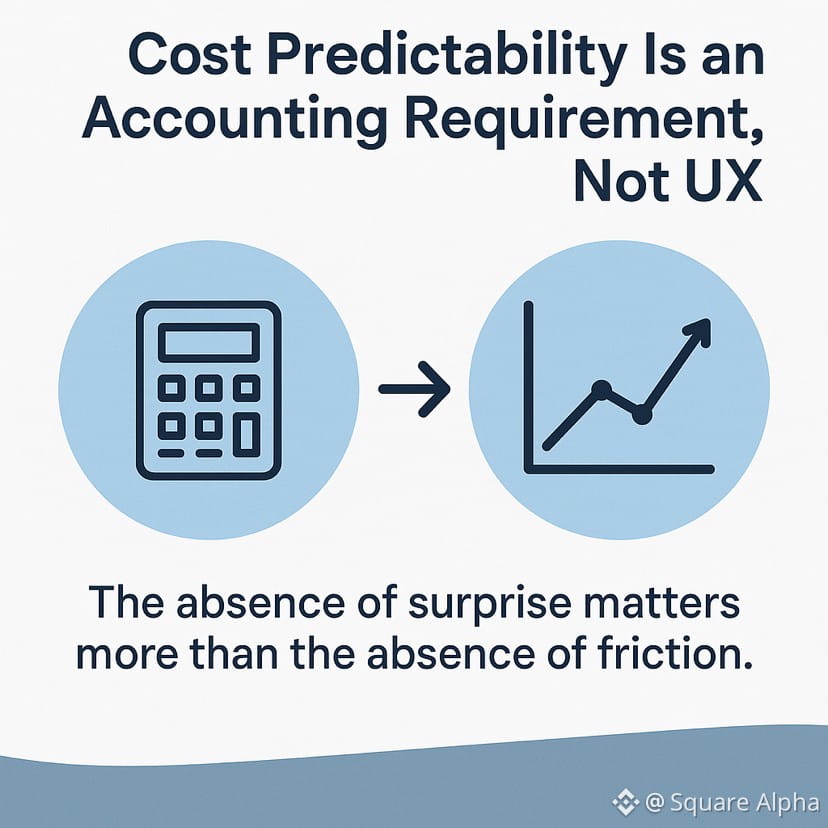
Cost Predictability Is an Accounting Requirement, Not UX
In retail crypto, variable fees are an inconvenience. In institutional systems, they are an accounting failure.
Plasma approaches cost behavior as something that must be modeled in advance, not explained after the fact. Predictable execution costs simplify reconciliation, automation, and internal controls. This is why Plasma avoids designs where congestion fundamentally reshapes transaction economics.
The absence of surprise matters more than the absence of friction.
Plasma Competes With Process, Not Platforms
A common mistake is to frame Plasma against other blockchains. Institutions don’t choose platforms the way developers do. They choose processes.
The real alternatives Plasma competes with are:
batch settlement with delayed finality
internal ledger adjustments followed by reconciliation
manual exception handling wrapped in policy
Plasma’s value proposition is not speed. It is reducing operational surface area. Fewer exceptions. Fewer manual interventions. Fewer explanations required.
That is why Plasma’s progress looks slow from the outside. Process change always does.
The Role of XPL in an Institutional Context
From an institutional perspective, $XPL is not a narrative asset. It is part of the system’s internal alignment. Plasma avoids turning the token into an incentive engine because incentives distort behavior — and distorted behavior breaks predictability.
This restraint is costly in the short term. It also keeps the system coherent. Institutions do not want to wonder whether activity exists because it is needed or because it is subsidized.
Plasma chooses clarity over acceleration.
Why Plasma Will Be Evaluated Late — and Strictly
Institutions rarely adopt infrastructure early. They adopt it after it has survived stress, audits, and quiet usage. Plasma’s design suggests it expects to be evaluated after being used, not before.
That makes @Plasma easy to ignore and hard to dismiss once embedded. Systems optimized for auditability and repeatability do not announce themselves. They accumulate trust slowly.
Conclusion
Plasma is built around a principle crypto rarely centers: nothing should need to be explained twice.
Its execution discipline, cost behavior, and token restraint all serve that goal. Plasma is not trying to sell institutions on blockchain potential. It is trying to remove reasons for internal objections.
If adoption comes, it will not come with applause.
It will come with approval.
And in institutional finance, approval matters more than excitement.
That is the real lens for understanding #Plasma , @Plasma , and the quiet role of $XPL .