
The biggest misconception in crypto right now is that AI adoption will be driven by innovation alone. It won’t. In practice, AI systems scale only where economic discipline, reliability, and accountability already exist. Infrastructure that cannot enforce these constraints becomes unusable the moment AI moves from experimentation to deployment.
This is where @Vanarchain quietly separates itself. Instead of positioning itself as another experimental AI chain, Vanar focuses on building infrastructure that can survive real-world economic pressure, with $VANRY acting as the settlement layer that anchors intelligent activity to measurable value. #vanar
Most blockchains were designed for human participation: occasional transactions, manual approvals, and fragmented usage patterns. AI systems behave very differently. They operate continuously, interact with other systems autonomously, and generate economic activity at machine speed. Without predictable settlement and enforceable outcomes, these systems fail quickly. Vanar’s architecture assumes this reality from the outset, prioritizing determinism over flexibility and execution over experimentation.
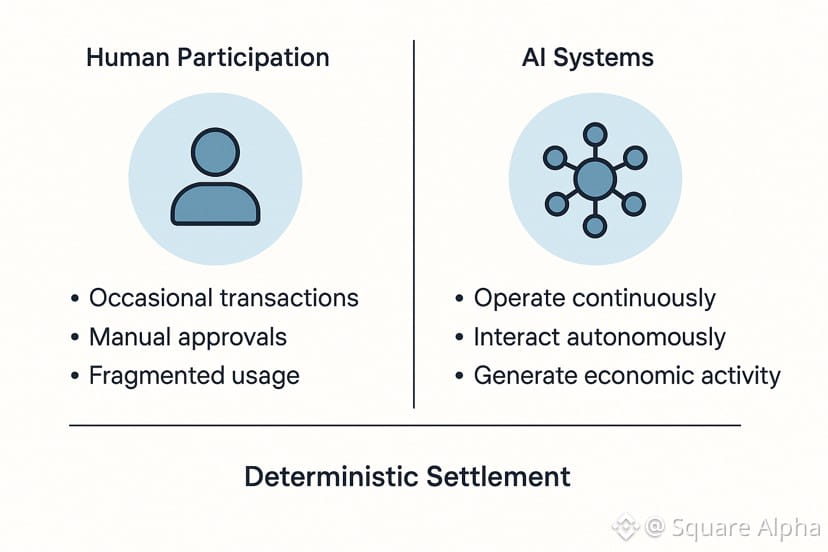
From an institutional perspective, this distinction matters more than innovation narratives. Enterprises and regulated entities are not looking for chains that promise future breakthroughs; they are looking for platforms that can support autonomous processes without introducing systemic risk. Vanar’s design aligns with this requirement by embedding intelligence into infrastructure while ensuring that all activity resolves economically through $VANRY. This creates a clear link between usage and value — something institutions can model, audit, and trust.
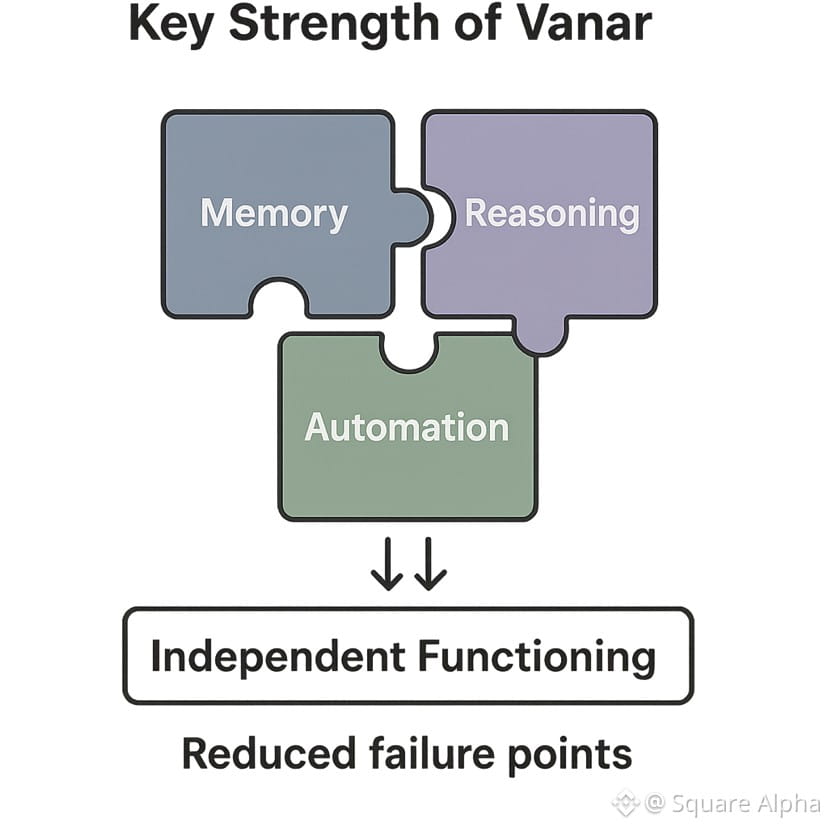
A key strength of Vanar is that it treats intelligence as an operational load, not a marketing feature. Memory, reasoning, and automation are integrated in a way that allows systems to function independently without relying on fragile off-chain coordination. This reduces failure points and increases predictability — two properties that matter far more to institutional adopters than raw performance metrics.
Economic settlement is the final filter that separates viable AI infrastructure from demos. AI systems must be able to pay, compensate, and settle outcomes without human intervention. VANRY enables this by functioning as a machine-compatible economic primitive, allowing autonomous systems to transact with clarity and finality. When economic resolution is native, AI activity becomes sustainable rather than experimental.
Vanar’s cross-chain expansion, starting with Base, reinforces this discipline. Instead of fragmenting intelligence across disconnected networks, Vanar enables systems to operate across environments while maintaining consistent economic rules. This matters because AI systems do not respect chain boundaries — they follow efficiency and reliability. Cross-chain availability increases usage without compromising structure, which is essential for long-term adoption.
The broader market is crowded with chains optimized for attention rather than endurance. Many will struggle as AI adoption accelerates because their infrastructure was never designed to handle autonomous economic behavior. Vanar takes the opposite approach: it assumes that automation will increase pressure on infrastructure, not reduce it. By building for that pressure now, Vanar positions itself ahead of the curve.
In the long run, AI will expose which blockchains were built for narratives and which were built for responsibility. Infrastructure that cannot enforce economic outcomes will fade. Infrastructure that aligns intelligence with settlement will compound in relevance. Vanar sits firmly in the second category, with VANRY capturing value as intelligent systems transact, coordinate, and execute in real conditions.
The AI era will not reward the loudest chains. It will reward the most disciplined ones.