

A few weeks ago I was watching a short warehouse clip someone posted online. Nothing special. Just a small robot carrying boxes from one side of the room to the other. What caught my attention wasn’t the robot itself. It was the silence around the activity. The machine moved, completed a task, and the moment basically disappeared. No persistent record, no economic trace, nothing the outside world could verify later.
That gap feels strange if you spend time around financial systems. In markets, almost everything leaves a footprint. A trade happens and instantly there is a timestamp, a price level, volume data, order flow. Analysts study those records months later. Physical machines, meanwhile, do millions of actions a day and most of it simply fades away once the task is done.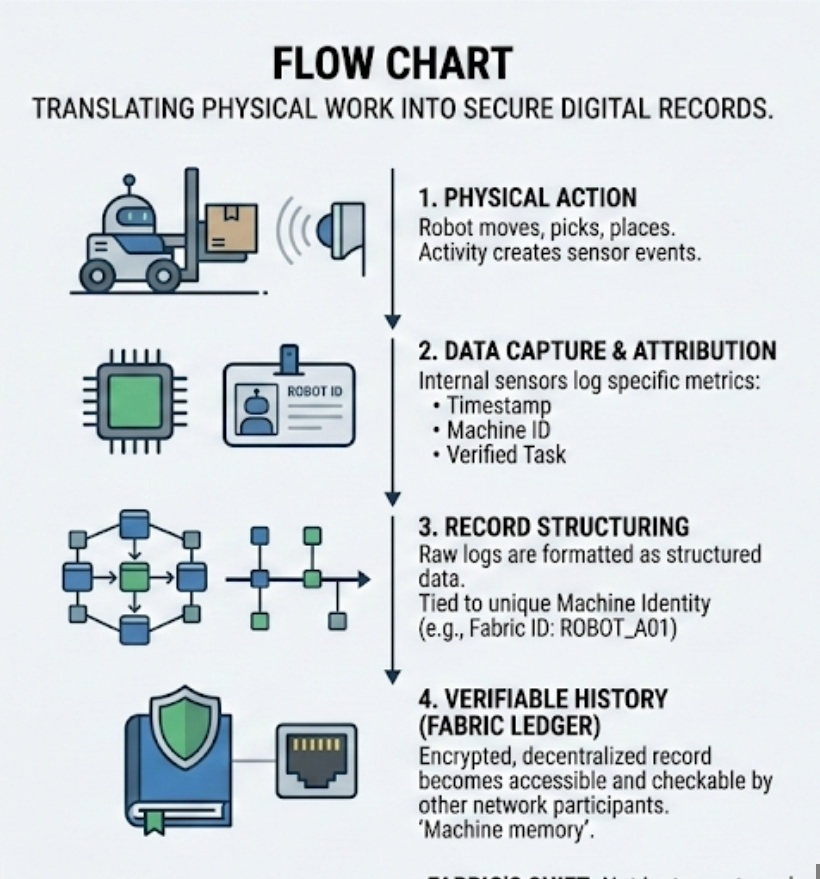
Fabric seems to be exploring a different direction. Not just building machines that work, but building infrastructure that remembers what they did. On the surface it’s simple. A robot performs a task and the system records that activity. Users might only see a log entry or dashboard metric. Underneath though, those logs are structured records tied to a machine ID, a timestamp, and a verifiable action.
It sounds technical, but the idea is almost mundane. Take physical work and turn it into data that other systems can check later.
The scale of this becomes easier to see when you look at robotics growth. The International Federation of Robotics reported around 553000 industrial robots installed globally in 2023. That number only reflects new installations during the year. Each machine performs thousands of operations daily. Multiply that across factories, warehouses, logistics hubs. The volume of machine activity becomes enormous very quickly.
Yet very little of that activity exists as trusted data outside the company running the machines.
That’s where Fabric’s approach starts to get interesting. Surface level, a robot moves objects or performs industrial tasks. Beneath that surface, sensors and logs capture every step. Over time those records can be verified by other participants in the network. If the infrastructure works correctly, machine activity stops being invisible labor and becomes a stream of structured information.
I’ve seen similar patterns before in crypto markets. Ethereum validators, for instance, don’t just process transactions. They produce verifiable records of network activity. Every block confirms something happened and when it happened. The chain itself becomes a memory system.
Fabric feels like an attempt to apply that same logic to the physical world.
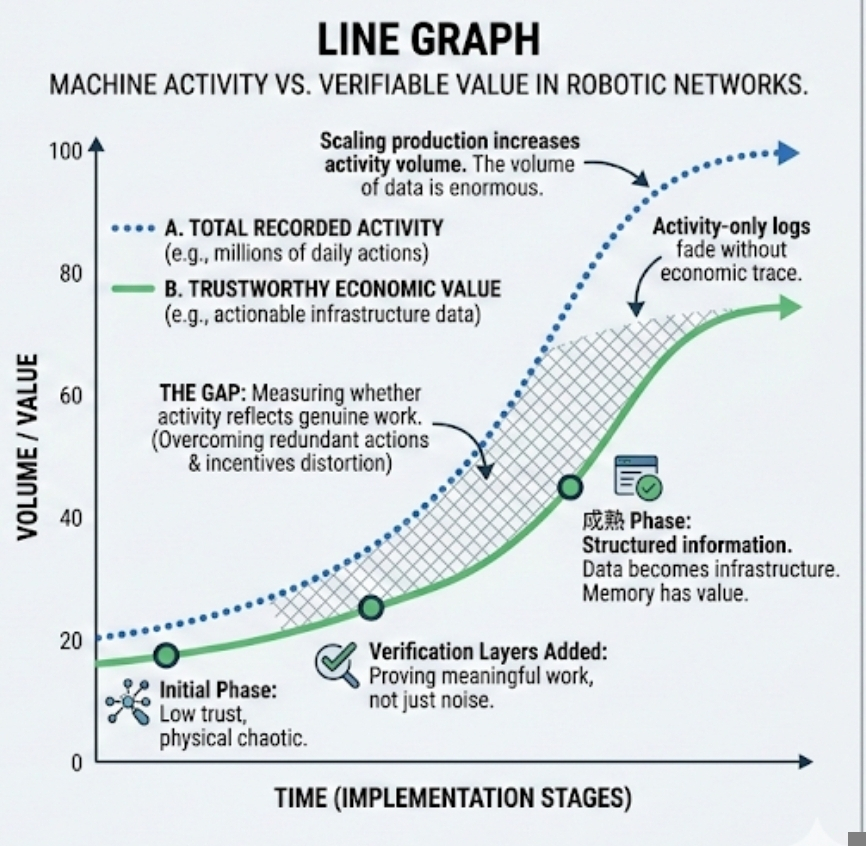
Still, recording activity is not the same as proving meaningful work. Anyone who has traded through liquidity mining periods understands how quickly incentives distort behavior. When rewards are tied to measurable activity, participants often start optimizing for the metric rather than the outcome. The network says “record activity,” and suddenly the system is full of activity that technically qualifies but doesn’t add much real value.
Machines could face similar dynamics.
A robot might perform redundant actions if the system rewards logged movement. Sensors might record tasks that were only partially completed. Small inaccuracies in physical data collection can multiply quickly, especially when thousands of machines are producing logs simultaneously.
Another layer of complexity appears when economic incentives enter the picture. The global robotics industry generated roughly 55 billion dollars in revenue in 2023. That number includes hardware manufacturing, deployment, and software systems. Fabric’s model hints at something slightly different. Instead of only selling robots or automation tools, it treats the record of machine activity as a form of infrastructure.
Not the machine. The memory of the machine.
That idea feels subtle but potentially powerful.
And oddly enough, the dynamics remind me of content platforms like Binance Square. Writers often assume visibility comes from strong opinions or clever phrasing. In reality the system looks at engagement patterns. How long readers stay on the post. Whether comments show real thought or just quick reactions. Saves and follow up discussions also matter.
CreatorPad’s evaluation models push even deeper into that territory. A post might receive thousands of impressions but still remain low in ranking if readers leave quickly. The infrastructure is quietly measuring whether activity represents genuine attention.
Fabric appears to be experimenting with a similar philosophy for machines.
Surface activity becomes visible data. Then the infrastructure evaluates whether that activity reflects real work. Over time the network starts shaping behavior because machines, operators, and developers adapt to whatever signals the system rewards.
Of course none of this guarantees the model will work. Physical environments are messy. Sensors break. Connectivity drops. A warehouse floor is not a clean digital network. Turning that chaotic environment into reliable infrastructure data is much harder than logging blockchain transactions.
But the attempt says something about where the conversation around robotics may be heading.
For years the industry focused on intelligence. Smarter robots, better perception, improved autonomy. Fabric seems to be asking a quieter question.
What if the most valuable thing machines produce isn’t intelligence at all, but a trustworthy record of what they actually did?