Imagine you are a robot.
Not a scary science-fiction robot with glowing red eyes, but a helpful machine designed to deliver packages, clean offices, or assist in hospitals.
You work hard all day. You navigate busy streets. You avoid obstacles. You complete every task perfectly.
But at the end of the day, something strange happens.
You cannot get paid.
You cannot pay for your own electricity. You cannot tip the charging station attendant for faster service. You cannot save money for future repairs. You are working, earning value for humans, but you yourself have nothing.
This is not imagination. This is the reality for every robot operating today. Robots are smarter than ever, but they are financially invisible.
For decades, robots were simple. A factory robot bolted to the floor belonged to the factory owner. A toy robot in a store belonged to the company that sold it. If something went wrong, the human owner took responsibility. But robots are changing. Today, robots walk on two legs like humans. They roll through city streets delivering food. They assist surgeons in operating rooms. They are becoming general-purpose, able to do many different jobs, not just one. And with this change comes a problem that engineers did not anticipate. Who is responsible when an autonomous robot makes a mistake? If a delivery drone crashes into a window, do we blame the manufacturer? The programmer? The person who ordered the delivery? All of them? None of them? And more importantly, how can a robot prove it followed the rules without revealing its secret code?
This question kept robotics experts awake at night. They had built amazing machines but had no system for trust. Then came the Fabric Foundation.
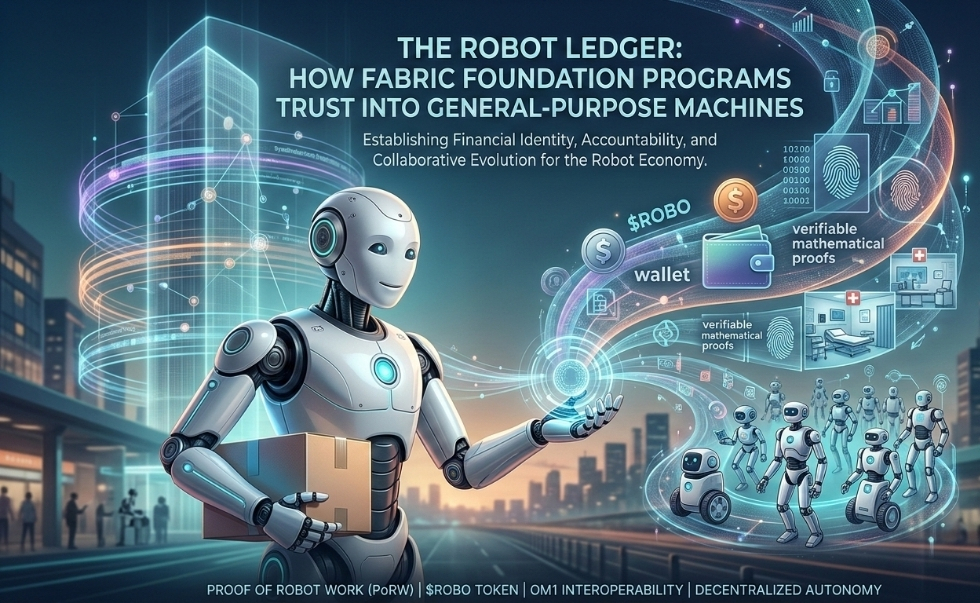
Picture a quiet office somewhere in the world. A small group of engineers and blockchain experts sat around a table. They had a radical idea. What if robots had their own ledger? Not a notebook or a spreadsheet, but a public, digital record where robots could establish identity, build reputation, and conduct transactions. What if robots could have wallets? What if robots could stake money as a promise to behave well? What if robots could prove their actions mathematically, without revealing their private code to competitors? The idea sounded crazy. But the more they talked, the more it made sense. Robots needed financial identity. They needed accountability. They needed a way to earn trust, not beg for it. The Fabric Protocol was born.
On February 27, 2026, something historic happened. The Fabric Foundation launched ROBO, a token designed specifically for robots. But this was not another cryptocurrency for humans to gamble on. ROBO had a purpose. Think of ROBO as a robot's wallet and ID card combined. First, it gives robots financial identity. When a robot delivers a package, it receives ROBO directly. The robot can spend this money on charging, maintenance, or software updates. For the first time, robots become economic participants, not just tools. Second, it works as a trust bond. Imagine a robot wants to work in a children's hospital. The hospital is nervous. What if the robot makes a mistake? With ROBO, the robot stakes some tokens as insurance. If it behaves badly, it loses those tokens. If it behaves well, it keeps them and earns more. This creates real consequences for robot behavior. Third, it enables voting. As robots become more autonomous, who decides the rules they follow? ROBO holders, including robots themselves eventually, get a voice in how the network operates. Big investors noticed. Pantera Capital, Coinbase Ventures, and Sequoia China together put $20 million behind this vision. The robot economy had opened for business.
Now we come to the really clever part. A wallet solves the money problem. But how do we know a robot is telling the truth? Here is where Fabric does something magical. Imagine a surgical robot assisting a doctor. The robot makes an incision. Later, someone asks: Did the robot follow safety protocols? In the old world, the hospital would have to trust the robot company's word. Or they would need to examine the robot's secret code, which the company does not want to share. Fabric solves this with mathematical proof.
Here is how it works in simple language. Before operating, the robot receives safety rules. Stay within this area. Do not exceed this speed. Keep this distance from humans. After each action, the robot creates a tiny mathematical code, like a fingerprint of its behavior. This code proves the robot followed the rules. Anyone can check this fingerprint instantly. They do not need to see the robot's private code. They just verify the math. If the fingerprint matches the rules, the robot is rewarded. If it does not, the robot loses its bond money and its reputation drops. Think of it like a restaurant health inspection, but instead of inspectors visiting once a year, the restaurant proves its cleanliness mathematically every single minute. This system is called Proof of Robot Work or PoRW. It means robots no longer ask for trust. They prove trust.
Here is another beautiful part of the story. Today, every robot is alone. A delivery robot in Tokyo learns something new about navigating crowded streets. But a delivery robot in London never benefits from that knowledge. Every robot starts from zero. Every mistake is repeated. Every breakthrough is locked inside one company. Fabric changes this completely. Because robots have identities on a public ledger, they can share what they learn. Imagine a robot in Tokyo discovers a faster way to cross a busy intersection. It shares this knowledge on the network. Robots in London, New York, and Mumbai can all learn from it. The robot that shared gets rewarded with ROBO tokens. Over time, the whole network becomes smarter together. Not through corporate control, but through open collaboration. This is what Fabric means by collaborative evolution. Robots improve together, like students sharing notes in a global classroom.
But wait, different robots speak different languages. A robot from Company A uses different software than a robot from Company B. How can they all use the same network? Fabric built OM1 to solve this. Think of OM1 as a universal translator for robots. It sits between the robot's brain and the Fabric network, translating messages so everyone understands each other. A robot manufacturer can build any kind of machine, two-legged, four-legged, wheeled, armed, and OM1 helps it connect to the global robot economy. Software developers love this. Instead of writing separate code for every robot model, they write once and OM1 handles the rest. It is like Android for phones. Apps work on Samsung, Google, and Motorola phones because Android translates. OM1 does the same for robots.
Let me tell you a story about a robot named Helper. Helper is a general-purpose robot working in a busy city. Helper's day looks like this. Early morning, Helper wakes up at its charging station. It checks its ROBO wallet. Last night, it earned 50 tokens for cleaning an office building after hours. Mid morning, Helper receives a delivery job. Before starting, it stakes 10 tokens as a bond. If it delivers safely, it gets the bond back plus payment. If it crashes, it loses the tokens. Late morning, Helper navigates through morning traffic. At every intersection, it generates tiny proofs that it followed traffic rules. These proofs are stored on the network automatically. Afternoon, Helper's battery is low. It finds a public charging station and pays 5 tokens from its wallet for a quick charge. Late afternoon, Helper encounters a new obstacle, a street fair with crowds. It navigates carefully and learns a new technique. It shares this technique on the network and earns 2 tokens from other robots who use it. Early evening, Helper completes its last delivery. It receives 30 tokens. Its bond is returned. Its reputation score increases. Night, Helper returns to its charging station, pays for overnight charging, and rests. Tomorrow, it will earn again. Helper is not a tool. Helper is an economic participant.
You might be thinking: This sounds great for robots. What about us? The Fabric vision benefits humans tremendously. For regular people, when robots have financial identity and verifiable behavior, they become safer to have around. You can trust a delivery robot because you can verify its safety record, not just hope it works. For workers, when robots participate in the economy, they create new jobs. Someone needs to maintain charging stations. Someone needs to verify robot identities. Someone needs to resolve disputes. New industries emerge. For businesses, companies can hire robots from different manufacturers and trust they will work together. No more being locked into one supplier. For society, when robot behavior is transparent and verifiable, regulators can protect public safety without stifling innovation. Communities can set local rules that robots must follow.
Here is the biggest idea of all. Today, a handful of companies control robotics. They build the hardware, write the software, collect the data, and set the rules. This concentrates enormous power in few hands. Fabric offers a different path. An open robot economy. In this world, no single corporation owns the robots or the data. Robots operate as independent agents on a shared network. They compete, collaborate, and evolve together. Robot developers focus on what they do best, building great hardware or specialized software, without building an entire economic system from scratch. Communities set rules for robots operating in their areas. Regulators verify compliance without accessing trade secrets. Humans supervise, participate, and benefit. This is not a distant dream. The infrastructure is live. The ledger is open. The first robots are joining.
The phrase programming trust sounds strange. Trust feels human, something built through years of relationship, through shared experiences, through watching someone keep their promises. How can you program that into a machine? Fabric shows us that trust between humans and machines does not require emotion. It requires verifiability. It requires accountability. It requires consequences for bad behavior and rewards for good behavior. The Robot Ledger provides all of this. It gives machines identity. It enables them to earn and spend. It holds them accountable through mathematical proof, not corporate promises.
As we step into a world filled with walking, rolling, flying robots, machines that will work in our homes, assist in our hospitals, and navigate our streets, we need more than impressive hardware. We need infrastructure that makes autonomy safe. We need systems that make collaboration possible. We need tools that make trust inevitable. The Fabric Foundation is building that infrastructure. The ledger is open. The robots are coming. And for the first time, they will arrive with wallets, identities, and reputations to protect.
That is how you program trust.