
i have a friend who works in treasury at a mid-sized company. every quarter she builds a cash flow model, not because the money is uncertain like what's happening with CARDANO and ETHEREUM , but because timing is everything. knowing you will receive something is completely different from knowing when you will receive it
the second question is the one that actually drives decisions.
i thought about her this week reading through the Glacier Drop thawing mechanic. because midnight built something genuinely elegant for aggregate supply management, and in doing so created a timing problem for individual claimants that i dont think gets talked about enough 😂
what this design gets right:
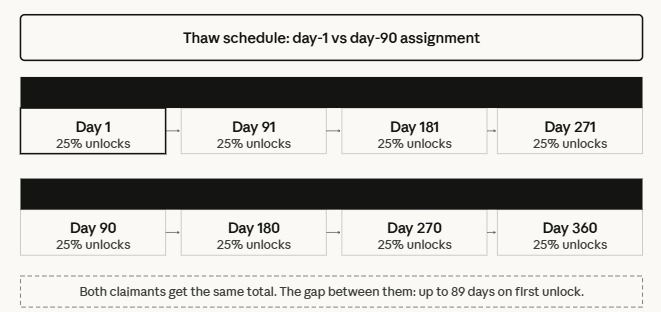
when a claimant successfully participates in Glacier Drop or Scavenger Mine, tokens do not arrive immediately. they are frozen in a redemption smart contract on Cardano. the unlock happens across four equal installments of 25 percent each, spaced 90 days apart over a total of 360 days.
the first unlock date is not fixed
it is randomly assigned to each claim at submission time, falling somewhere in a window of 1 to 90 days after the redemption period begins. a day-1 schedule unlocks at days 1, 91, 181 and 271. a day-90 schedule unlocks at days 90, 180, 270 and 360.
the rationale is explicit and genuinely smart
if every Glacier Drop claimant unlocked simultaneously the supply entering circulation would be enormous and concentrated into a single window. by spreading first unlock dates randomly across 90 days the protocol distributes supply impact automatically without requiring any governance vote or coordination from claimants. supply shock prevention baked into the protocol itself.
that is a thoughtful mechanism. no committee needed. no holder behavior required. the randomization does the work.
what keeps nagging me:
the same randomness that smooths aggregate supply creates genuine planning uncertainty for individual claimants.
when someone submits a successful Glacier Drop claim they do not know when their first tokens will unlock. they know the window is 1 to 90 days but the specific date is assigned at submission, after the fact. you submit and then wait for a date that could be tomorrow or could be three months away.
for passive holders this doesnt matter
tokens arrive when they arrive. but for participants with plans around their allocation, treasury modeling, operational timing, anything requiring predictability, the uncertainty is real and front-loaded. transparency about the mechanism and helpfulness for the person navigating it are different things.
my concern though:
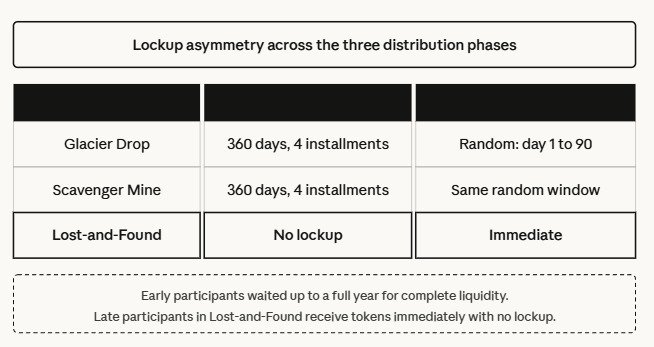
theres also an asymmetry in the design that i keep returning to. Glacier Drop and Scavenger Mine tokens are subject to the full 360-day thawing schedule. Lost-and-Found tokens are not. participants in the third phase receive tokens immediately with no lockup at all.
the reasoning makes sense from one angle, removing lockup makes Lost-and-Found participation more attractive for a group who already missed the first window. but it creates a structural liquidity difference between early and late claimants that sits with me.
early participants carried the lockup. late participants do not. the design rewards patience in phase one and then removes the same constraint in phase three for a different group.
honestly dont know if the random staggered thaw is the most elegant supply shock prevention mechanism available or a system that trades smooth aggregate distribution for individual planning uncertainty that compounds quietly the more seriously someone was counting on their allocation?? 🤔
#night @MidnightNetwork $NIGHT
