

I’ve had moments where I open a thread, skim the first few lines… and already know how it ends.
Same language. Same rhythm. Same quiet assumption that if you just say “infrastructure” enough times, people will stop asking what it actually does.
Most of it collapses under five minutes of attention.
So when I paused on Sign Protocol, it wasn’t because it sounded exciting. It didn’t. That’s probably why it worked.
It felt… heavier.
Not in the marketing sense. In the this might actually matter later sense.
Let’s be honest about the problem first.
Because crypto hates doing that.
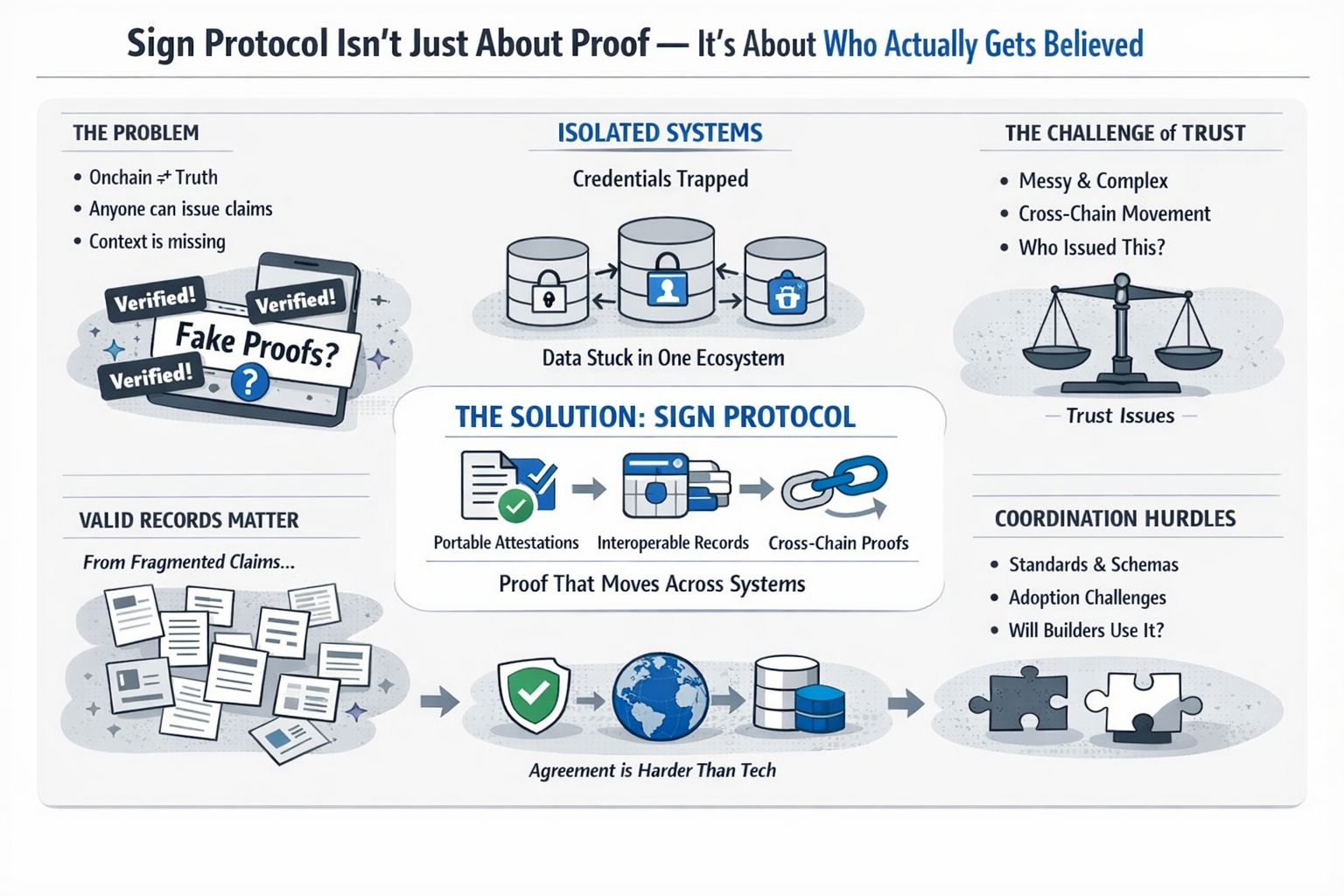
We act like putting something onchain magically upgrades it into truth. It doesn’t. It just makes it permanent. And permanence without context is just… noise that never goes away.
Anyone can sign a message.
Anyone can issue a claim.
Anyone can spin up a UI that looks legitimate.
That part is easy.
I’ve seen wallets full of “proofs” that meant absolutely nothing the second you asked one basic question: who actually issued this, and why should I care?
That’s where things start to crack.
I remember digging through a project a while back—won’t name it—and everything looked clean. Credentials, badges, activity logs… all neatly structured.
Until you realized none of it traveled.
The moment you stepped outside that ecosystem, it lost meaning. Like a currency that only works inside one arcade.
That’s the quiet failure most people ignore.
Not that data exists.
That it doesn’t carry weight.
This is where Sign Protocol starts to get interesting.
Not because it’s adding more data. We have too much of that already. Too many dashboards. Too many “verified” stamps that only work if you already believe the system issuing them.
Sign Protocol is working on something more uncomfortable.
The shape of proof itself.
Attestations. Records. Structured claims that aren’t just there… but can actually be checked, reused, moved, and trusted across contexts without falling apart.
That’s a different game.
But let’s not romanticize it.
This is not a clean problem.
Digital trust is messy. Slow. Full of edge cases nobody wants to talk about. You’re dealing with issuers, verifiers, incentives, reputation, and the uncomfortable truth that “trustless” systems still depend on… well, trust.
Just hidden better.
So yeah, I don’t look at Sign Protocol like it’s solved anything yet.
I look at it like it’s choosing to sit in the hardest part of the system.
And that matters.
Because most projects avoid that entirely.
They operate in closed loops. Build something that works internally. Keep the assumptions tight. Don’t let the data travel too far. Don’t let outsiders question it.
It’s cleaner that way.
But it doesn’t scale.
The real pressure starts when proof has to leave home.
When a credential issued in one system needs to mean something in another. When identity, permissions, ownership, or agreements need to move across chains, apps, and environments without turning into meaningless strings of data.
That’s where most systems break.
And that’s the lane Sign Protocol is stepping into.
I like that… but I don’t trust it yet.
That’s the balanced
Because I’ve seen “good ideas” get buried before. Not because they were wrong, but because they were early, or clunky, or just too hard for people to care about in the moment.
This market doesn’t reward depth.
It rewards simplicity.
And Sign Protocol is not simple.
You can’t explain it in one clean line without losing the point.
It’s not “faster transactions.”
It’s not “cheaper gas.”
It’s not even “better identity” in the way people casually use that phrase.
It’s about making digital records… mean something outside their origin.
That’s subtle.
And subtle things get ignored.
Still, I keep coming back to one idea.
Records are cheap.
Valid records are not.
That gap is only getting wider.
As everything scalesbDeFi, identity systems, governance, credentials, tokenized assets—the number of claims explodes. Everyone is issuing something. Everyone is verifying something. Everyone is building their own version of “truth.”
And most of it doesn’t connect.
It just sits there. Fragmented. Isolated. Useless outside its own sandbox.
That’s the inefficiency nobody likes talking about.
Because it’s not flashy.
But it’s real.
And it compounds.
Sign Protocol feels like it’s trying to build underneath that.
Not above it. Not around it. Underneath it.
A layer where attestations aren’t just visible, but structured in a way that makes them usable across systems. A place where proof isn’t tied to one app, one chain, one issuer.
Where it can actually move.
That’s the ambition, at least.
Whether it gets there… different story.
Because here’s the downside nobody wnts to admit:
For something like this to work, people have to agree on structure.
Schemas. Standards. Formats. Expectations.
And crypto is notoriously bad at agreeing on anything.
Everyone wants to build their own system. Their own definitions. Their own version of how things should work.
Coordination is the real bottleneck.
Not technology.
So I’m watching Sign Protocol through that lens.
Not just “can it work?”
But… will people actually use it the way it needs to be used?
Will builders adopt shared schemas instead of reinventing the wheel?
Will issuers care about portability beyond their own ecosystem?
Will users even notice the difference?
Because if they don’t…
Then this becomes another well-designed layer sitting quietly underneath a market that never bothered to plug into it.
And I’ve seen that movie before.
But if they do…
If proof starts needing to travel…
If systems start needing records that hold up outside their origin…
If verification becomes something you can’t fake with a clean UI and a confident tone…
Then Sign Protocol is sitting in a very uncomfortable, very important position.
The kind of position that doesn’t look exciting early… but becomes impossible to ignore later.
That’s probably why it sticks in my head.
Not because I think it’s going to explode. Not because I think the market suddenly got smarter.
But because it’s working on something the market keeps pretending isn’t a problem.
Until it is.
And I’ve learned to pay attention to those.
The quiet pressure points. The structural cracks. The parts of the system that don’t fail loudly, but slowly… until suddenly everything built on top of them starts wobbling.
That’s where the real opportunities usually sit.
Or the real failures.
Sometimes both.
So yeah… I’m watching Sign Protocol.
Not chasing it. Not dismissing it.
Just watching.
Because if this space actually moves toward a world where proof matters more than presentation… where records need to carry weight instead of just existing…
Then the real question isn’t whether Sign Protocol works.
It’s whether anything else can keep up if it does.