
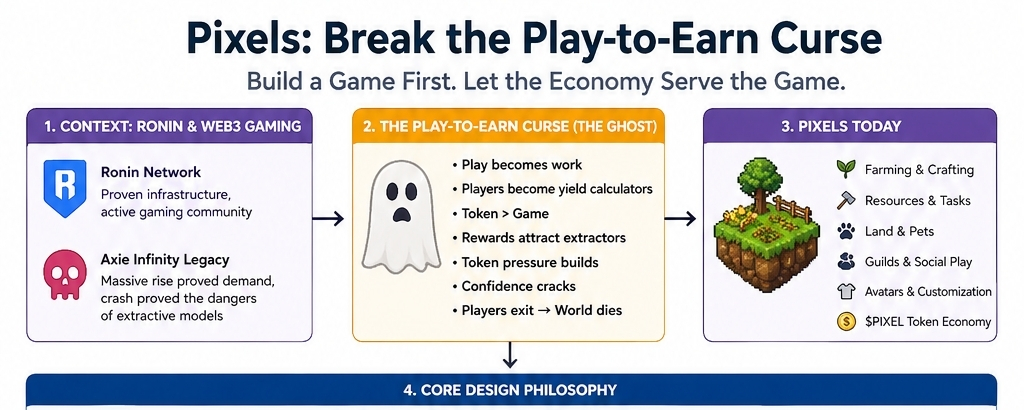
There is a ghost on Ronin.
It does not swing a sword or haunt some pixelated dungeon. It sits in the marketplace tab. It whispers through token charts. It shows up every time a player stops asking, “Is this fun?” and starts asking, “What can I get out of it?”
That ghost is play-to-earn.
Web3 gaming has been trying to outrun it for years, but the thing keeps dragging its chains behind every new project. The first wave of crypto games did not just stumble; it burned a hole through player trust. Games promised income, ownership, freedom, community, all the shiny words. Then the numbers turned ugly. Tokens bled. Rewards shrank. Players who had arrived like gold miners packed up and left the moment the soil stopped producing.
And now here comes Pixels, walking straight through that graveyard with a hoe, a backpack, and a token economy.
Brave? Maybe.
Dangerous? Definitely.
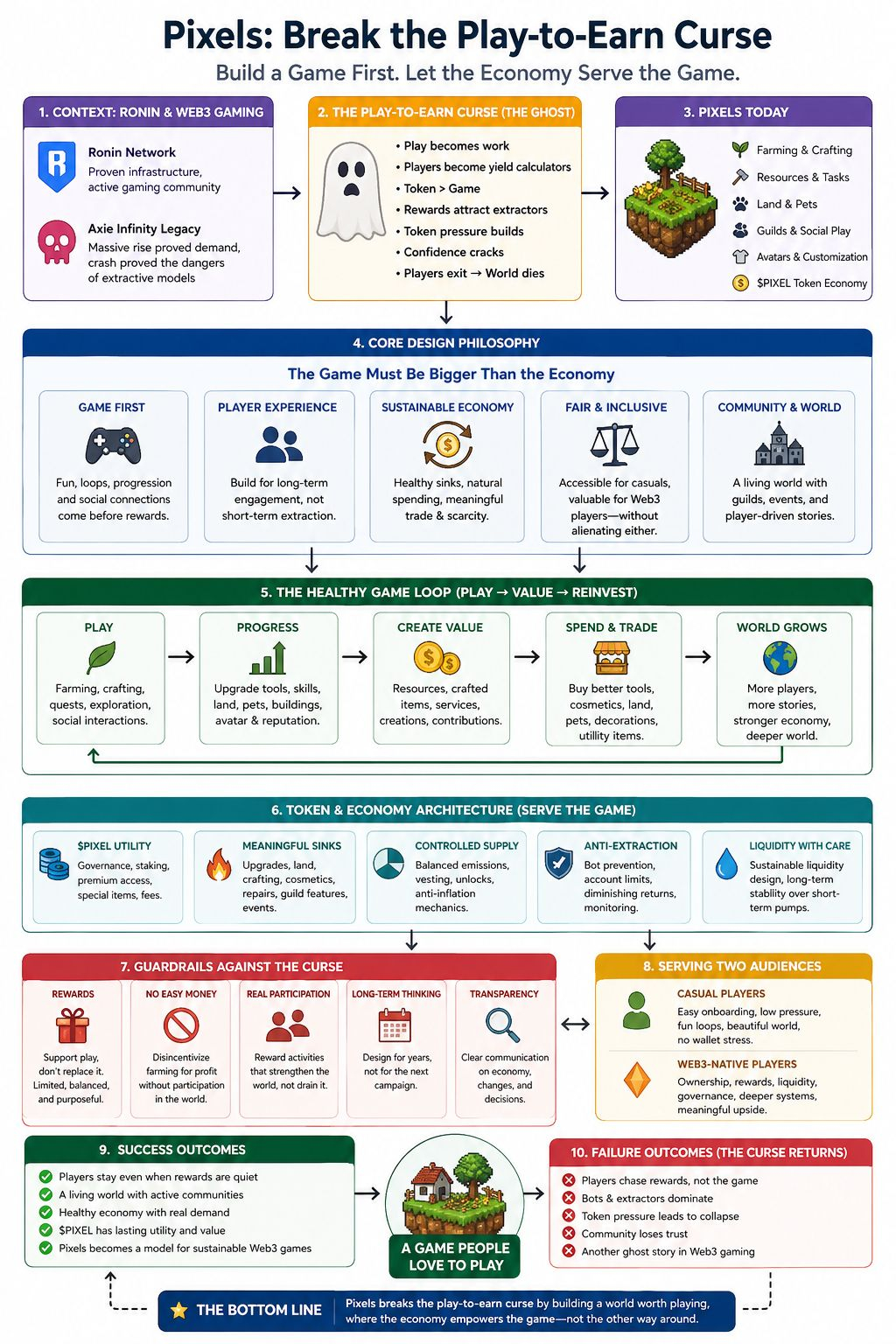
Pixels is a social casual Web3 game built on Ronin, the same network forever tied to Axie Infinity’s spectacular rise and equally instructive fall. That history matters. Ronin is not just another chain with gaming ambitions; it is the place where play-to-earn became a global story, then became a warning label. So when Pixels shows up with farming, crafting, land, pets, guilds, resources, avatars, and the PIXEL token, people are not wrong to squint a little.
We have seen this movie before.
Or at least we have seen the trailer.
A cheerful world. A busy economy. A promise that this time, the loop will be better. This time, the rewards will make sense. This time, players will come for the game and not just the cash-out button.
That is the part Pixels has to prove.
Because the old play-to-earn model did something ugly to games. It turned play into work. Not always on purpose, but that was the result. Quests became shifts. Players became yield calculators. Guilds started to look less like communities and more like little production floors. Every patch became a financial event. Every reward change became a reason to panic. The game world was no longer a place to live in; it was a machine to squeeze.
Once that happens, the magic is already halfway dead.
Pixels, to its credit, does not feel like it is trying to win through spectacle. It is not selling itself as the next giant cinematic universe or some impossible AAA blockchain miracle. Its appeal is smaller, almost stubbornly ordinary. You plant. You harvest. You craft. You wander around. You bump into other players. You upgrade things. You come back later because something is ready, something needs fixing, something can be improved.
That sounds basic because it is.
But basic can work.
There is a reason farming games have survived across generations of platforms. The genre understands the quiet addiction of routine. The repetitive click of a pixelated hoe. The tiny satisfaction of clearing space. The little mental note that your crops will be ready later. The strange pride of making a digital patch of land feel like yours. It is not epic in the trailer-friendly sense, but it can be sticky in a way louder games often are not.
Pixels has that foundation. That matters.
The danger is what sits on top of it.
A token can add texture to a game economy. It can support ownership, trade, identity, access, and community coordination. It can make players feel like their time leaves a mark beyond a closed server. But a token can also walk into the room, put its boots on the table, and make everything about itself.
That is where Web3 games keep getting into trouble.
When the token becomes the main character, the game becomes scenery. Players stop looking at the world and start watching the floor price. They stop asking whether the town square feels alive and start asking whether the reward pool is worth their time. The anxiety changes. It is no longer “Did I miss the event?” It becomes “Am I exit liquidity?”
Nobody wants to relax inside that.
Pixels has a chance because its world is not built around one simple extraction loop. There are systems here: resources, tasks, upgrades, social play, guild activity, land use, progression, and the usual little frictions that make casual games tick. That gives it more muscle than the thin reward machines that flooded Web3 during the boom. It gives players something to do besides grind, dump, repeat.
But chance is not the same as safety.
If Pixels wants to survive, it has to be ruthless about one thing: the game must stay bigger than the economy.
Not equal to it. Bigger.
That means rewards cannot be the main reason people log in. They can be part of the rhythm, sure. They can make progress feel sharper. They can reward commitment. But the minute Pixels trains players to think of every action as a financial calculation, it starts walking the same road as the games it is trying not to become.
And that road has a cliff at the end.
A healthy game economy needs spending that feels natural. Not forced. Not desperate. Not dressed up as “utility” because someone needed a bullet point for a token document. Players should want better tools because they make the game smoother. They should want cosmetics because identity matters in a social world. They should care about guilds because other people make the place less lonely. They should trade because the world has needs, not because everyone is trying to outrun inflation.
That is the difference between an economy and a faucet.
A faucet runs until it dries up.
An economy circulates.
Pixels also has to be honest about who it is serving. There are casual players who may just want a charming, low-pressure farming world. There are crypto-native players who want incentives, ownership, liquidity, and upside. Those two groups can share space, but they do not always want the same thing. One group may hate the friction of wallets and tokens. The other may get bored if the rewards are too small.
Trying to please both can turn a game into soup.
So Pixels needs priorities. Clear ones.
The casual player cannot feel like they need to become a token analyst to enjoy the game. The Web3 player cannot be allowed to turn the whole thing into a spreadsheet with grass tiles. If Pixels leans too far toward extraction, bots and farmers will eat the economy from the inside. If it leans too far toward premium gates, regular players will feel like they showed up late to a party where everyone else already bought the furniture.
This is the messy part nobody can solve with branding.
Ronin gives Pixels a useful home, but it also gives it baggage. The network has infrastructure, wallets, marketplaces, and a community that understands blockchain games. That is valuable. It also carries the memory of Axie Infinity, which still hangs over Web3 gaming like a cautionary mural painted on the side of a burning building.
Axie proved demand existed. It also proved that demand built too heavily on earnings can vanish with brutal speed.
Pixels does not get to ignore that. In fact, it should treat that history like a warning siren.
Because if Pixels becomes another game where users arrive mainly to farm tokens, the ending is already written. The names will change. The charts will look different. The community posts will be more polished. But the structure will be familiar: rewards attract players, players extract value, token pressure builds, confidence cracks, and suddenly everyone starts talking about “long-term vision” while quietly checking the exit.
That is not innovation.
That is a rerun with better pixel art.
The hopeful case for Pixels is that it seems to understand the importance of ordinary play. Its world is accessible. You do not need a 40-minute lore video to understand why you are there. You do not need to pretend that harvesting crops is a revolution. You can just play. That simplicity might be its strongest defense against Web3’s worst habits.
A social farming game does not need to shout. It needs to feel lived in.
It needs a town square with too many avatars standing around. It needs small goals that stack into bigger goals. It needs guild drama, weird player routines, market chatter, and the tiny satisfaction of making progress without feeling like you are trapped in a financial dashboard. It needs friction, but not punishment. It needs scarcity, but not cruelty. It needs rewards, but not addiction.
Most of all, it needs players who would still care if the token stopped trending for a week.
That is the line.
Not whether Pixels can pump. Not whether it can pull huge numbers during campaigns. Not whether influencers can make it sound important for one more cycle. The real measure is uglier and more useful: when the reward chatter gets quiet, is there still a game here?
If there is, Pixels has a shot.
But it will have to make unpopular decisions. Sustainable economies are not built by giving everyone everything forever. Rewards need limits. Bots need to be treated like termites, not “engagement.” Token sinks need to feel meaningful rather than predatory. Guilds need to add life to the world instead of becoming extraction squads with Discord logos. Progression has to reward patience without making new players feel doomed.
That is hard work. Boring work. Necessary work.
And yes, some players will complain. They always do when the free money slows down.
Let them.
Pixels cannot build for the loudest wallet in the room. It has to build for the player who logs in because the world has become part of their routine. The player who likes the loop. The player who wants to decorate, trade, help a guildmate, finish a task, chase a small upgrade, or just exist in a digital place that feels active enough to matter.
That player is worth more than a thousand mercenaries chasing the next reward campaign.
This is where Web3 gaming keeps confusing itself. It talks about community, but often rewards extraction. It talks about ownership, but designs around speculation. It talks about fun, then measures success by token volume. Pixels will not escape the play-to-earn curse by saying better things. It will escape only by designing against the behavior that killed the last wave.
The token should have a role.
It should not have a throne.
That may sound harsh, but the space needs harsh. Web3 gaming has had enough soft language. “Empowering players.” “Reimagining ownership.” “Building the future of gaming.” Fine. Lovely. Put it on a pitch deck. But players are not stupid. They know when a game is a game, and they know when it is a yield farm wearing a costume.
Pixels has to choose which one it wants to be.
The best version of Pixels is not a fantasy where everyone earns easy money from a cozy farming world. That dream is rotten at the root. The better version is more modest and more durable: a game where ownership adds weight, where the economy supports play, where rewards feel like part of the experience instead of the reason for its existence.
That would actually be interesting.
Not because every game needs blockchain. Most do not. Not because tokens magically make communities better. They often make them worse. But because Pixels could show that Web3 mechanics can sit inside a game without poisoning the whole thing. It could prove that ownership and entertainment do not have to fight for oxygen.
Could.
That word is doing a lot of work.
Because the ghost is still there. It is there when players talk more about rewards than updates. It is there when the market moves faster than the design. It is there when “community growth” starts looking suspiciously like people farming whatever can be farmed. It is there every time someone says they are “bullish” before they say whether the game is any good.
Pixels cannot exorcise that ghost with a roadmap.
It has to starve it.
Build the world. Protect the loop. Punish extraction. Reward actual participation. Make the game worth playing on a bad market day. Make the town square matter more than the chart. Make the farm feel like a place, not a job.
That is the only path that matters.
Pixels is not proof that Web3 gaming has grown up. Not yet. It is proof that the next test has arrived in a friendlier shape: a cozy farming game carrying the baggage of an entire sector on its back.
Maybe that is unfair.
Too bad.
If Pixels wants the benefits of Web3 gaming — the liquidity, the ownership pitch, the token attention, the Ronin network effect — then it also inherits the wreckage. It does not get to pretend the last cycle did not happen. It has to answer for it in design, not slogans.
So can Pixels break the play-to-earn curse?
Yes, but only by refusing to be a play-to-earn game in spirit.
If it becomes a place people farm because they care about the world, it might survive. If it becomes a place people farm because they are waiting to sell, then we are not watching the future of gaming.
We are watching the same ghost story again — just with better crops.
