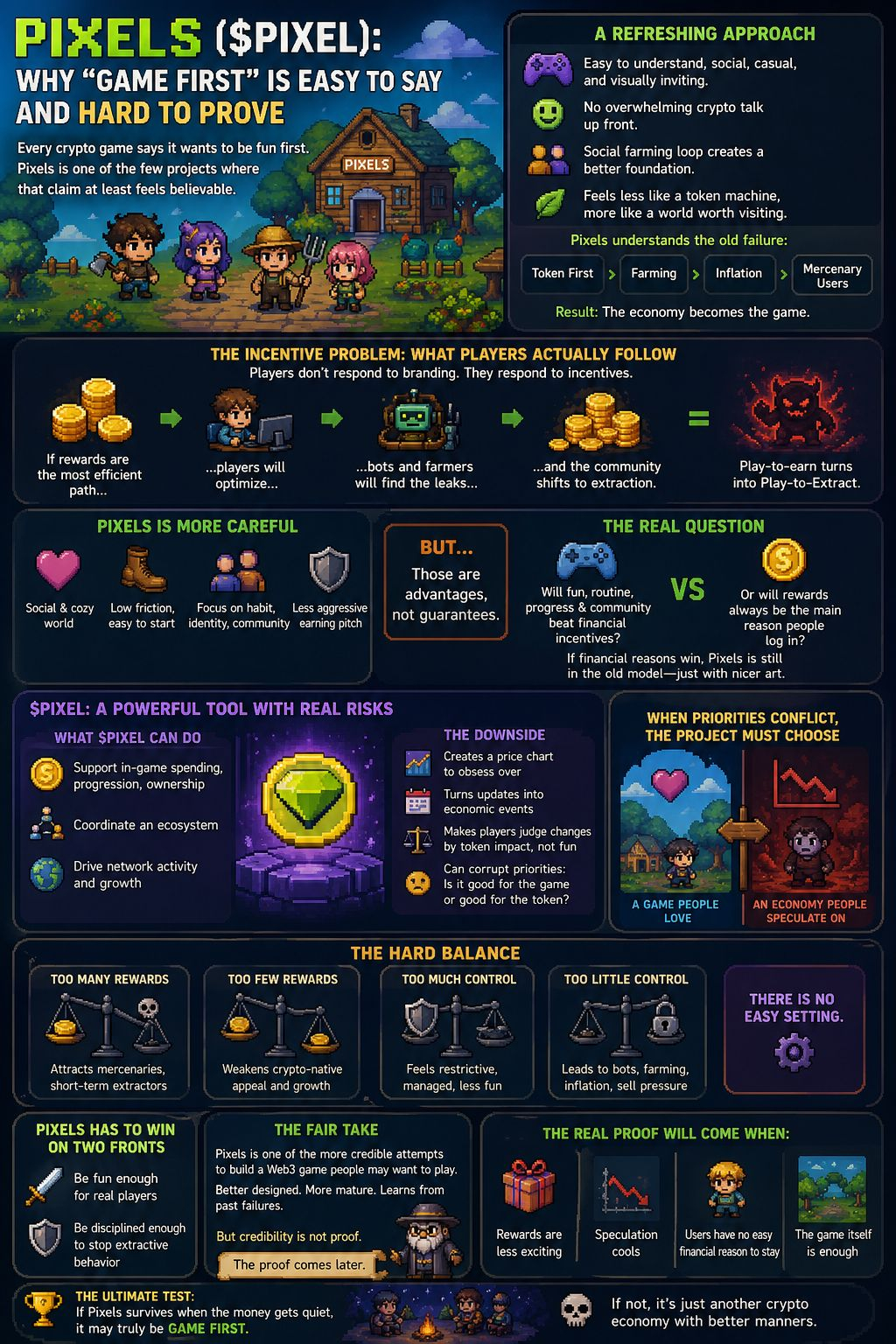
Every crypto game says it wants to be fun first.
That phrase has become almost automatic now. After the first wave of play-to-earn games collapsed under farming, inflation, and mercenary users, nobody wants to sound like they are building another reward machine. So every project says the same thing.
Game first. Economy second.
Pixels is one of the few projects where that claim at least feels believable.
The game is easy to understand. It is social, casual, and visually soft. It does not overwhelm new users with crypto language from the first moment. You can look at it and immediately understand why someone might spend time there without needing a complicated token thesis.
That is already progress.
A lot of Web3 games never reached that point. They talked about ownership, rewards, and open economies before they had built anything people actually wanted to play. The result was predictable. Players treated the game like a job, the token became the product, and the economy eventually started carrying more weight than the experience.
Pixels is trying to avoid that fate.
But the phrase “game first” only matters if it survives contact with incentives.
Because players do not respond to branding. They respond to rewards, friction, scarcity, status, and opportunity. If the most efficient way to interact with a game is to farm value from it, then that is what many users will do. It does not matter how cozy the art looks. It does not matter how friendly the world feels. The system teaches people how to behave.
That is the uncomfortable part.
A game can say it wants casual players, community, and long-term engagement. But if the economy rewards optimization more than enjoyment, the community will slowly reorganize around optimization.
That is how play-to-earn turns into play-to-extract.
Pixels seems more careful than the older model. It feels less like a game built only to emit tokens and more like a world trying to hold attention. The social farming loop gives it a better foundation. The lower-friction experience makes it more approachable. The whole thing feels calmer than the aggressive earning pitches that defined earlier crypto gaming.
Those are real advantages.
But they are not guarantees.
The real question is whether Pixels can make non-financial reasons to play strong enough to compete with financial ones. That is the whole battle. If people log in because they enjoy the world, like the routine, care about their progress, or feel attached to the community, the token can become a supporting layer. But if people mostly log in because the rewards justify their time, then the game is still trapped inside the old model.
It may just look better.
This is why $PIXEL is so complicated.
A token can help coordinate an ecosystem. It can support in-game spending, progression, ownership, and broader network activity. But it also gives players a price chart to obsess over. It turns updates into economic events. It makes people evaluate gameplay changes through the lens of supply, demand, emissions, and utility.
That can be corrosive.
Suddenly, the community is not only asking whether the game is more fun. It is asking whether the update is good for the token. Those are not always the same question.
And when those priorities conflict, the project has to choose what it really is.
That is where Pixels still has something to prove. It may be one of the stronger Web3 gaming attempts because it understands the old failure pattern. It knows that reward loops alone are not enough. It knows a game needs habit, identity, social energy, and emotional attachment.
But knowing that is not the same as building something immune to extraction.
Crypto users are good at finding value leaks. Bots, farmers, multi-account strategies, and short-term speculators can turn even thoughtful systems into extraction games if the incentives allow it. The more valuable the economy becomes, the more pressure it attracts.
So Pixels has to win on two fronts at once.
It has to be fun enough for real players.
And it has to be disciplined enough to stop extractive behavior from becoming the dominant strategy.
That is a difficult balance. Too much control can make the game feel managed and restrictive. Too little control can let the economy spiral into farming and sell pressure. Too many rewards can attract mercenaries. Too few rewards can weaken the crypto-native appeal.
There is no easy setting here.
That is why Pixels should be taken seriously, but not romanticized.
It is better designed than many earlier play-to-earn projects. It feels more mature. It seems to understand that the game cannot just be a wrapper around a token. But the central question remains open: can it keep the economy from becoming the real game?
Because if the answer is no, then Pixels does not escape the old trap.
It only makes the trap more comfortable.
For now, the fair take is this: Pixels is one of the more credible attempts to build a Web3 game that people may actually want to play. But credibility is not proof.
The proof comes later.
When rewards are less exciting.
When speculation cools.
When users have no easy reason to stay except the game itself.
That is when we find out whether Pixels is truly game first, or just another crypto economy with better manners.