
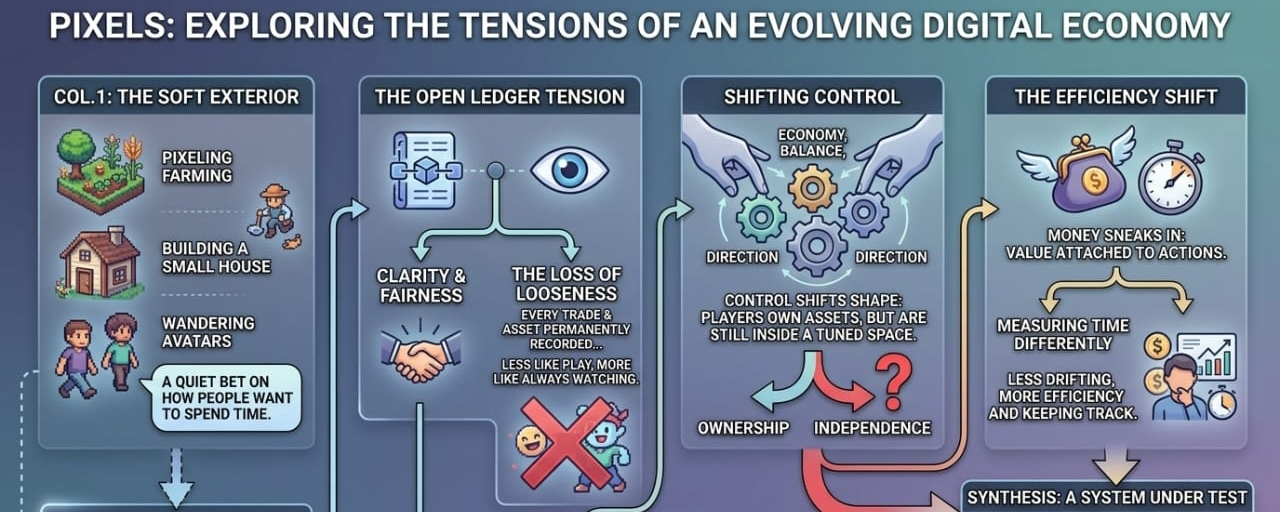
The Phase 1 launch of PIXELS—positioned as a social, casual Web3 game built on the Ronin Network—fits a now-familiar pattern in the crypto space: a compelling narrative, an accessible gameplay loop, and the promise of digital ownership layered atop a vibrant, community-driven world. Farming, exploration, and creation are deliberately low-friction mechanics, designed to attract users who may not care about blockchain at all. And yet, as with many such projects, the real question isn’t whether PIXELS can attract attention—it’s whether it can sustain it.
From the vantage point of someone who has watched multiple crypto cycles rise and collapse, Phase 1 launches are rarely about durability. They are about momentum. PIXELS executed this phase competently: onboarding was relatively smooth, the Ronin ecosystem provided a scalable and low-cost environment, and early incentives—whether token-based or social—encouraged rapid user growth. The open-world framing gave players a sense of agency, while the integration of Web3 elements such as asset ownership and trading hinted at deeper economic layers to come.
But this is precisely where skepticism begins.
Phase 1 in crypto projects often conflates activity with engagement. Wallet connections, daily active users, and transaction counts are treated as proxies for success, yet they frequently mask shallow participation driven by speculation or short-term rewards. PIXELS, like many GameFi projects before it, risks becoming a case study in this dynamic. If players are primarily motivated by earning tokens or flipping in-game assets, their loyalty is transactional. When incentives dry up—or when another project offers better yields—they leave.
This brings us to the often-touted role of privacy in blockchain ecosystems. While PIXELS itself is not primarily marketed as a privacy-first platform, the broader Web3 narrative frequently leans on privacy as a retention mechanism. The argument goes something like this: users who feel secure and in control of their data will stay longer. On paper, this is appealing. In practice, it’s overstated.
Privacy features in blockchain—whether through pseudonymous identities, zero-knowledge proofs, or selective disclosure—address a specific set of concerns: surveillance, data ownership, and censorship resistance. These are important, but they are not the primary drivers of user retention in a game. Players return to a game because it is fun, socially engaging, and continuously rewarding in a meaningful way—not because their wallet address is shielded.
In fact, excessive emphasis on privacy can sometimes work against retention. Friction increases when systems become more complex, and most casual users—PIXELS’ target audience—have little appetite for managing cryptographic keys or understanding nuanced privacy settings. The average player does not wake up thinking about zero-knowledge proofs; they think about whether the game is enjoyable and whether their friends are still playing.
Moreover, history suggests that privacy alone does not create sticky ecosystems. Numerous privacy-focused chains and applications have struggled to maintain active user bases once initial curiosity fades. The same pattern can emerge in gaming: if the core loop is not compelling, no amount of cryptographic sophistication will keep players engaged.
For PIXELS, the real test lies beyond Phase 1. Can it evolve from an incentive-driven ecosystem into a genuinely engaging social game? Can it build a community that values creativity and collaboration over extraction? And perhaps most importantly, can it decouple its success from the volatility of token economics?
A seasoned observer would note that the projects which endure are those that quietly shift focus from “Web3 features” to “user experience.” They treat blockchain as infrastructure, not identity. If PIXELS leans too heavily on the novelty of ownership or the speculative appeal of its economy, it risks following the same trajectory as many predecessors: an explosive शुरुआत followed by a slow erosion of interest.
Privacy, in this context, is a supporting actor—not the lead. It can enhance trust, but it cannot manufacture engagement. Long-term retention will depend on whether PIXELS can deliver something far more difficult than a successful launch: a reason to stay when the hype is gone.
