
Pixels proves one thing clearly.
Crypto games can look and feel much better than they used to.
That may sound like a small compliment, but it matters. The first wave of play-to-earn games often felt like spreadsheets with characters attached. The token came first, the economy came second, and the actual game sat somewhere in the background trying to justify the whole thing.
Pixels does not feel like that at first.
It feels more casual. More social. More approachable. The farming loop is simple enough to understand, and the world has a friendlier rhythm than the usual Web3 reward machine.
That gives it a real advantage.
Because if a crypto game feels like work from the beginning, only workers will show up. Farmers, grinders, bots, speculators, and reward hunters may create activity, but they do not automatically create a healthy game.
They create pressure.
Pixels seems to know this. It appears to be aiming for something softer: a game people might actually enjoy spending time in, not just a system they use to extract value.
That is the right ambition.
But the hard part is not attracting users.
The hard part is keeping the right kind of users.
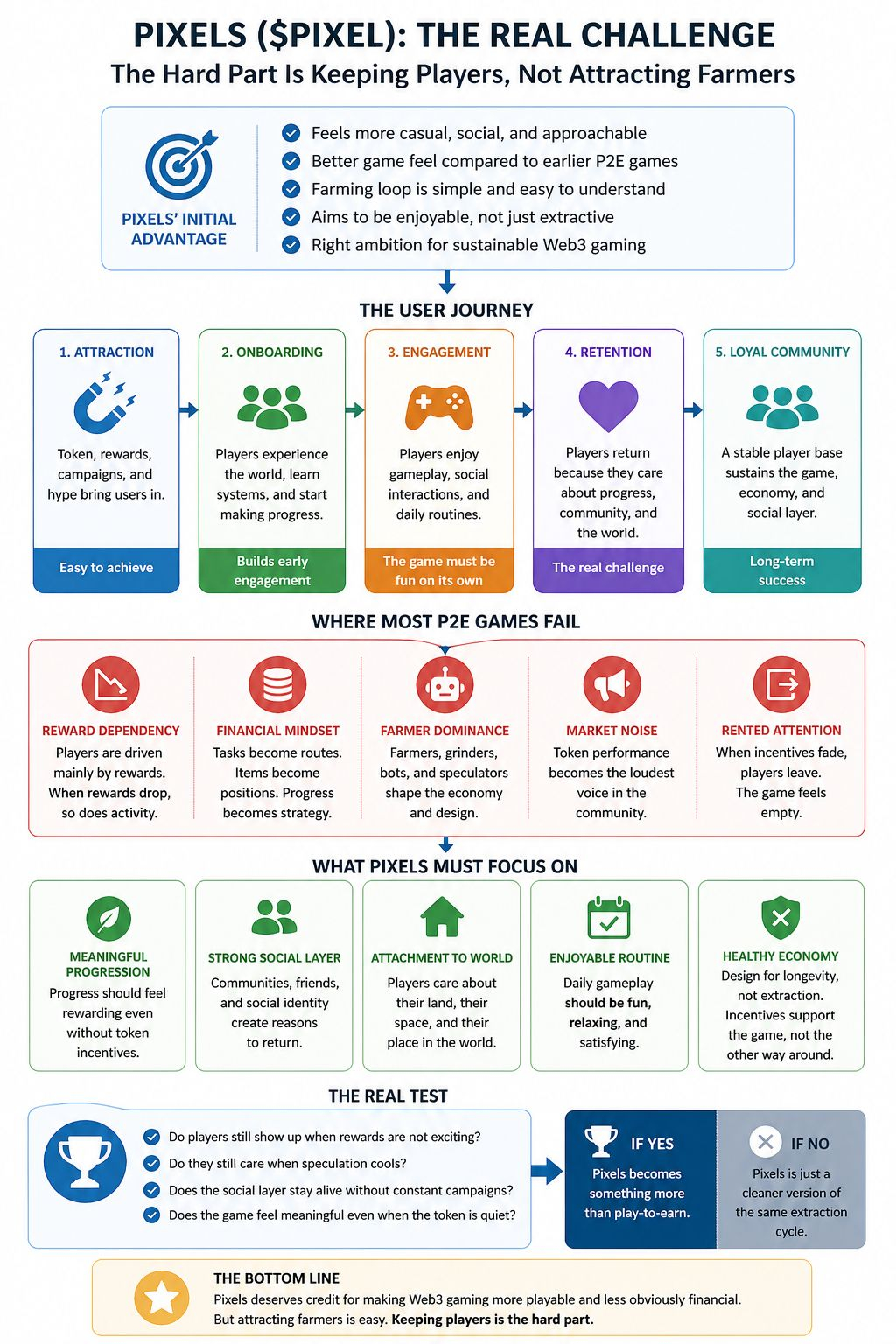
A token can bring attention quickly. Rewards can create movement. Campaigns can pull people into the world. But none of that proves the game has durable retention. It only proves the incentive is strong enough to attract behavior.
And behavior changes when the incentive changes.
That is where many play-to-earn games failed. The moment rewards became less attractive, the user base shrank. The community looked active while value was flowing, but once the flow slowed, it became clear that many people were never deeply attached to the game itself.
Pixels has to avoid that outcome.
It needs players who care about more than the return. People who like the routine. People who enjoy the world. People who feel some attachment to their progress, land, social identity, or community.
That kind of attachment is much harder to build than token activity.
And it is much more valuable.
The risk is that $PIXEL still pulls the experience back toward financial behavior. Once players know their time can produce value, they start measuring everything. Tasks become routes. Items become positions. Progress becomes economic strategy. The game may still look cozy, but the mindset becomes extractive.
That is the old trap.
Pixels may manage it better than earlier projects, but it cannot ignore it. If farmers become the most important users, the design will slowly bend toward them. If token performance becomes the loudest community concern, updates will be judged through market logic. If rewards become the main reason to stay, then the game is still renting attention.
That is why the next stage matters so much.
Pixels does not need to prove that people will try a crypto farming game. That has already been proven many times. It needs to prove that people will keep returning when the financial upside is ordinary.
That is the real test.
Do players still show up when rewards are not exciting?
Do they still care when speculation cools?
Does the social layer stay alive without constant incentive campaigns?
Does the game feel meaningful even when the token is quiet?
If yes, Pixels becomes something more interesting than play-to-earn.
If no, then it is just a cleaner version of the same extraction cycle.
For now, Pixels deserves credit for making Web3 gaming feel more playable, less desperate, and less obviously financial. That is progress.
But progress is not proof.
Because in crypto gaming, attracting farmers is easy.
Keeping players is the hard part.
