
When you first step into Pixels (PIXEL), it doesn’t feel like you’re dealing with infrastructure or chains or systems. It feels light. You farm, you explore, you build a small rhythm of progress, and everything seems like it belongs to you and the community around you.
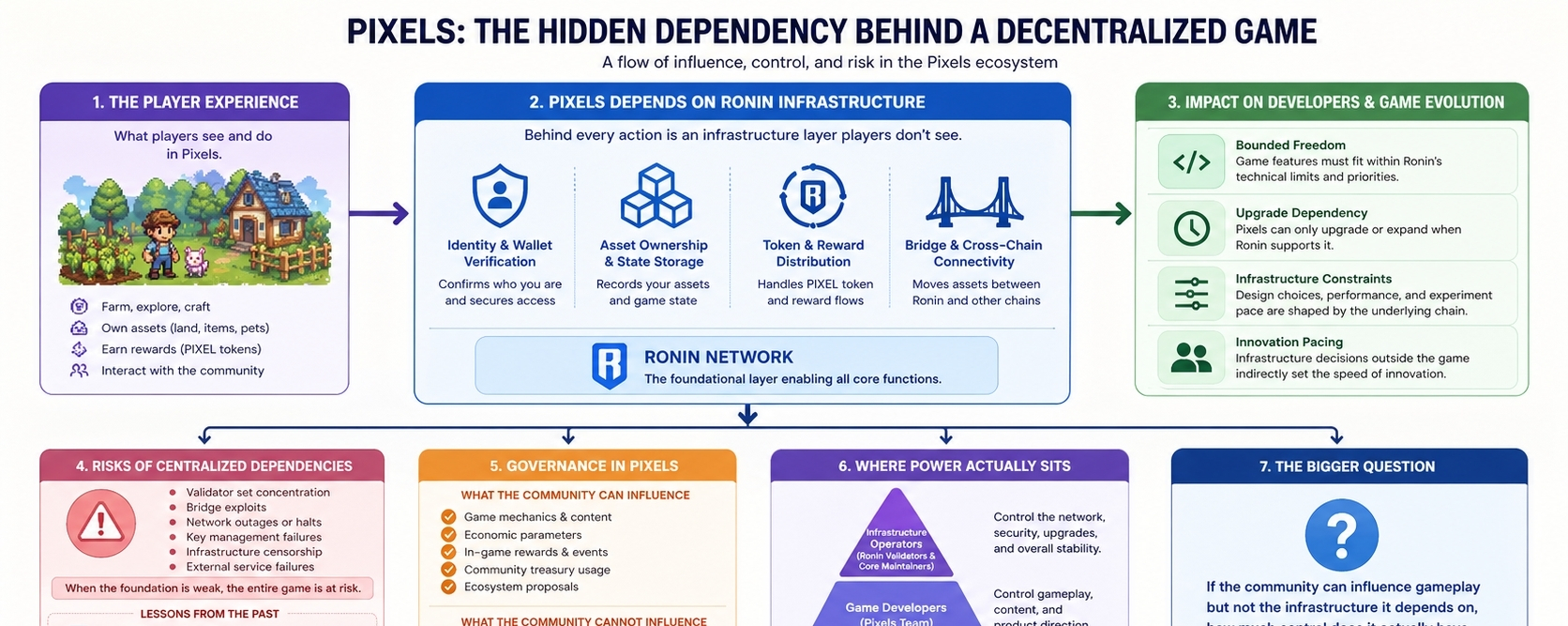
But underneath that feeling, there is something most players never really see, even though it quietly holds everything together: the dependence on Ronin Network.
It’s not just “the blockchain behind the game.” It’s the layer that decides whether your actions are recorded correctly, whether your assets are truly yours, and whether rewards actually reach you. And because of that, it shapes the game more than it lets on.
The interesting part is that developers working on Pixels probably don’t feel “limited” in the usual sense. They can design systems, add mechanics, and shape how the world grows. But every one of those decisions still has to fit inside what Ronin can support. If the infrastructure moves slowly, the game moves slowly. If the infrastructure prioritizes safety over experimentation, creativity inside the game has to adjust around that.
It’s not control in a dramatic way. It’s more like quiet boundaries that everyone learns to work within.
And history has already shown what happens when those quiet foundations fail. The Ronin Bridge hack 2022 wasn’t just a technical incident—it was a reminder that even systems built for scalability and gaming can break at their weakest trust points. When that happened, it wasn’t the game design that mattered. It was the structure underneath it.
That’s where the idea of “decentralization” becomes complicated. Pixels does have community governance elements. Players can vote, participate, and feel involved in shaping parts of the ecosystem. But those decisions mostly sit on top of the system, not inside its deepest layers.
And that creates a strange split. You can influence how the world feels, but not always the systems that decide whether it works at all.
So the question that lingers isn’t about whether Pixels is decentralized on paper. It’s something more human than technical.
When everything you do depends on systems you don’t control, and upgrades you can’t fully vote on, and infrastructure decisions made elsewhere… how much of the world are you really shaping?
And how much of it is simply letting you feel like you are?