
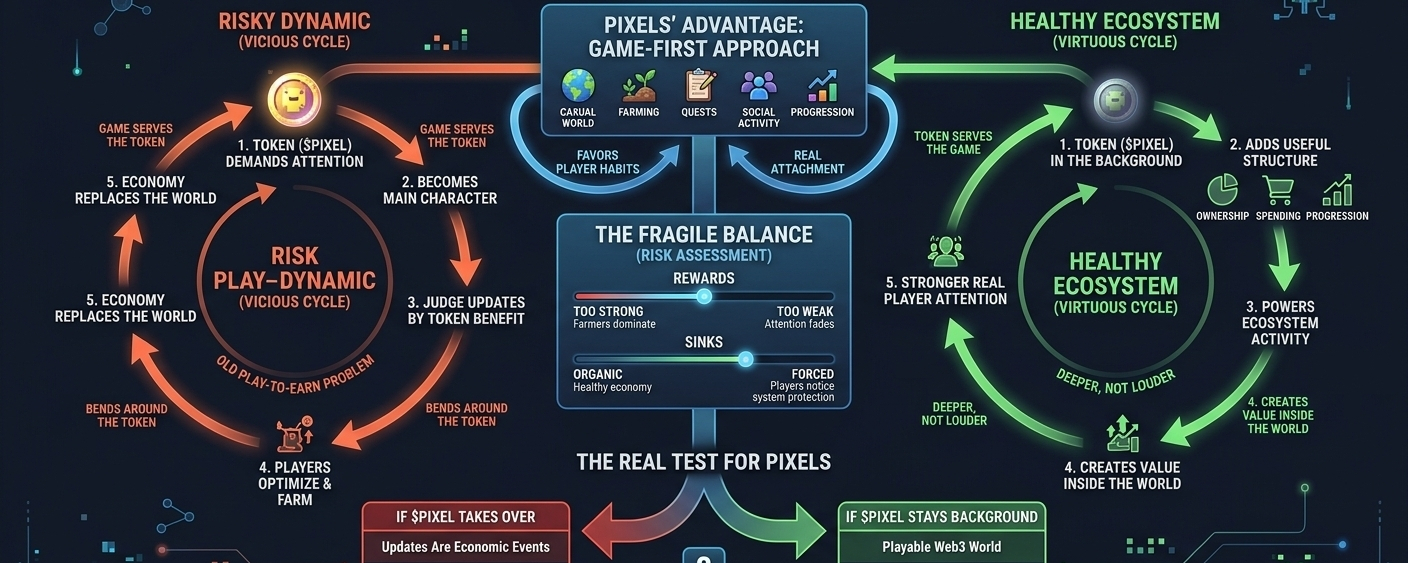
Pixels has a real advantage because it does not feel like crypto first.
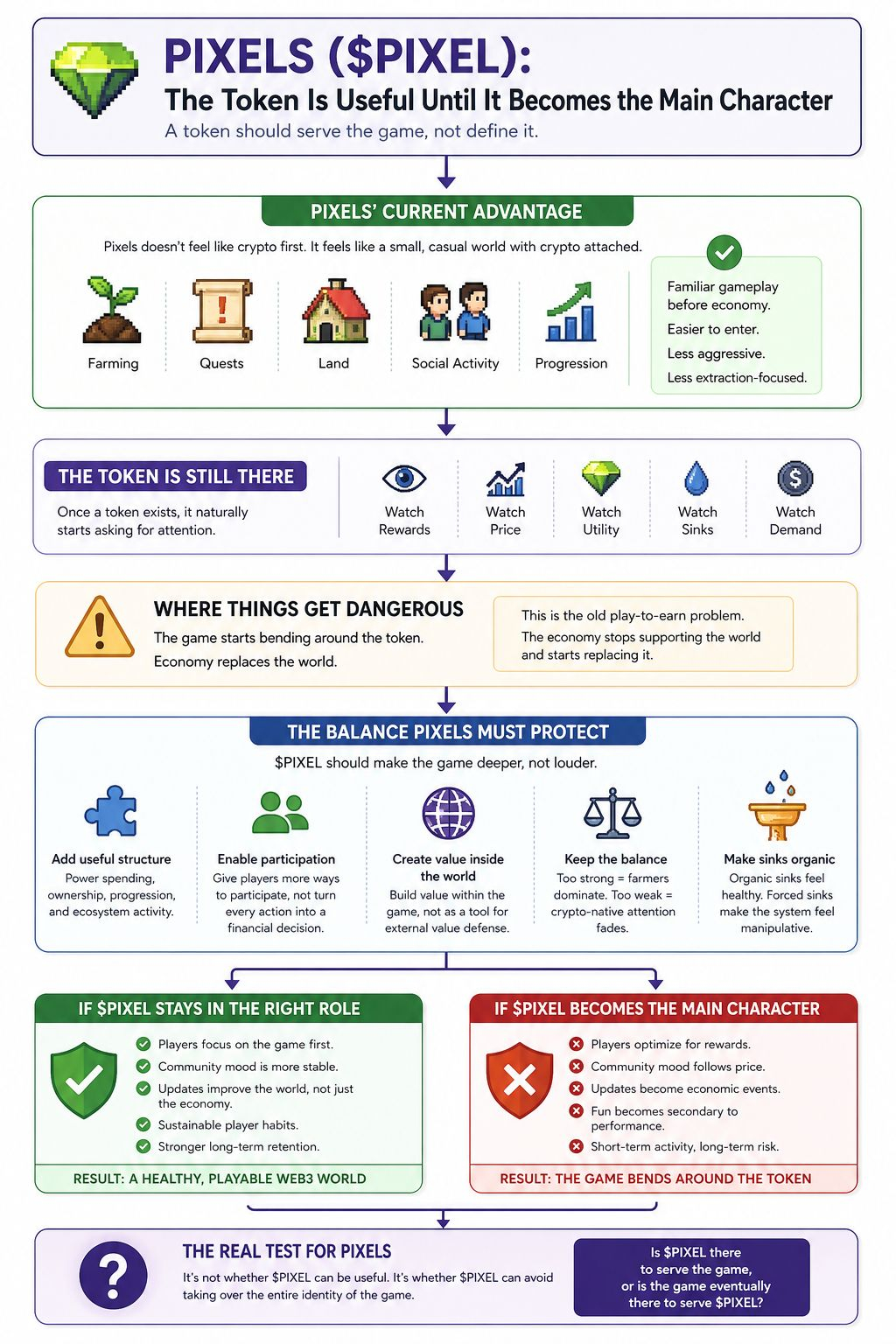
It feels like a small, casual world that happens to have crypto attached to it. Farming, quests, land, social activity, and progression give players something familiar to do before the economy becomes the whole conversation.
That is why Pixels stands out.
A lot of Web3 games made the token the main character from day one. The game existed mostly as a reason to distribute rewards, create demand, and keep users moving through an economic loop. That may create activity for a while, but it rarely creates real attachment.
Pixels seems to be trying something healthier.
It gives the game more space to breathe. The experience is easier to enter, less aggressive, and less obviously built around extraction. That matters because crypto gaming cannot survive on financial motivation alone. At some point, people need to care about the world itself.
But the token is still there.
And once a token is there, it starts asking for attention.
Players watch rewards. They watch price. They watch utility. They watch sinks, emissions, and demand. They start judging updates not only by whether the game improves, but by whether the token benefits.
That is where things get dangerous.
A token can support a game when it adds useful structure. It can power spending, ownership, progression, and broader ecosystem activity. But when it becomes the main reason people care, the game starts bending around it.
That is the old play-to-earn problem.
The economy stops supporting the world and starts replacing it.
Pixels has to keep $PIXEL in the right role. The token should make the game deeper, not louder. It should give players more ways to participate, not turn every action into a financial decision. It should create value inside the world, not make the world feel like a tool for defending value outside it.
That balance is fragile.
If rewards are too strong, farmers dominate. If rewards are too weak, crypto-native attention fades. If sinks feel organic, the economy can feel healthy. If sinks feel forced, players notice that the system is trying to protect itself.
That is why Pixels is still unproven.
It may be one of the better Web3 gaming projects because it understands that people need more than earnings. It feels more thoughtful than the older play-to-earn wave. It has a stronger chance of creating real player habits instead of only attracting reward hunters.
But the risk has not disappeared.
The token can still become the main character.
And if that happens, the game changes. Players optimize more. Community mood follows price more closely. Updates become economic events. Fun becomes secondary to performance.
That is not where a game wants to live.
The real test for Pixels is not whether it can make useful. It probably can. The harder test is whether it can stop $PIXEL from taking over the entire identity of the game.
Because a crypto game can survive with a token in the background.
It struggles when the token moves to the center.
For now, Pixels looks like a smarter attempt to build a playable Web3 world.
But the question remains simple:
Is $PIXEL there to serve the game, or is the game eventually there to serve
