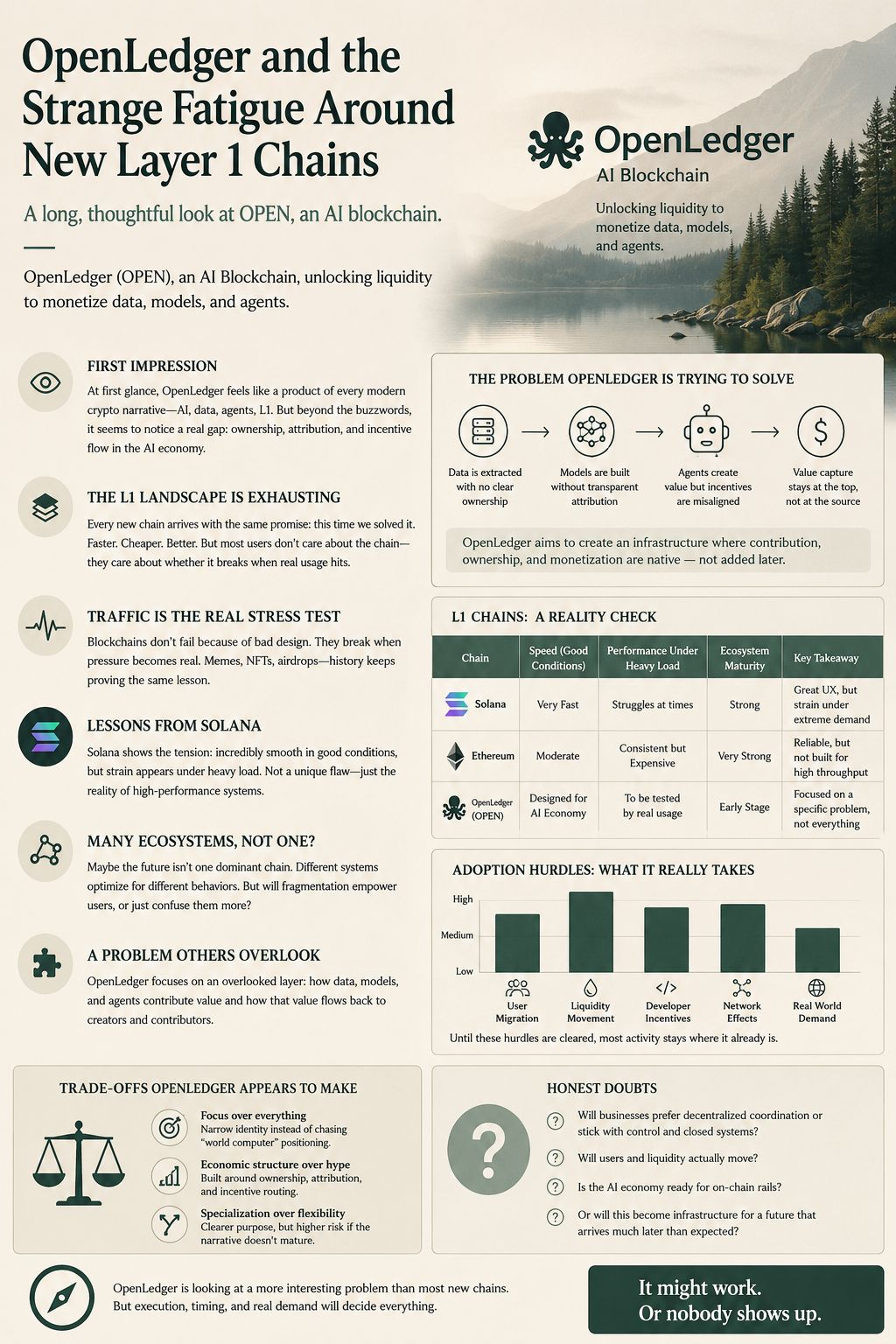
OpenLedger is one of those projects that, at first glance, almost feels algorithmically assembled from the last two years of crypto discourse. AI. Data liquidity. Agents. Layer 1. Decentralized infrastructure. It presses every modern button at once, which usually makes me instinctively lean back in my chair a little. Not because those ideas are meaningless. Some of them are probably inevitable. But because crypto has this habit of discovering a legitimate future trend and then immediately wrapping it in ten thousand exhausted token launches before the infrastructure underneath even exists.
And still, after sitting with OpenLedger for a while, I don’t think it feels entirely fake. Over-designed maybe. Slightly too aware of the current narrative cycle. But not hollow in the same way a lot of “AI chains” feel hollow. There’s at least an attempt to identify an actual coordination problem underneath the branding. That matters more than people admit.
The Layer 1 landscape has become strange. Every new chain now arrives with the same quiet implication: this time we solved it. Faster execution. Better throughput. Lower latency. Modular this, parallelized that. And the thing nobody says directly anymore is that most users genuinely do not care about the chain itself. They care about whether the thing breaks when activity becomes real. That’s the entire game now. Not whitepapers. Not architecture diagrams. Stress.
Crypto learned this the hard way over and over. Networks look elegant when nobody is using them. Every chain feels revolutionary at 4,000 transactions per day. The personality of infrastructure only appears once speculation turns into pressure. Meme coin frenzies exposed this. NFT seasons exposed this. Airdrop farming exposed this. You only really meet a blockchain when it’s uncomfortable.
Solana is probably the clearest example of that tension. When it works well, it feels almost suspiciously smooth compared to older systems. There’s a reason people keep coming back to it despite the criticism. The user experience matters. Speed matters. Cheap transactions matter. But then periods of extreme demand hit and suddenly the conversation changes from performance to survivability. Not because Solana is uniquely flawed, but because all high-throughput systems eventually encounter the same ugly reality: coordination at scale is messy. Real users are chaotic. Bots are relentless. Financial incentives distort everything.
That’s partly why OpenLedger’s focus on AI-related infrastructure caught my attention in a different way than most new Layer 1s. It seems less obsessed with becoming “the chain for everyone” and more interested in becoming a settlement environment for a very specific emerging economy around models, data, and autonomous systems. That distinction matters. Slightly. Maybe more than slightly.
Because the uncomfortable truth around AI right now is that everyone talks about models, but almost nobody talks seriously about ownership, attribution, or incentive routing. Data appears from nowhere in these conversations. Models appear from nowhere too, as if intelligence is just generated by corporate gravity. OpenLedger seems to quietly notice that gap. If AI systems become economically meaningful, then somebody will eventually want infrastructure that tracks contribution, value flow, access rights, usage, maybe even reputation around data itself.
Whether blockchain is actually the right tool for that is another question entirely. Crypto has spent years forcing itself into problems that could’ve been solved with a database and a legal agreement. Sometimes decentralization is a technical breakthrough. Sometimes it’s just ideological decoration around an inefficient system. I don’t think the industry has fully learned the difference yet.
Still, there is something coherent in the idea that machine-generated economies might require different financial rails than human-centered applications. Agents paying agents. Models accessing datasets dynamically. Small automated transactions happening constantly between systems that don’t really care about traditional banking infrastructure. You can at least see the outline of why someone would build a chain around that assumption.
The problem is that assumptions in crypto tend to arrive years before behavior does.
That gap destroys most projects.
OpenLedger, like every Layer 1 before it, eventually runs into the same wall: nobody migrates just because technology is cleaner. Liquidity is lazy. Users are lazy too, honestly. Developers even more so unless incentives become overwhelming. Entire ecosystems persist mainly because moving is annoying. Ethereum survives partly because everything already exists there. Solana survives because the culture around it became self-sustaining. People underestimate how much inertia matters online.
A new chain therefore has to answer an awkward question without sounding desperate: why would activity relocate here specifically?
And “AI” by itself is not an answer. Not anymore. Maybe it was eighteen months ago. Now the term mostly triggers fatigue. Every startup deck says AI. Every blockchain says AI. Half the time it just means adding a chatbot somewhere unnecessary and hoping investors stop asking difficult questions.
To OpenLedger’s credit, it seems less interested in cosmetic AI integration and more interested in economic structure. Monetization of datasets. Shared model access. Incentive layers for contributors. Again, these are real coordination problems. The issue is whether enough people actually want decentralized versions of those systems badly enough to bootstrap an ecosystem around them.
That part feels uncertain.
Because crypto people often romanticize open infrastructure while actual businesses quietly prefer control. Especially in AI, where proprietary advantages matter enormously. The largest companies are not racing toward transparent decentralized networks right now. They are building walls. Expensive walls. Training data walls. Compute walls. Distribution walls. That doesn’t mean OpenLedger’s thesis is wrong, but it does mean adoption may arrive from unexpected places if it arrives at all.
Maybe smaller developers use it first. Maybe open-source AI communities. Maybe regions where access to centralized infrastructure becomes politically or economically constrained. Or maybe nobody wants on-chain coordination for this stuff because it introduces friction where companies want simplicity.
That’s the difficult thing about evaluating new Layer 1s now. Technical merit alone stopped being enough years ago. Social gravity matters more. Distribution matters more. Timing matters more. You can build something elegant and still end up as a ghost town with validators.
And honestly, I think the market is slowly realizing that there may never be one dominant chain anyway. The “winner takes all” theory always felt slightly artificial to me. Different systems optimize for different behaviors. Some chains become financial backbones. Others become speculative casinos. Others quietly support infrastructure nobody talks about publicly. Maybe AI-focused coordination eventually becomes its own environment with its own economic logic.
Or maybe fragmentation just becomes unbearable for users and everything recentralizes around a few large platforms pretending to be decentralized enough.
That possibility still hangs over the entire industry.
OpenLedger also appears to make certain trade-offs deliberately. It seems willing to narrow its identity instead of chasing universal general-purpose positioning. I actually think that’s healthier than the endless “world computer” ambition every chain inherits by default. Specialization may look smaller at first, but sometimes smaller systems survive longer because they know what they’re for.
At the same time, specialization limits surface area. If the AI economy develops differently than expected, the chain risks building infrastructure for a behavior pattern that never fully materializes. That’s always the danger with thematic Layer 1s. You stop being adaptable. You become dependent on a narrative maturing into reality before attention moves somewhere else.
And attention always moves somewhere else eventually.
I don’t know if OpenLedger becomes important. I don’t even know if the future AI economy actually wants blockchain-level coordination underneath it. But I do think the project is at least looking at a more interesting problem than most new chains. Not just faster transactions. Not just cheaper fees. More like trying to define ownership structures for machine-native systems before those systems become too large to redesign.
That could matter later.
Or it could become another technically competent chain searching for users while the market chases the next distraction.
Hard to know anymore. Crypto has a way of making intelligent ideas look ridiculous for years before suddenly making them seem obvious overnight. And sometimes the opposite happens too.
It might work. Or nobody shows up.