
OpenLedger is one of those projects that immediately triggers two opposite reactions at the same time. The first is exhaustion. Another Layer 1. Another attempt to reorganize the internet around tokens, incentives, coordination, data ownership, AI infrastructure, whatever the phrase of the month happens to be. You look at it for ten seconds and your brain almost auto-completes the pitch before you even read it.
Then there’s the second reaction. A quieter one. The moment where you stop skimming and realize the team might actually be looking at a real problem instead of inventing a fake one for fundraising purposes.
That’s what stood out to me with OpenLedger. Not the AI branding. Honestly that part almost works against it now. Every second project suddenly wants to become “the AI chain,” which already feels dated somehow, even while the market is still obsessed with it. It reminds me of the metaverse phase where people kept stapling the same word onto things that had no connection to each other. Eventually the vocabulary itself starts sounding hollow.
But underneath the branding, OpenLedger seems less interested in building another generalized casino-chain and more focused on something narrower: the awkward gap between AI systems and the people providing the raw material those systems consume. Data, models, inference, agents. The actual inputs. The economic plumbing around them.
And that’s at least a real tension in the current internet.
Right now, most AI infrastructure feels strangely feudal. A handful of companies absorb massive quantities of public and private data, train systems behind closed walls, and then resell intelligence back to the same people who unknowingly supplied the inputs. Crypto people love talking about decentralization in abstract philosophical terms, but OpenLedger appears to notice a simpler thing: contributors usually have no liquidity path. Their data has value in aggregate, but no direct economic surface.
Whether blockchain is actually the right answer for that is another question entirely.
That’s where the Layer 1 discussion gets messy. Because by now, anyone who has survived more than one cycle has learned to be suspicious of new base layers. Not because innovation is impossible, but because the graveyard is already full of technically competent chains that discovered an uncomfortable reality: infrastructure means nothing without sustained pressure.
A blockchain never really reveals itself in test environments. It reveals itself when people arrive all at once with conflicting incentives, bots, arbitrage systems, spam, leverage, panic, NFT mints, liquidations, governance fights, and weird user behavior nobody predicted. That’s the actual benchmark. Throughput numbers on slides don’t matter much before that moment.
You can see this clearly with Solana. When it works well, it feels almost suspiciously smooth compared to older chains. Fast confirmations, low friction, applications that resemble normal software instead of academic prototypes. And yet even Solana, probably one of the few post-Ethereum chains that genuinely achieved cultural gravity, has repeatedly shown what happens when real demand collides with system assumptions. Congestion changes user psychology fast. Reliability suddenly matters more than ideology.
That’s why I find OpenLedger more interesting when viewed as specialized infrastructure rather than “the next dominant chain.” The dominant chain narrative itself feels increasingly outdated. Crypto still talks as if there will be one universal settlement environment where everything eventually converges, but reality keeps fragmenting instead. Different chains for different behavior patterns. Different latency expectations. Different economic cultures even.
Maybe that’s healthier.
Or maybe it just creates twenty disconnected cities with empty sidewalks.
I honestly don’t know anymore.
What OpenLedger seems to quietly acknowledge is that AI-related activity may not fit comfortably inside the existing architecture of general-purpose chains. Data markets behave differently from financial markets. AI inference has different computational rhythms. Agent-based systems introduce weird transactional patterns that normal DeFi infrastructure was never designed around. Most chains treat these things as add-ons. OpenLedger appears to start from the assumption that they are native activities instead.
That distinction matters more than the branding language around it.
At the same time, you can already see the trade-offs emerging. Specialization usually means narrowing the audience whether teams admit it or not. A chain optimized around AI liquidity and data coordination may struggle to attract broader cultural energy. And culture matters more in crypto than engineers like to admit. Users do not migrate purely because architecture improves. If that were true, half the industry would look completely different by now.
People stay where liquidity already exists. Developers stay where users already exist. Stablecoins stay where markets already exist. Even bad ecosystems can survive for years if enough capital becomes trapped socially inside them.
That’s the invisible moat most new Layer 1s underestimate.
OpenLedger also seems to simplify certain assumptions on purpose. It feels less obsessed with becoming a fully universal execution environment and more focused on facilitating economic coordination around AI assets and contributions. That probably helps clarity internally. But it also means betting that this niche becomes large enough to justify an entire sovereign chain rather than simply existing as middleware on another ecosystem.
That’s a difficult bet.
Because eventually every Layer 1 runs into the same uncomfortable question: why does this need its own chain at all?
Sometimes there’s a good answer. Sometimes there isn’t.
And to be fair, crypto has developed a bad habit of overbuilding sovereignty. Entire blockchains created for applications that could have survived perfectly fine as protocols elsewhere. The market spent years rewarding independence over practicality. Now the industry feels bloated with infrastructure competing for attention from the same relatively fixed pool of users.
Still, OpenLedger doesn’t feel entirely cynical to me. That’s important. You can usually sense when a project exists mainly because a narrative became investable. This feels slightly different. There’s at least an attempt to address the economic asymmetry around AI systems before it calcifies completely under centralized platforms.
Whether users actually care enough to change behavior is harder to predict.
That friction is real. Most people will not move data workflows onto a blockchain simply because ownership sounds philosophically cleaner. Most developers will not abandon existing ecosystems unless the advantages become painfully obvious. And enterprises definitely won’t touch experimental infrastructure just because crypto people are excited on Twitter for two weeks.
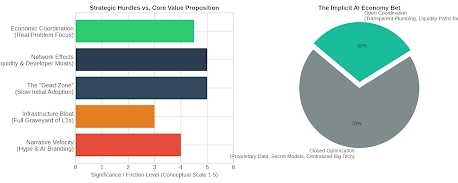
Adoption usually happens slower than crypto timelines allow. Then suddenly faster than expected once habits flip. The hard part is surviving the dead zone in between.
And that dead zone kills most Layer 1s.
The thing I keep coming back to with OpenLedger is that it doesn’t seem to be pretending scalability alone is enough. A lot of earlier chains treated speed as if it automatically generated purpose. But fast empty systems are still empty systems. OpenLedger appears more concerned with creating a specific economic loop around AI participation itself. Contributors, models, data providers, agents. A network where these interactions are not peripheral activity but the main event.
Maybe that focus gives it a better chance at coherence.
Or maybe it narrows the market too early and ends up isolated while larger ecosystems absorb the same ideas later with better distribution.
That happens all the time too.
There’s also the broader question nobody can answer yet: how much of the future AI economy will actually want transparency? Crypto assumes openness is inherently valuable, but AI companies increasingly compete on proprietary advantages. Data secrecy. Model secrecy. Infrastructure secrecy. OpenLedger is implicitly betting that some meaningful portion of this world eventually prefers open coordination over closed optimization.
I can see the argument for it. I can also see the opposite outcome.
At this point in crypto, certainty usually makes me trust a project less, not more.
And honestly, maybe that’s why OpenLedger remains somewhat interesting. It feels like a project trying to solve a real coordination problem while existing inside an industry that still confuses narrative velocity with product-market fit. There’s ambition here, but also visible risk. The shape of the thing makes sense in theory. The hard part is whether human behavior bends around it naturally or has to be forced.
