
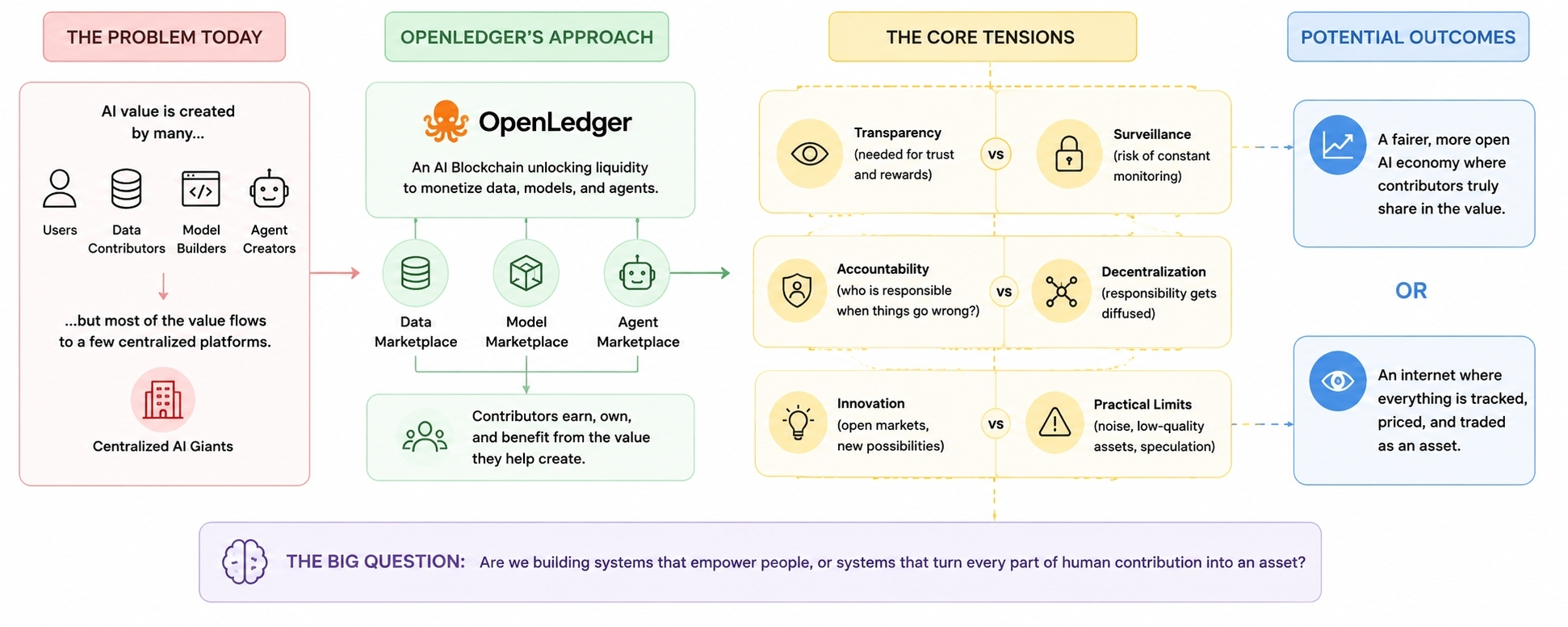

OpenLedger feels like one of those ideas that sounds really smart at first, then gets more complicated the longer you sit with it. On paper, it makes sense. AI companies are building billion-dollar systems using massive amounts of public data, human interaction, and community knowledge, while most people contributing to that ecosystem get nothing back. So naturally, projects start appearing that say: what if people could actually own a piece of the value they help create?
I get why that idea attracts people. There’s a real frustration underneath it. AI already feels controlled by a very small group of companies, and every year that gap looks bigger. So when something like OpenLedger talks about open networks, shared ownership, and monetizing data or models, it taps into a very real feeling that the current system is tilted too heavily toward centralized power.
Still, I can’t help thinking there’s another side to it that people don’t talk about enough.
To make a system like this work, everything has to become measurable. Contributions need tracking. Data needs attribution. Agent activity needs verification. The network has to constantly observe interactions so it knows who deserves rewards. And somewhere along the way, transparency starts looking a lot like surveillance. Not in some dramatic dystopian way just quietly, structurally. The system only functions properly if people are continuously visible to it.
That tension feels bigger than the technology itself. A lot of blockchain projects treat transparency like an automatic good, but human beings don’t always thrive inside systems where every action becomes part of an economic record.
I also wonder about accountability. Decentralized systems love the idea of removing gatekeepers, but when something goes wrong, responsibility becomes strangely hard to locate. If an AI agent spreads harmful content or manipulates people, who answers for it? In centralized systems, at least there’s usually a company attached to the damage. In decentralized ones, responsibility can dissolve into the network itself.
And honestly, I think some of these projects overestimate how much people actually want ownership over every digital interaction. Most users usually choose convenience first. They say they care about control over their data, but then continue using centralized platforms because those platforms are easier, smoother, and familiar. That doesn’t make people hypocrites it just means behavior tends to follow simplicity more than ideology.
What makes OpenLedger interesting to me isn’t necessarily the promise that it will “change everything.” It’s more that it reflects where tech culture is heading. There’s this growing belief that intelligence itself should become an economic layer something tradable, tokenized, and liquid across networks. Data becomes an asset. Models become assets. Even autonomous agents become assets.
Maybe that future works. Maybe it creates fairer systems.
But sometimes I wonder if we’re slowly building an internet where everything valuable has to justify itself economically. Every interaction tracked. Every contribution priced. Every system optimized for incentives first and human experience second.
That’s probably why I feel both curious and skeptical about projects like this at the same time. They’re trying to solve a real problem, but they also seem to carry the same mindset that created parts of the problem in the first place.