
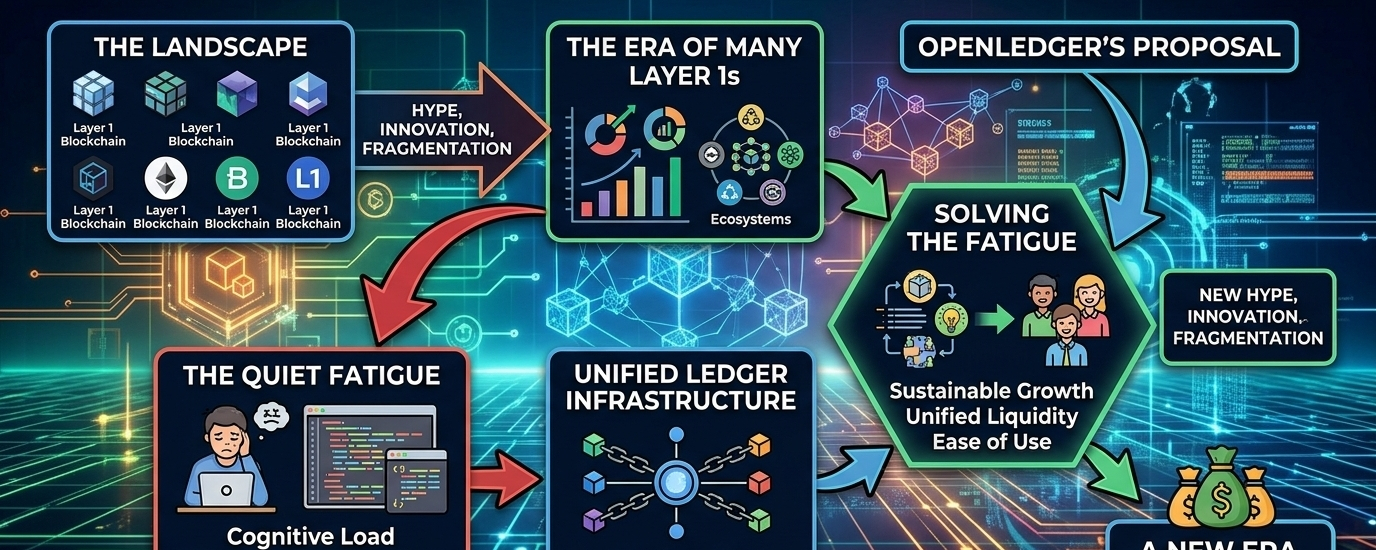
OpenLedger is one of those projects that immediately triggers two opposite reactions at the same time. First reaction is fatigue. Another AI chain. Another Layer 1. Another attempt to reorganize the internet around “data ownership” and decentralized intelligence and all the phrases people started stitching together the second ChatGPT traffic exploded. You see the words before you even read them. AI agents. Data liquidity. Monetization layers. Permissionless intelligence. It all starts sounding strangely interchangeable after a while.
But then there’s the second reaction. The quieter one. The part where you stop scrolling for a minute because beneath the familiar language, there’s at least a real observation hiding in there.
OpenLedger seems less obsessed with becoming the fastest chain on earth and more focused on a question most crypto infrastructure still handles awkwardly: if AI systems are going to consume massive amounts of data and generate value from it, who actually captures that value? Not theoretically. Not philosophically. Mechanically.
That’s a more interesting place to start than another “global computer” pitch.
Crypto has spent years pretending every problem is solved by throughput graphs and consensus diagrams. We’ve watched entire cycles built around chains claiming they solved scalability forever, only for reality to show up a few months later with actual users, actual bots, actual congestion, and everything starts wobbling. It happens over and over. People talk about architecture as if systems fail neatly in laboratories. They don’t. They fail when too many humans arrive at once and start doing weird things the designers didn’t predict.
That’s still the real test for every Layer 1, including OpenLedger. Not whitepapers. Not benchmark screenshots. Traffic.
Solana is probably the easiest example because it demonstrates both sides of the argument at once. Under normal conditions, Solana feels genuinely good. Fast enough that people stop thinking about the chain itself. Cheap enough that experimentation becomes natural. That matters more than crypto people sometimes admit. Most users do not care about elegant decentralization debates while staring at a frozen transaction.
But Solana also showed what happens when success arrives unevenly. Congestion, validator pressure, network instability. Not because the engineers were incompetent. Mostly because large-scale distributed systems are ugly once real economic behavior enters the room. The internet itself barely functions cleanly under pressure half the time, and that thing has had decades to mature.
So when I look at OpenLedger, I don’t really care whether it calls itself an AI blockchain. That part feels almost cosmetic now. Every second infrastructure project adds AI somewhere in the sentence because capital still reacts to the word like it’s 2021 and we’re all trapped inside another narrative centrifuge.
What matters more is whether the chain is quietly optimizing for a future where computation, data contribution, model usage, and incentive flows are all happening simultaneously instead of separately.
That’s harder than it sounds.
Most chains were built around moving tokens. Then smart contracts expanded things a bit. But AI systems introduce a different kind of mess. Suddenly you have questions around provenance, model attribution, data sourcing, contribution tracking, inference payments, and coordination between actors who may not even trust each other enough to share raw datasets. Traditional blockchains don’t naturally handle that environment elegantly. They can force themselves into it, but you can feel the friction.
OpenLedger at least seems aware of that friction from the beginning instead of retrofitting itself later.
Still, awareness is not adoption.
That’s the part crypto keeps relearning like a person touching the same hot stove every two years. Technical design is maybe 30% of the story. Sometimes less. Liquidity inertia is real. User inertia is real. Developers follow incentives until incentives disappear. Then they leave faster than they arrived. Entire ecosystems that looked unstoppable suddenly feel abandoned six months later because emissions dried up and nobody actually loved the product itself.
A new Layer 1 today is not entering an empty market. It’s walking into a crowded city where most people already signed apartment leases somewhere else.
Ethereum still owns mindshare even while frustrating people constantly. Solana owns speed narratives. Cosmos owns modularity discussions. Avalanche carved out its own institutional corner. Meanwhile newer chains keep appearing with increasingly refined architectures and increasingly weaker reasons for users to migrate.
So the question becomes uncomfortable pretty quickly. Why would liquidity move here specifically? Why would developers rebuild habits? Why would users bridge assets onto another ecosystem unless something materially better happens there?
And “AI” alone is not enough anymore. Maybe it was briefly. Not now.
What I do find mildly compelling about OpenLedger is that it doesn’t seem entirely trapped in the old Layer 1 psychology where the chain itself is treated as the product. There’s at least an attempt to position the network as infrastructure for interactions between models, data providers, and applications rather than just another execution environment searching for activity.
That distinction matters. Slightly.
Because honestly, the future may not belong to a single dominant chain anyway. That idea increasingly feels outdated. Not wrong exactly. Just too clean for reality. Different systems optimize for different behaviors. One environment becomes good for payments, another for gaming, another for AI coordination, another for stablecoin settlement. That fragmented world actually feels more believable than the old thesis where one chain absorbs everything and wins permanently.
But interoperability still feels more theoretical than seamless in practice. Bridges remain awkward. User experience remains fragmented. Security assumptions get blurry fast once assets start bouncing across ecosystems. People say “multi-chain future” very confidently while most users still barely tolerate using one network properly.
So maybe OpenLedger benefits from specialization. Or maybe specialization just limits addressable demand. Hard to know yet.
The trade-offs are visible too. Every chain chooses what kind of pain it’s willing to accept. OpenLedger appears willing to simplify parts of general-purpose blockchain ambition in favor of AI-oriented coordination. That may help focus. It may also reduce flexibility long term. Specialized infrastructure often looks smart early and restrictive later.
And there’s another uncomfortable possibility nobody likes discussing during infrastructure cycles: maybe AI itself becomes increasingly centralized regardless of what crypto builds around it.
Large-scale models require enormous capital, compute access, energy, distribution, and data pipelines. The gravitational pull toward centralization in AI is very real. Open-source efforts matter, yes, but concentration keeps creeping back in because economics keep dragging it there. A blockchain layer can coordinate incentives beautifully and still end up orbiting around a handful of dominant model providers anyway.
That tension sits underneath projects like OpenLedger whether people acknowledge it or not.
Still, I can see why some developers would be interested. If the next generation of applications genuinely revolves around autonomous agents exchanging services, consuming data, triggering transactions, and interacting economically without constant human input, then existing blockchain structures may feel strangely incomplete for that environment.
And maybe that’s where OpenLedger has a chance. Not because it becomes the next massive retail chain everyone suddenly migrates toward. That story feels increasingly rare now. But because it notices a specific infrastructure gap early enough and stays focused long enough to become useful before the market fully forms around it.
Execution becomes everything at that point. Quiet execution especially. Less conference-stage energy. More surviving contact with reality.
Because eventually every Layer 1 reaches the same moment. The marketing fades. Incentives shrink. Traffic either arrives or it doesn’t. Developers either stay or disappear. The chain either becomes somewhere people actually do things, or it turns into another ecosystem screenshot from an old cycle.
OpenLedger feels aware of some real problems. That alone already puts it ahead of many chains that spent years optimizing for benchmark competitions nobody outside crypto cared about.
But awareness is cheap. Sustained usefulness is not.
It might work. Or nobody shows up
@OpenLedger #OpenLedger $OPEN $RAY .
